
Quick Answer
Do camouflage backpacks work?
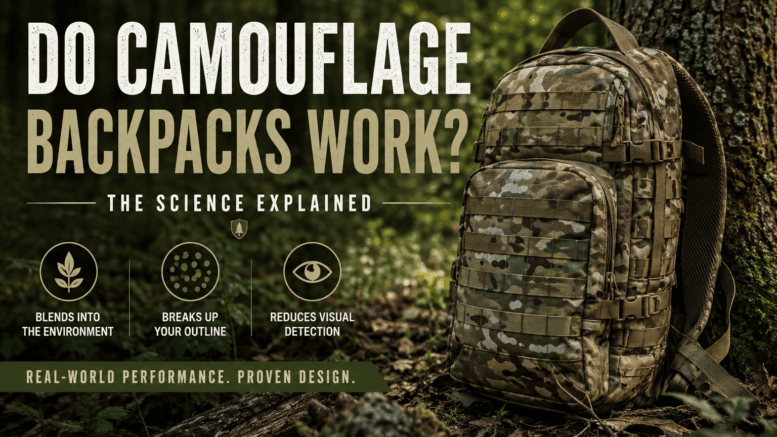
Yes—camouflage backpacks reduce visibility by blending into their environment, breaking up recognizable shapes, and disrupting how the brain identifies objects. They don’t make you invisible, but they can significantly delay detection when used in the right conditions.
Why Camouflage Backpacks Actually Work (The Science Explained)
If you’ve ever walked through the woods, you already know the answer instinctively.
A bright red backpack sticks out like a sore thumb in a sea of greens and browns. But swap that for a camouflage pack, and suddenly your outline softens, you start to blend into the environment instead of popping out from it.
That’s not just visual preference. That’s science.
After manufacturing tens of thousands of backpacks used in real-world operations, we’ve seen firsthand how camouflage impacts visibility in the field. And the reason it works comes down to how the human eye and brain process information.
Camouflage doesn’t make you invisible, it makes you harder to recognize.
What Camouflage Is Designed to Do (And What It Isn’t)
Camouflage is about disruption, not disappearance.
A camo backpack works by:
- Blending into surrounding colors and textures
- Breaking up the recognizable shape of the pack
- Reducing contrast that draws attention
Your brain is constantly scanning for familiar shapes, like human silhouettes and structured objects. A backpack is naturally boxy and distinct. Camouflage interferes with that recognition process.
Instead of seeing “a person with a backpack,” your brain sees fragmented shapes that resemble the environment.
Real-World Example: Deer Hunting in the Woods
This principle becomes obvious outside of military use…especially in hunting.
A deer hunter moving slowly through the woods relies heavily on camouflage to avoid detection. Deer are highly sensitive to movement and contrast. If a hunter wears solid colors, their outline becomes easy to pick out against the natural backdrop.
But with camouflage:
- The hunter blends into the greens and browns of the environment
- Their silhouette breaks apart visually
- Subtle movement looks more like bushes shifting in the wind than a predator approaching
Now apply that same concept to a backpack.
Without camouflage, the pack becomes a large, unnatural block of color on your back. With camouflage, it blends into the same background as your clothing, reducing your overall visibility as a system.
The Science Behind Camouflage Effectiveness
There are three core principles that make camouflage work:
1. Environmental Mimicry
Camouflage patterns replicate natural elements, leaves, branches, shadows, and textures. From a distance, these patterns visually merge with the environment.
2. Color Matching
Even the best pattern fails if the colors are wrong. Woodland, desert, and urban environments all require different palettes.
3. Shape Disruption (Eye-Brain Interference)
The brain is wired to recognize outlines. Camouflage breaks up edges and creates visual noise, making it harder to identify objects quickly.
This delay in recognition is critical, it buys time and reduces detection risk.
Why Camouflage Matters Specifically for Backpacks
Backpacks are one of the most visible pieces of gear you carry.
They:
- Add bulk to your silhouette
- Create straight lines and edges
- Move independently from your body
Without camouflage, they stand out immediately.
A well-designed camouflage backpack:
- Blends into surrounding terrain
- Disrupts the overall human outline
- Reduces visibility during both movement and stillness
From a manufacturing standpoint, even small details matter. Misaligned patterns across seams, straps, or panels can create unnatural lines that actually increase visibility.
Popular Camouflage Styles (And How They Perform)
Not all camouflage is created equal. Different styles are designed for different environments and distances.
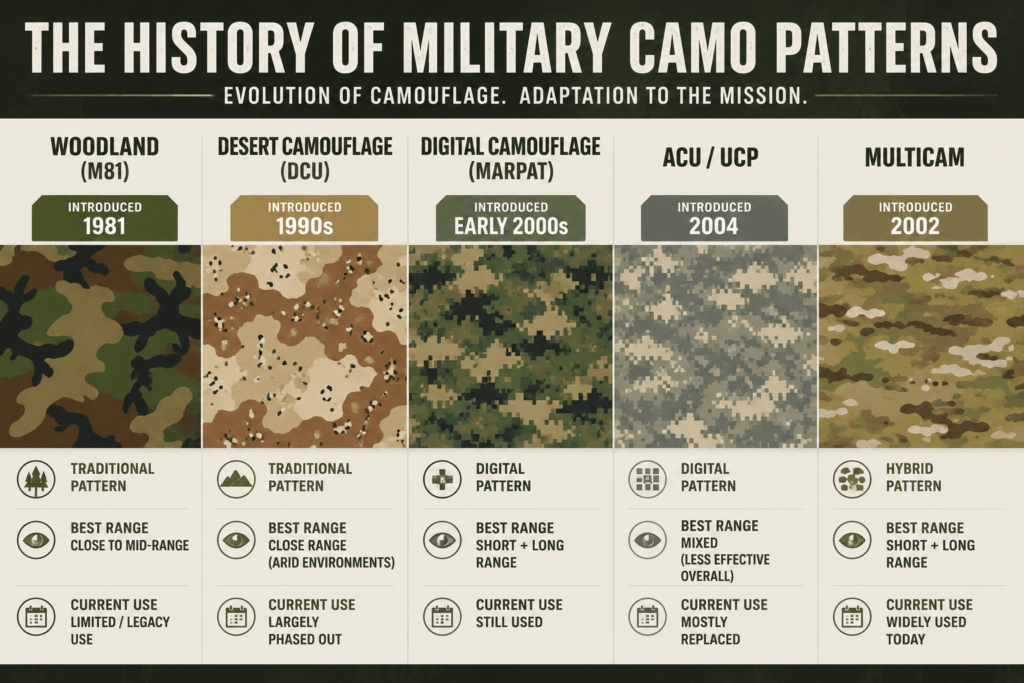
Here’s a breakdown of widely used camouflage patterns:
| Camouflage Style | Introduced | Type | Best Range Effectiveness | Current Use |
|---|---|---|---|---|
| Woodland (M81) | 1981 | Traditional | Close to mid-range | Limited / legacy use |
| Desert Camouflage (DCU) | 1990s | Traditional | Close range (arid environments) | Largely phased out |
| Digital Camouflage (MARPAT) | Early 2000s | Digital | Short + long range | Still used |
| ACU / UCP | 2004 | Digital | Mixed (less effective overall) | Mostly replaced |
| MultiCam | 2002 | Hybrid | Short + long range | Widely used today |
Digital vs Traditional Camouflage on Backpacks
Traditional Camouflage
- Mimics organic shapes like leaves and branches
- Highly effective at close to mid-range
- Works best in consistent environments
Digital Camouflage
- Uses pixelated patterns to create a “blurring” effect
- Breaks up shapes across multiple distances
- More versatile across changing environments
For backpacks specifically, digital patterns often perform better because they help disguise the structured, geometric shape of the pack.
That said, the most important factor is still environmental match, not pattern type alone.
When Camouflage Backpacks Work Best
Camouflage is highly effective, but only under the right conditions.
Most Effective When:
- The pattern matches the environment
- Movement is slow or controlled
- Lighting conditions align with the terrain
Less Effective When:
- The pattern contrasts with surroundings
- Movement is fast or erratic
- Advanced detection methods are used
Even the best camouflage won’t help if you’re moving quickly across an open field.
The Bottom Line: Do Camouflage Backpacks Work?
Yes! camouflage backpacks absolutely work.
Not because they make you invisible, but because they:
- Reduce visual contrast
- Break up recognizable shapes
- Interfere with how the brain detects objects
Whether it’s a soldier in the field, a hunter in the woods, or an outdoor enthusiast trying to stay low-profile, the principle is the same:
Blend in, disrupt the outline, and buy time.
Final Thoughts
At Fieldtex, we don’t see camouflage as just a visual choice, it’s a functional component of performance gear.
When designed and applied correctly, it plays a measurable role in reducing visibility and improving effectiveness in real-world environments.
If you’re developing tactical backpacks or outdoor gear where visibility matters, camouflage isn’t optional, it’s part of the system.