
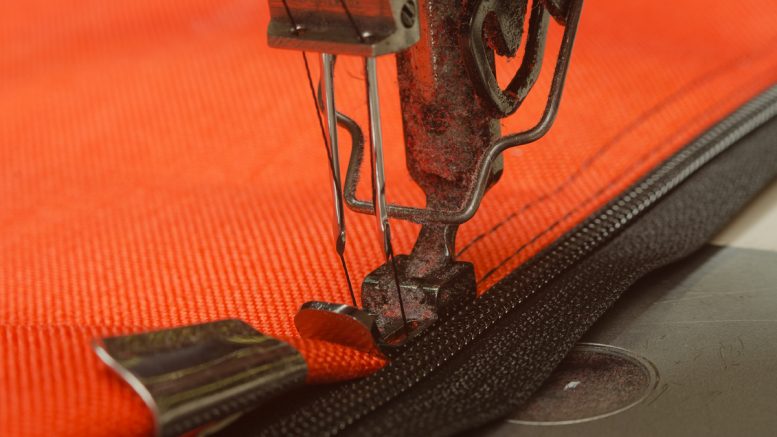
Industrial sewing refers to the large-scale production of fabric products that must handle heavy use, repeated stress, and demanding environments. Instead of small craft projects or clothing items, industrial sewing focuses on making durable products such as military packs, medical bags, equipment covers, and protective carrying cases.
These items often use thick materials like ballistic nylon, vinyl, canvas, or reinforced webbing that require specialized machines and reinforced stitch patterns.
The goal is not appearance, it is performance and repeatability. Products must hold weight, resist abrasion, and perform the same way across hundreds or thousands of units. That is why industrial sewing uses dedicated production equipment, trained operators, and strict quality controls.
You will find industrial sewing across many sectors. Military and emergency response gear are common examples, but OEM equipment manufacturers, industrial tool makers, and outdoor product companies also rely on it.
When durability, consistency, and production scale are important, industrial sewing becomes the manufacturing method that makes those products possible.
Industrial Sewing vs. Garment Manufacturing
While both involve stitching fabric, industrial sewing and garment manufacturing serve very different purposes. Garment manufacturing focuses on clothing and textiles designed for wear shirts, pants, dresses, and accessories. These items often prioritize aesthetics and comfort, using lighter materials like cotton, rayon, or polyester blends.
Industrial sewing, on the other hand, deals with heavy-duty fabrics and functional products. We’re talking about things like ballistic nylon tactical gear, reinforced carrying cases for heavy equipment, and multi-layered medical supply packs.
These products must meet strict standards for durability, water resistance, abrasion tolerance, and weight-bearing capacity. It’s not about looking good, it’s about holding up under pressure.
Here is a simple comparison that shows how industrial sewing and garment manufacturing differ in purpose, materials, and testing requirements.
| Factor | Industrial Sewing | Garment Manufacturing |
| Main priority | Durability and function | Comfort, fit, and appearance |
| Typical materials | Ballistic nylon, Cordura, vinyl, canvas, webbing | Cotton, rayon, polyester blends |
| Stitch tolerance | Reinforced stress areas and load paths | Flexible seams for comfort |
| Testing focus | Load strength, abrasion resistance, field use | Fit tests, wash durability |
| Common failure points | Strap anchors, stress seams, webbing attachments | Seam splitting, fabric wear |
In short, garment manufacturing focuses on how clothing looks and feels. Industrial sewing focuses on how fabric products perform under pressure, weight, and repeated use.
Factory Sewing vs. Home Sewing
The contrast between factory sewing and home sewing is significant. Home sewing usually involves one machine and one person working on small projects in a craft space or spare room. It works well for simple items or repairs, but it does not support consistent production.
Factory sewing operates at a completely different scale. Production takes place on organized manufacturing floors where multiple operators and machines handle specific steps of the same product. Instead of creating one item at a time, the goal is to produce large batches that all meet the same specifications using structured processes that maintain consistency across production runs.
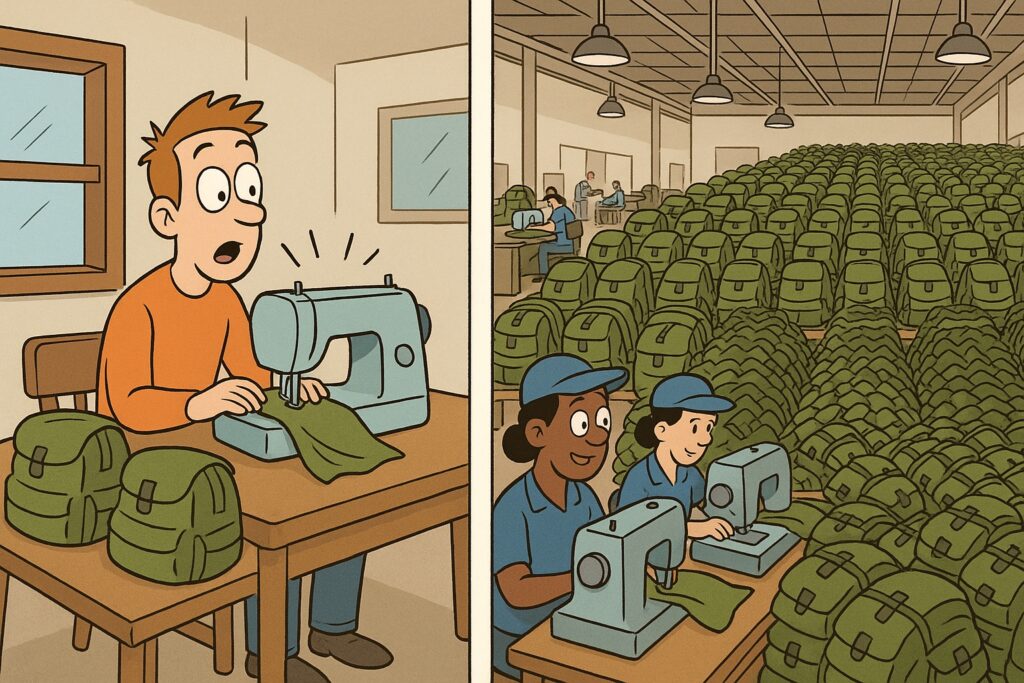
Typical factory sewing operations include:
- Production lines: Operators focus on specific steps to maintain speed and consistency
- Line balancing: Work is distributed across stations, so production moves smoothly
- Fixtures and guides: Tools help hold thick materials in place and maintain alignment
- Written work instructions: Clear procedures help operators repeat the same steps correctly
- Quality control checkpoints: Items are inspected during production, not only at the end
- Batch repeatability: Processes are designed so that large production runs remain consistent
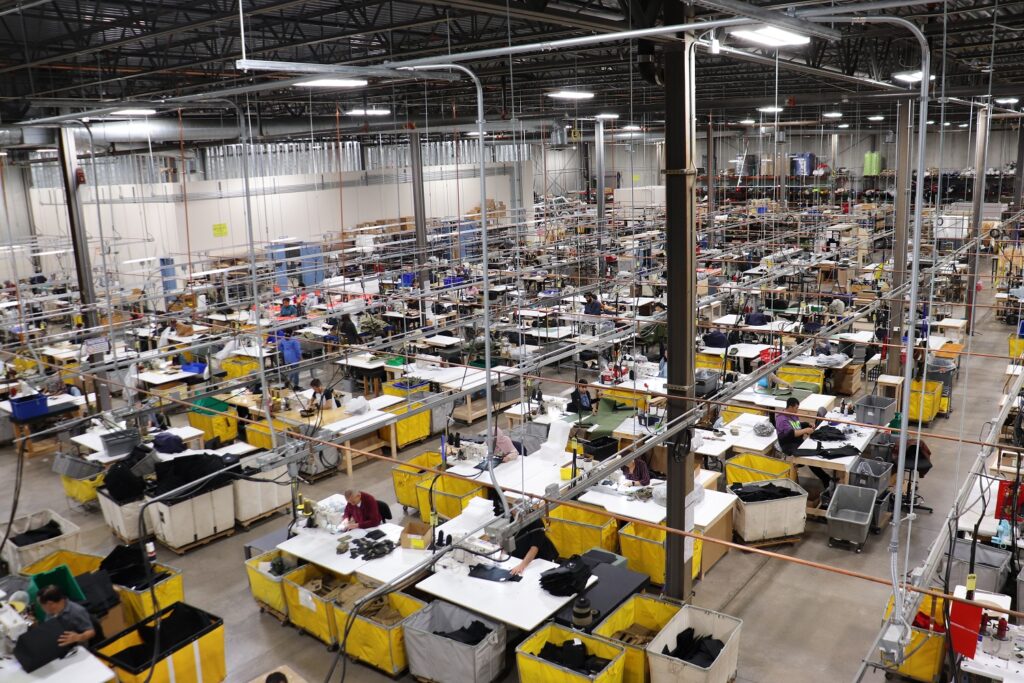
At Fieldtex, we’ve optimized our production floor for efficiency and consistency. A well-organized line allows multiple operators and machines to work on the same product simultaneously, ensuring uniformity and reducing production time.
Industrial Sewing Machines vs. Home Machines
You can’t fill a warehouse with $500 home machines and expect them to sew through layers of ballistic nylon or vinyl for very long. Industrial sewing machines are built differently, and they’re priced accordingly.
- Power & Durability: Industrial machines feature motors that produce significantly more horsepower. This enables them to punch through thick, layered materials without strain or overheating.
- Materials Compatibility: They are designed for heavyweight fabrics and materials like Cordura, Kevlar, vinyl, and canvas.
- Needle and Thread Handling: These machines use large needles and industrial thread types that withstand much more tension and abrasion than standard home equipment can handle.
- Cost & Automation: Entry-level industrial machines start around $3,000, but some of our automated systems on the production floor cost over $45,000. Our industrial fabric cutting systems alone can exceed six figures, but they are essential for precision and volume.
In short, home machines are for crafting. Industrial machines are for battle-ready, field-tested products.
It’s also important to note that Industrial sewing machines operate at much higher speeds than home machines.
- Typical speed: Many home machines run at about 600–1,000 stitches per minute
- Industrial speed: Industrial machines often operate between 3,000 and 7,000 stitches per minute
This higher speed supports large production runs while maintaining consistent stitch quality.
Another key difference is specialization. Industrial sewing machines are often designed for very specific tasks or materials.
Examples include:
- Heavy material machines: Designed to sew thick stacks such as ballistic nylon, vinyl, or layered webbing
- Reinforcement machines: Used for stress points where straps, loops, or anchors carry weight
- Programmable pattern machines: Repeat the same stitch pattern with precision across large production runs
These specialized machines help manufacturers maintain consistent results when producing hundreds or thousands of textile products.
They are also important when sewing high-stress areas, such as:
- Strap anchors
- Webbing attachments
- Reinforced seams
- Load-bearing stitch points
Simply put, using the right machine for each task helps maintain durability and repeatability across every production batch.
Types of Industrial Sewing Machines We Use
Different jobs require different tools, and the same is true for industrial sewing and contract sewing manufacturing. At Fieldtex, we use a variety of specialized industrial sewing machines tailored for durability, efficiency, and high-volume output, and these include:
- Walking Foot Machines: These machines feed both the top and bottom fabric layers evenly, making them ideal for sewing thick or layered materials like ballistic nylon, vinyl, or webbing. They reduce fabric shifting and are essential for products like trauma kits, tactical belts, and heavy-duty carrying cases.
- Bar Tack Machines: Used to reinforce stress points, bar tackers create dense, short zig-zag stitches in high-tension areas—think backpack shoulder straps, MOLLE webbing, or load-bearing loops. They’re a key component of MIL-SPEC compliant products.
- Programmable Pattern Tackers: These are our most advanced machines—some costing over $45,000. They’re capable of repeating complex stitch patterns with precision and speed, which is invaluable for OEM projects requiring detailed reinforcement or exact replication across large product runs.
These machines allow us to produce reliable, durable sewn products that hold up under real-world stress—whether in the field or in emergency scenarios.
Common Industrial Stitch Types (and What They’re Used For)
Different materials and product designs require different stitch structures. In industrial sewing, stitch selection affects durability, flexibility, and how well a seam handles stress over time.
The stitch type used often depends on the fabric, the load placed on the seam, and how the final product will be used. Some common industrial stitches include:
Lockstitch
Lockstitch is one of the most common stitches used in industrial sewing. It forms when two threads interlock between layers of fabric, creating a strong and stable seam.
Because the threads lock together, the seam does not easily unravel if one section breaks. This makes lockstitch a reliable choice for structural seams in products such as equipment bags, protective cases, and tactical gear.
Lockstitch is often used when products must maintain durability under repeated handling or weight-bearing use.
Chain Stitch
Chain stitch uses a looping thread structure that creates a flexible seam. This flexibility allows the seam to stretch slightly without breaking, which can be helpful in certain textile applications.
However, chain stitch seams can unravel if the thread breaks, which is why they are typically used in areas where flexibility is needed but structural reinforcement is not the primary concern.
Zigzag and Cover Stitch
Zigzag stitches move back and forth across the seam rather than forming a straight line. This structure allows the seam to handle movement and stress across a wider area.
Cover stitches are commonly used for finishing edges and creating flat seams. These stitch types are useful when working with flexible materials or when preventing fabric edges from fraying.
Reinforcement Stitching for Load Paths
Some areas of a textile product carry significantly more stress than others. Reinforcement stitching is used in these locations to strengthen the seam and distribute tension.
Two common reinforcement methods include:
- Bar tacks, which create short, dense stitches that strengthen high-stress points
- Programmable reinforcement patterns, which repeat precise stitch shapes across reinforcement areas
These reinforcement stitches are commonly used on:
- Strap anchors
- MOLLE webbing systems
- Equipment loops
- Load-bearing attachment points
Choosing the Right Stitch for the Application
| Application | Common Stitch Type |
| Structural seams in heavy bags or cases | Lockstitch |
| Flexible seams requiring stretch | Chain stitch |
| Edge finishing and flat seams | Zigzag or cover stitch |
| Reinforcement at stress points | Bar tack or programmed reinforcement |
Selecting the correct stitch structure helps improve durability, reduce seam failure, and maintain consistent product performance across large production runs.
Sewing vs Welding (and When Each Makes Sense)
Industrial textile products can be assembled using different joining methods. Two common options are sewing and material welding. Each method has strengths depending on the fabric type, product design, and performance requirements.
Sewing joins materials with thread and stitch patterns, while welding bonds certain synthetic materials together using heat, pressure, or ultrasonic energy. Choosing the right method depends on the material and the function of the final product.
When Sewing Is the Better Choice
Sewing works well for many textile products because it maintains flexibility and works across a wide range of fabrics.
Sewing is often preferred when products require:
- Breathable materials: Many woven fabrics need airflow and flexibility
- Elastic or flexible seams: Stitched seams allow controlled movement under stress
- Layered materials: Multiple layers of fabric, padding, or webbing can be sewn together
- Prototypes or small production runs: Sewing allows design changes and adjustments more easily
- Repairable products: Stitched seams can often be repaired if damaged
For products such as tactical gear, equipment bags, and reinforced cases, sewing provides the strength and versatility needed for complex fabric assemblies.
When Welding Is the Better Choice
Welding is commonly used when products require airtight or watertight seams. Instead of thread, the material itself is fused together.
This method works best with certain synthetic materials, such as PVC, TPU, and PE-coated fabrics
Welding is typically used when products require:
- Airtight seams
- Watertight protection
- Smooth sealed surfaces
- Plastic-coated or laminated materials
This makes welding common in items such as inflatable structures, waterproof dry bags, and certain protective covers.
Sewing vs Welding Comparison
| Factor | Sewing | Welding |
| Seam strength | Strong when reinforced with proper stitch patterns | Strong material bond, but less flexible |
| Airtight / watertight | Not inherently airtight | Can produce airtight or watertight seams |
| Material compatibility | Works with most woven fabrics and layered materials | Works best with coated or thermoplastic materials |
| Production flexibility | Easy to adjust during prototyping and small runs | Requires specialized equipment and setup |
| Typical applications | Tactical gear, equipment bags, medical kits | Waterproof products, inflatables, sealed covers |
In some cases, manufacturers combine both methods depending on the product design.
It is also worth noting that seam tape or specialized coatings can improve the water resistance of sewn seams. However, stitched seams themselves are not naturally airtight or fully waterproof without additional treatments.
A Practical Industrial Sewing Workflow (From Prototype to Production)
Industrial sewing projects usually follow a structured process. Each stage helps ensure the final textile product meets the required specifications, performs reliably, and can be produced consistently at scale.
The workflow typically moves through the following stages.
1. Requirements and Product Specifications
The process begins with clear product requirements. These may include drawings, material specifications, dimensions, load expectations, and performance criteria.
Engineering teams often define how the product will be used, the environments it must withstand, and any durability or compliance standards that apply.
2. Material Selection and Sourcing
Once the requirements are defined, the next step is selecting appropriate materials. This may include heavy-duty fabrics, reinforcement webbing, foam padding, or specialized coatings.
Material choice affects durability, weight, abrasion resistance, and overall performance, so sourcing reliable suppliers is an important part of the process.
3. Fabric Cutting
After materials are selected, the fabric components are cut according to the product design. Industrial cutting systems help maintain accuracy and repeatability across large production runs.
Precise cutting is important because even small variations can affect seam alignment and overall product quality.
4. Sewing and Reinforcement
At this stage, the product components move through the sewing process. Operators use industrial sewing machines to assemble the fabric panels, add webbing or straps, and reinforce stress points.
Reinforcement techniques such as bar tacks or programmed stitch patterns are often added at load-bearing areas like strap anchors or attachment loops.
5. Inspection and Testing
Quality checks take place during and after production. These inspections help confirm that stitching, alignment, and materials meet the required standards.
Typical quality checks may include:
- Visual inspections to verify seam alignment and stitch quality
- Pull tests to confirm that load-bearing seams can handle the expected stress
- Dimensional checks to confirm the product matches the design specifications
6. Scaling Production and Maintaining Consistency
Once a product design is finalized, production can scale to larger volumes. At this stage, manufacturers focus on maintaining consistent quality across every batch.
Standardized work instructions, production line organization, and ongoing quality checks help ensure that each unit matches the original design and performance expectations.
What Products Require Industrial Sewing?
Industrial sewing is most commonly used in the manufacturing of:
- Military backpacks, MOLLE pouches, and tactical belts: These products must carry heavy loads and handle repeated field use, which requires reinforced seams and durable materials that resist abrasion and stress.
- Medical bags and trauma kits: Medical transport bags must withstand frequent handling and equipment weight while maintaining reliable seams that do not fail during emergency use.
- Custom carrying cases for OEM electronics and tools: Protective cases often include padding, layered fabrics, and reinforced attachment points to secure sensitive equipment during transport.
- Equipment covers, tarps, and transport gear: These products are exposed to outdoor environments, friction, and repeated use, which requires strong stitching and durable materials.
- Utility belts, harnesses, and industrial safety gear: Safety gear must support body weight and maintain structural integrity under load, which makes reinforced stitching and consistent production standards essential.
These products require exacting standards and consistent quality over large production runs. At Fieldtex, we sew to commercial specifications as well as government and military standards like MIL-SPEC.
Quality and Compliance in Industrial Sewing (What Buyers Should Look For)
When companies evaluate an industrial sewing partner, quality systems are just as important as machines or materials. Consistent production requires documented processes, trained operators, and clear quality controls that keep every batch aligned with the original product specifications.
Many manufacturers use structured quality management systems to support this level of consistency. Frameworks such as ISO-style quality systems help guide how production is documented, monitored, and improved.
These systems typically support:
- Process consistency: Standard procedures help ensure each product is made the same way across different production runs
- Documentation and traceability: Materials, production steps, and inspections are recorded to support quality tracking
- Process control: Defined workflows reduce variation and help maintain repeatable results
- Quality inspections: Products are checked during and after production to confirm they meet specifications
For buyers working in regulated or high-performance industries, these quality controls help reduce risk and support long-term product reliability.
At Fieldtex, production processes are supported by a quality management system aligned with ISO 13485 standards, which focuses on documented procedures, process control, and continuous improvement.
For projects involving medical products or regulated equipment, manufacturers may also work within additional quality frameworks. These systems help guide how products are designed, produced, and documented to meet industry expectations for safety and reliability.
When selecting a contract sewing manufacturer, buyers should look for clear evidence of structured quality processes, documented inspection procedures, and consistent production controls that support reliable textile manufacturing.
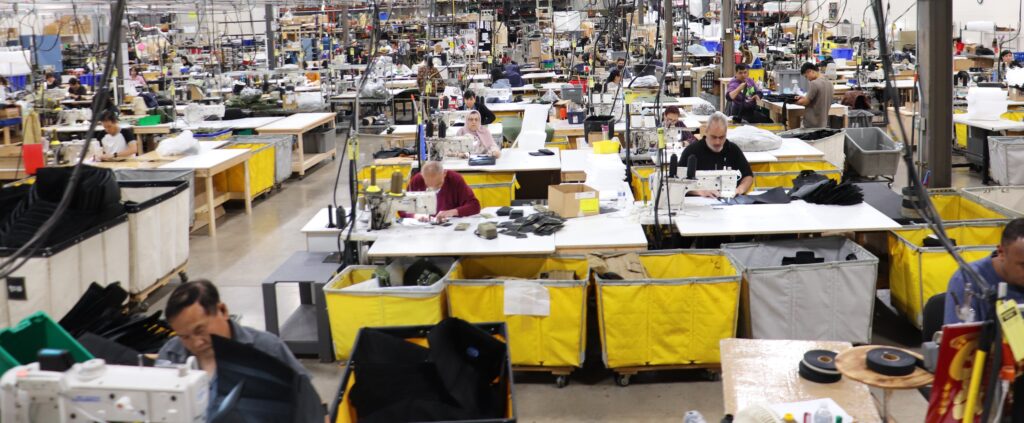
Why Choose a Contract Sewing Manufacturer?
Choosing a contract sewing manufacturer like Fieldtex means getting more than stitching. It means working with a production partner that has the equipment, processes, and experience needed to support reliable textile manufacturing.
When It’s the Right Call
Partnering with a contract sewing manufacturer often makes sense when products require capabilities that go beyond small in-house production setups.
Companies often outsource industrial sewing when they need:
- Production capacity: The ability to produce dozens, hundreds, or thousands of units while maintaining consistent quality
- Repeatable processes: Structured production systems that ensure every product meets the same specifications
- Specialized machines: Industrial equipment designed for thick materials, reinforcement stitching, and complex assemblies
- Engineering support: Access to in-house design and prototyping teams that help refine textile components before full production
Working with an experienced manufacturer also helps reduce production risk, especially when products must perform reliably in demanding environments.
What Buyers Should Ask
Before choosing a contract sewing partner, it is important to understand how the manufacturer manages production and quality.
Buyers often ask questions such as:
- Minimum order quantities (MOQ): What production volumes are supported?
- Lead times: How long does prototyping and full production take?
- Prototyping process: How are designs tested and refined before scaling production?
- Material sourcing: Does the manufacturer source specialized fabrics, webbing, or hardware?
- Quality documentation: What inspection procedures and quality controls are in place?
- Change control: How are design updates or revisions managed during production?
These questions help ensure the manufacturing process aligns with the product’s requirements and long-term production goals.
If your product requires durable sewn components and reliable production capacity, working with an experienced contract sewing manufacturer can simplify development and scale manufacturing efficiently.
Request a quote or talk to an engineer to discuss your project and production requirements.
Final Thoughts
Industrial sewing is a world of horsepower, heavy-duty materials, and high-volume production. It isn’t glamorous, but it’s essential. Whether you’re an OEM seeking custom-sewn products or a company that needs production at military standards, working with a true industrial sewing company ensures you get products that perform.At Fieldtex, we bring decades of experience, a factory full of top-tier equipment, and a focus on functional sewn solutions. If your product needs to be strong, smart, and scalable, it needs industrial sewing.
FAQs About Industrial Sewing
Industrial sewing refers to the large-scale production of textile products using specialized machines and structured manufacturing processes. It is commonly used for products that must handle heavy use, repeated stress, or demanding environments. Unlike home sewing, industrial sewing focuses on durability, consistency, and high-volume production.
A contract sewing manufacturer produces textile products on behalf of another company. Businesses often partner with contract manufacturers when they need specialized machines, production capacity, or technical sewing expertise. This allows companies to scale production without building their own sewing facilities.
Industrial sewing is typically used for heavy-duty materials such as ballistic nylon, Cordura, vinyl, canvas, and reinforced webbing. These materials are often used in products that must carry weight or resist abrasion. Industrial machines and stronger thread types help maintain seam strength under these conditions.
Industrial sewing machines are designed for continuous operation and heavy materials. They use stronger motors, larger needles, and more durable components than home machines. This allows them to sew thick fabric layers and maintain consistent performance across long production runs.
Industrial sewing can be used with many coated or water-resistant fabrics. However, stitched seams themselves are not naturally airtight or waterproof. Additional treatments, such as seam tape or coatings, may be applied when higher levels of water resistance are required.
Companies often outsource sewing when products require specialized equipment, consistent quality, or large production volumes. Contract manufacturers also help during product development by assisting with prototyping and material selection. This approach allows companies to scale production without managing their own textile manufacturing operations.