
When medical device OEMs source sewn soft goods, the compliance question surfaces early: does the sewing supplier need FDA registration, ISO 13485 certification, or both?
The FDA registration vs. ISO 13485 distinction matters because these two credentials address different questions entirely.
Before production begins, OEMs need to know what each credential means, what it does not mean, and what documentation a qualified sewing partner should actually be able to provide.
The Short Answer
- FDA Registration is a mandatory administrative requirement issued by the U.S. government. It notifies the FDA of a facility’s activities and lists its products – tracking who is making what. It is not an approval, certification, or endorsement of quality.
- ISO 13485 Certification is an audited quality management standard issued by an accredited third-party body. It proves that a supplier operates under rigorous, standardized quality controls, traceability, risk management, and documentation protocols specific to medical devices.
In short: FDA Registration establishes regulatory visibility; ISO 13485 proves quality system capability.
FDA Registration vs. ISO 13485: The Quick Difference
| Requirement or Credential | Who Issues or Controls It | What It Shows |
|---|---|---|
| FDA establishment registration and device listing | U.S. Food and Drug Administration | The establishment performs certain regulated medical device activities and has listed its devices with FDA |
| FDA device clearance/approval/authorization | U.S. Food and Drug Administration | A specific device has received FDA marketing authorization via 510(k), PMA or De Novo pathway |
| ISO 13485 certification | Accredited third-party certification body (not FDA) | The supplier’s QMS was audited against ISO 13485 within a defined scope at a defined location |
| ISO 13485-aligned or compliant manufacturing support | Defined through quality agreements and OEM supplier controls | The supplier can operate under the OEM’s documentation, traceability, calibration, and change-control requirements |
| ISO 9001 certification | Accredited third-party certification body | The supplier’s general quality management system meets ISO 9001 requirements |
What FDA Registration Actually Means for Medical Device Manufacturers
Under FDA’s device establishment registration and listing requirements, domestic establishments that manufacture, prepare, propagate, compound, or process medical devices intended for commercial distribution in the United States must register with the FDA annually and list their devices.
This includes contract manufacturers that produce a finished device to another establishment’s specifications; an activity category FDA explicitly recognizes in its registration process.
Not every role in the supply chain triggers the same obligation. Manufacturers of components distributed only to a finished device manufacturer may not be required to register solely in that capacity. However, regulatory status is not a determination any sewing supplier should make unilaterally.
The OEM’s regulatory team needs to define whether the sewn item is a finished device, accessory, component, kit item, cover, transport case, or a soft good that falls outside device classification entirely before the first pattern is cut.
What FDA Registration Does Not Mean
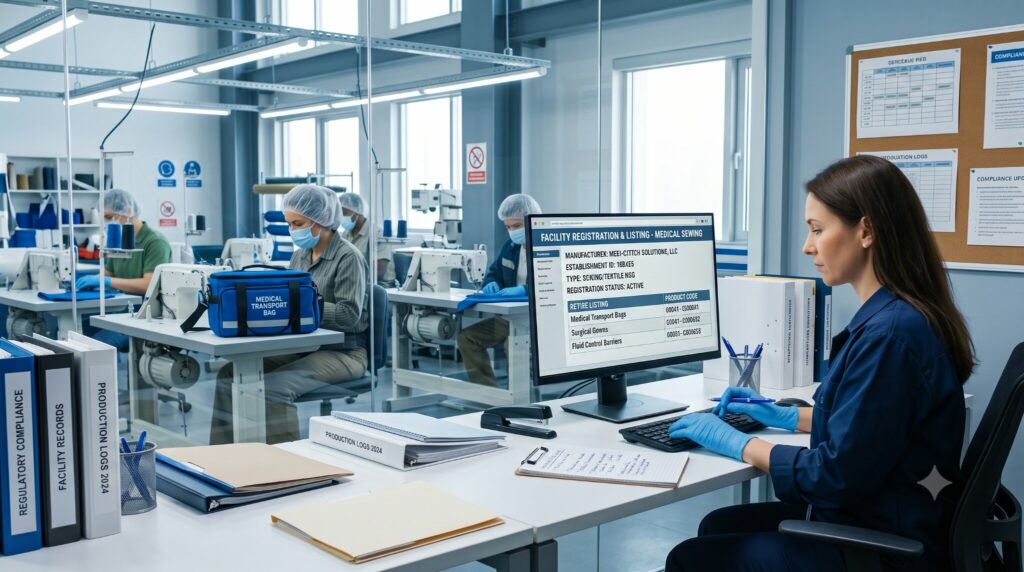
FDA registration does not mean the facility or device is approved, cleared, or authorized by the FDA. Registration identifies who is doing what; it is an administrative function, not an endorsement of quality or performance. FDA makes this distinction explicit: registration confirms an establishment has notified FDA of its activities, nothing more.
This matters when evaluating supplier claims. A contract sewing facility that describes itself as “FDA-certified” or displays an FDA logo on marketing materials as proof of quality is misrepresenting its status.
FDA does not certify manufacturing facilities through registration, and private-sector use of FDA certification-type claims can be misleading under FDA guidance.
The registration number is a verifiable data point – verify it against the FDA establishment registration database, but do not treat it as a quality signal on its own.
When a Sewing Supplier Might Need FDA Registration
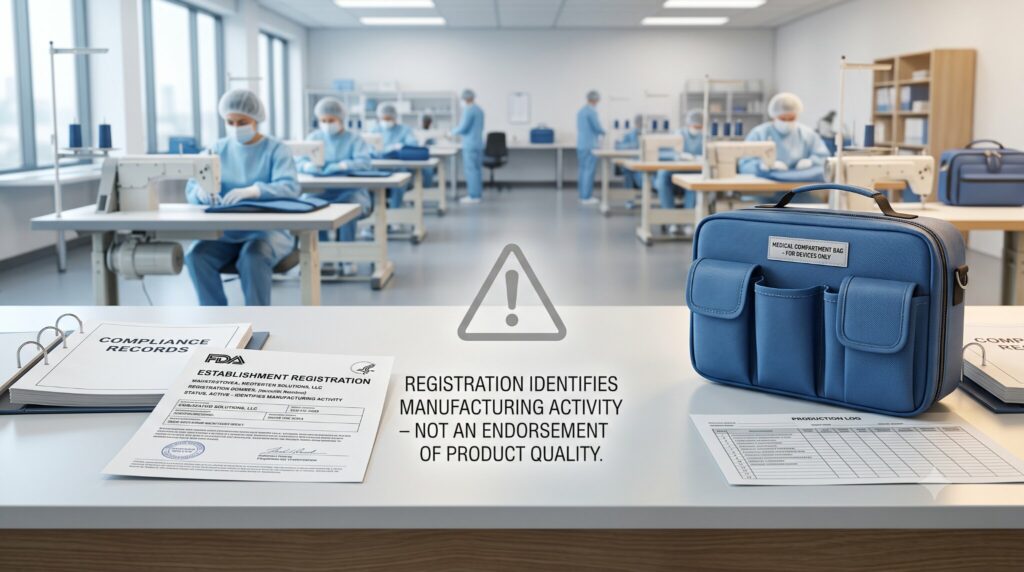
A contract sewing company manufacturing a finished device or accessory to an OEM’s specifications may fall into the contract manufacturer category under the FDA’s registration framework.
A sewn patient positioning device marketed as a medical device is a straightforward example. A carrying case used purely for transport, with no medical claims and no functional integration into the device system, may sit outside that definition entirely.
The line between “component supplier” and “contract manufacturer” in the FDA’s framework is not always obvious, and it can shift based on the item’s function, the claims made about it, and how it is incorporated into the finished device. The supplier should not define that line alone.
| Ask your regulatory team first. OEM regulatory and quality personnel should define the intended use, device classification, documentation package, and supplier control requirements before production begins. A sewing contractor’s role in FDA compliance is to support those requirements, not to interpret device classification independently. |
What ISO 13485 Means in Contract Manufacturing
ISO 13485 is a quality management system standard developed specifically for medical device manufacturing. Where ISO 9001 addresses general quality principles, ISO 13485 adds requirements for regulatory compliance, risk management, process validation, controlled documentation, and consistent production across the device lifecycle.
For OEMs, an ISO 13485 contract manufacturer is valuable because it can support supplier qualification, documentation expectations, audit preparation, and controlled production in ways a general commercial sewing house typically cannot.
Scope matters. An ISO 13485 certificate should be reviewed for the specific location it covers, the activities included, the product categories within scope, and any explicit exclusions. A certificate that covers packaging operations at one facility does not automatically extend to sewing operations at another.
It is also worth noting that FDA’s Quality Management System Regulation, finalized in 2024 and effective February 2026, incorporates ISO 13485:2016 as the structural basis for 21 CFR Part 820. However, FDA does not require ISO 13485 certificates or accept them as a substitute for FDA inspection. The two systems now share a common framework; they are not interchangeable credentials.
ISO 13485 Certification vs. ISO 13485-Aligned Support
These are not the same thing, and the distinction matters for supplier qualification.
Certified means a third-party certification body accredited under the IAF multilateral recognition arrangement has audited the supplier’s quality management system against ISO 13485 within a defined scope, issued a certificate, and conducts ongoing surveillance audits to maintain it.
ISO 13485-aligned support means the supplier can operate under customer-defined procedures, documentation controls, traceability requirements, calibration schedules, inspection protocols, and change-control processes – without necessarily holding a certificate
We are transparent about where we stand. Our processes are structured to support customers operating within ISO 13485 quality management frameworks, including lot traceability, first article inspections, controlled work instructions, calibration records, in-process inspection, and nonconformance documentation.
OEMs working with us define the documentation package; we execute it. Learn more about our medical sewing services and what we can support within your supplier qualification process.
Decision Guide: When FDA Registration, ISO 13485, or Both Matter
If the Sewn Product Is a Finished Medical Device or Accessory
FDA establishment registration and device listing are likely to apply, depending on the supplier’s specific activity. The supplier may also need to support QMSR requirements, inspection readiness, and device records. OEMs in this situation typically expect either ISO 13485 certification within a relevant scope or documented ISO 13485-aligned support backed by a quality agreement and supplier audit history.
If the Sewn Product Is a Component Supplied Only to the OEM
The supplier may not need FDA registration solely in a component supplier role, depending on how the component is defined and how it is used in the finished device. FDA registration requirements shift based on the specific activity performed.
If the Sewn Product Is a Carrying Case, Protective Cover, or EMS Bag
Not all cases and bags are medical devices. If the item makes no medical claims and performs no medical function, it may fall outside FDA device classification. OEMs may still require ISO 9001-level quality controls, cleanable and durable materials, accurate labeling, and lot consistency – but the regulatory burden may be lower than for a classified device.
If the Product Has Patient Contact
Patient-contact applications introduce biocompatibility and cleaning requirements that go beyond standard sewn goods documentation. Material selection, surface treatments, and disinfection compatibility all become relevant.
OEMs should reference FDA’s guidance on ISO 10993-1 for biological evaluation of medical devices when defining material requirements for patient-contact components, and should communicate those requirements to the sewing supplier before material sourcing begins.
How Fieldtex Supports Medical Sewing Programs
Fieldtex Cases is a U.S.-based contract sewing manufacturer with over 50 years of experience producing medical soft goods for OEMs, healthcare suppliers, and emergency response product companies.
We support the full production sequence in-house – design and engineering, prototyping, material sourcing, cutting, sewing, assembly, packaging, and final inspection. For medical programs, that means a single partner managing the sewn component from controlled drawing to documented shipment.
Where Fieldtex Fits in the OEM Supply Chain
We are a contract sewing and soft goods manufacturing partner, not a regulatory consultant. Our role is to translate your drawings, samples, patterns, specifications, and quality requirements into repeatable sewn production.
We support supplier qualification by providing the documentation package your quality team defines – lot traceability, calibration records, first article inspection reports, in-process QC documentation, SOPs and traveler documentation.
Our processes are structured to support customers operating within ISO 13485 quality management frameworks. We are also FDA-registered and maintain an ISO 9001-compliant quality system.
Soft Goods We Can Support
- Medical device carrying cases and transport bags
- EMS and trauma bags
- Wearable equipment holders and device supports
- Patient positioning soft goods
- Diagnostic equipment covers and soft-sided cases
- Custom straps and sewn fasteners
- Soft packs and organizer inserts
- Protective covers for portable medical equipment
If you are sourcing a medical sewn component and need a U.S.-based manufacturing partner with the documentation discipline your program requires, contact our team to discuss your specifications and request a quote.
FAQs: FDA Registration vs. ISO 13485
No. FDA registration identifies establishments performing certain regulated medical device activities and is administered by the FDA. ISO 13485 is a quality management system standard for medical device manufacturers, audited and certified by accredited third-party certification bodies – not by FDA.
It depends on the specific activity. A contract manufacturer producing a finished medical device or accessory to an OEM’s specification may need FDA registration in that role. A supplier producing only components supplied to a finished device manufacturer may not require registration solely as a component supplier, but is still subject to the OEM’s supplier controls.
Yes, a supplier can operate under ISO 13485-aligned documentation and process controls without holding a third-party ISO 13485 certificate. The wording matters: “ISO 13485-aligned support” is distinct from “ISO 13485 certified,” and suppliers should not blur that distinction.
No. FDA registration means the establishment has notified the FDA of its activities and is listed in the FDA registration database. It is an administrative requirement, not a quality endorsement or approval. FDA does not approve manufacturing facilities through registration.
Before awarding a medical sewing program, OEMs should collect approved drawings, a complete BOM with material specifications, a defined quality agreement, material certificates of conformance, a lot traceability plan, first article inspection requirements, an in-process and final inspection plan, a defined change-control process, and packaging and labeling specifications. These documents should be in place before the first production run, not assembled after delivery.
Resources:
1. Health, Center for Devices and Radiological. “Device Registration and Listing.” 1 Oct. 2020. https://www.fda.gov/medical-devices/how-study-and-market-your-device/device-registration-and-listing
2. FDA, “Establishment Registration & Device Listing.” https://www.accessdata.fda.gov/scripts/cdrh/cfdocs/cfRL/rl.cfm
3. FDA, “Quality Management System Regulation.” 2026. https://www.fda.gov/medical-devices/postmarket-requirements-devices/quality-management-system-regulation-qmsr
4. Center for Devices and Radiological Health. “Use of ISO 10993-1, Biological Evaluation of Medical Devices – Part 1.” Sept. 2023. https://www.fda.gov/regulatory-information/search-fda-guidance-documents/use-international-standard-iso-10993-1-biological-evaluation-medical-devices-part-1-evaluation-and