
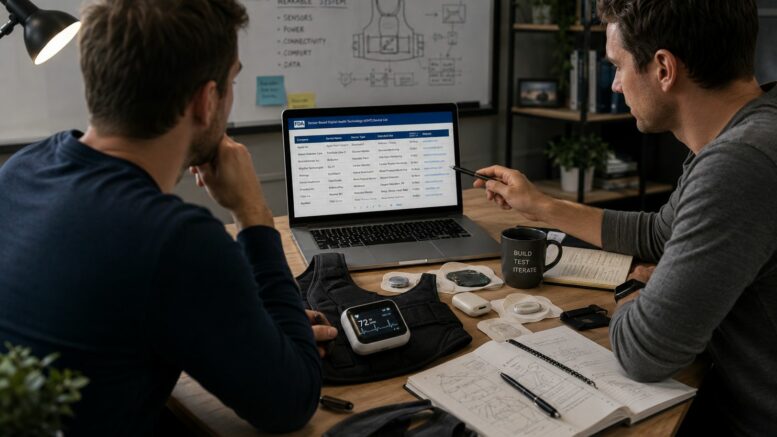
Wearable medical device startups face a difficult challenge: building innovative healthcare technology while also navigating FDA regulation, clinical validation, manufacturing complexity, and long-term commercialization.
That is one reason the FDA’s sensor-based digital health technology database — commonly called the FDA’s sDHT list — has become such a valuable resource for wearable medical device companies.
For startups developing wearable monitoring systems, digital therapeutics, connected health platforms, or sensor-enabled medical devices, the FDA’s sDHT list provides a rare opportunity to study how real wearable products successfully reached the market.
Instead of navigating commercialization blindly, founders can now review FDA-authorized wearable medical devices, research regulatory pathways, study intended-use language, and better understand how similar products were classified.
For many wearable startups, that visibility can significantly reduce development risk, improve commercialization planning, and help avoid expensive regulatory mistakes later.
What Is FDA’s sDHT List?
The FDA’s sensor-based digital health technology (sDHT) list is a public database of wearable and sensor-enabled medical devices that have already received authorization for marketing in the United States.
The database primarily includes technologies that are:
- Wearable or portable in nature
- Non-invasive or minimally invasive
- Used outside traditional clinical environments
- Designed for continuous or spot-check monitoring
- Intended to collect physiological or therapeutic data
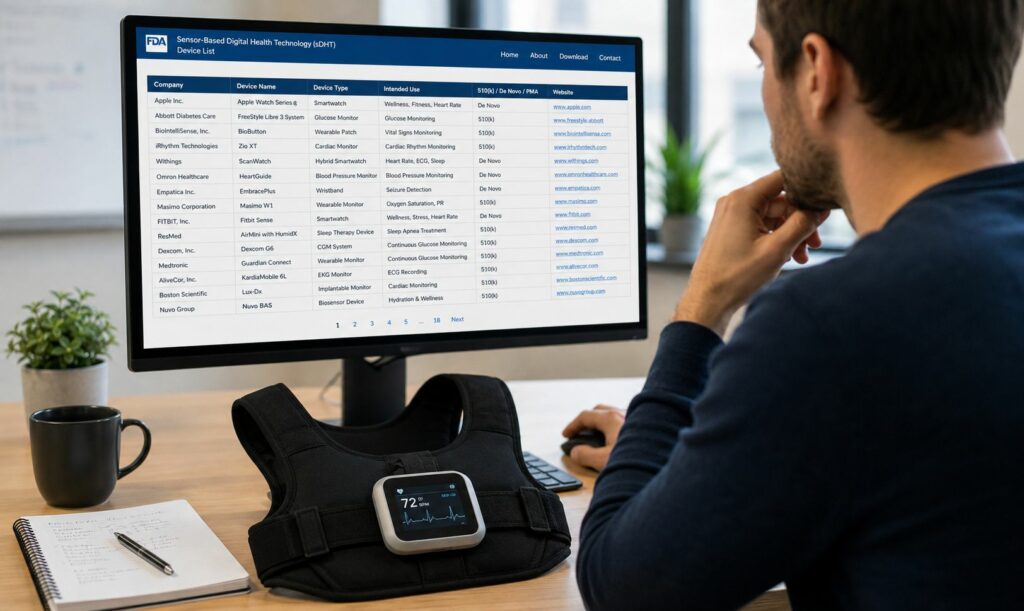
The FDA’s sDHT database includes products such as:
- Smartwatches
- Connected wearable patches
- Remote patient monitoring systems
- Glucose monitoring wearables
- Blood pressure monitoring devices
- Sleep monitoring systems
- Sensor-enabled therapeutic technologies
Many entries also provide access to FDA summaries, classifications, authorization pathways, and supporting regulatory documentation.
For wearable startups, the database functions less like a simple directory and more like a wearable medical device commercialization research tool.
Why the FDA Created the sDHT Database
Healthcare is increasingly moving outside hospitals and clinics and into the home.
Remote patient monitoring, preventative healthcare, digital therapeutics, and chronic disease management all rely heavily on wearable systems capable of collecting health data continuously in real-world environments.
As wearable healthcare technology has matured, the FDA has worked to improve transparency around digital health regulation and help innovators better understand existing pathways.
The FDA’s sDHT database was created to:
- Improve visibility into wearable medical devices already on the market
- Support digital health product development
- Encourage safe and effective innovation
- Help companies understand existing wearable technologies
- Increase transparency around sensor-based healthcare systems
The growth of the database also illustrates how quickly wearable medical technology has evolved.
The earliest companies included on the FDA’s sDHT list date back to January 2015. Today, the database contains hundreds of wearable and connected medical technologies spanning:
- Physiological monitoring
- Remote patient monitoring
- Wearable therapeutics
- Connected healthcare systems
- Sensor-enabled diagnostic devices
For startups entering the market today, that growing body of precedent can dramatically reduce the uncertainty that surrounded wearable commercialization only a few years ago.
Why FDA’s sDHT List Matters for Wearable Startups
Many wearable startups spend months — sometimes years — developing technology before discovering that similar FDA-cleared products already exist.
That usually creates avoidable problems later involving:
- Regulatory strategy
- Product claims
- Clinical validation
- Device classification
- Manufacturability
- Investor expectations

The FDA’s sDHT list gives founders the ability to study previously authorized products before major engineering and commercialization decisions become difficult to reverse.
For example, a startup developing a wearable cardiac monitoring patch can review similar monitoring systems to better understand:
- How comparable products were positioned
- Which FDA pathways were used
- What intended-use language was approved
- What level of monitoring triggered medical device regulation
Similarly, a company building a wearable sleep-monitoring platform may discover that some products were treated as general wellness technologies while others required FDA clearance due to diagnostic claims.
That distinction can completely change a startup’s development timeline.
How Wearable Startups Use FDA’s sDHT List
The FDA’s sDHT database can be extremely valuable during early-stage product planning.
Startups commonly use the database to research:
- Existing intended-use language
- Predicate devices
- FDA classifications
- Regulatory pathways
- Wearable form factors
- Sensor configurations
- Clinical validation approaches
- Performance testing expectations
For startups planning a 510(k) pathway, the database can also help identify likely predicate devices much earlier in development.
That research can help companies:
- Avoid unnecessary regulatory mistakes
- Reduce development costs
- Refine product claims earlier
- Better prepare for FDA discussions
- Understand likely testing requirements
- Improve commercialization timelines
In many ways, the FDA’s sDHT list acts as a roadmap for wearable medical device commercialization.
Using FDA’s sDHT List to Research Predicate Devices
One of the most valuable uses of the database is identifying potential predicate devices.
Many first-time founders underestimate how important predicate strategy becomes during FDA planning.
A wearable startup developing a remote patient monitoring device, for example, may assume its product is entirely novel. But the FDA’s sDHT list may reveal multiple previously authorized systems with similar functionality, sensor configurations, or clinical applications.
That visibility can help startups:
- Understand likely FDA expectations
- Compare intended-use statements
- Evaluate classification similarities
- Better estimate testing requirements
- Anticipate documentation needs
This type of early research can prevent companies from making expensive assumptions about regulatory strategy later.
One of the Biggest Mistakes Wearable Startups Make
One of the most common mistakes we see is startups misunderstanding when a wearable product transitions from a wellness device into a regulated medical device.
That line is often far less obvious than founders expect.
Low-risk wellness products focused on general lifestyle improvement may avoid medical device classification entirely.
Examples include:
- Basic fitness tracking
- General activity monitoring
- Relaxation applications
- Non-clinical sleep tracking
However, once a wearable device begins:
- Diagnosing medical conditions
- Monitoring disease progression
- Measuring clinical physiological signals
- Supporting treatment decisions
- Delivering therapeutic intervention
…the product is much more likely to enter regulated medical device territory.
We regularly see startups unintentionally move into clinical claims without fully understanding the downstream impact on:
- Development timelines
- Clinical testing
- Documentation requirements
- Quality systems
- Manufacturing controls
- Commercial strategy
The FDA’s sDHT list helps founders recognize where that regulatory line has historically been drawn.
Commercialization Is Usually Harder Than the Prototype
Many wearable founders assume the hardest part is building the initial prototype.
In reality, commercialization often becomes significantly more difficult once a device moves beyond proof-of-concept development.
From the outside, wearable healthcare technology can appear heavily software-driven. But scalable wearable medical devices quickly become a complex integration of:
- Electronics
- Sensors
- Connectivity hardware
- Power systems
- Textile integration
- Patient comfort
- Durability
- Manufacturability
- Repeated-use performance
In many wearable systems, the garment or patient-contact textile component eventually becomes just as important as the electronics themselves.
We are currently involved in multiple wearable medical projects still in the prototype and clinical trial phase, and both illustrate how complicated commercialization can become.
One project is replacing a therapy that traditionally requires patients to remain seated in a clinic for hours with a wearable system that allows treatment mobility and potentially home-based care.
Another project involves reorganizing and integrating the cords, tubing, and power systems of a continuously worn medical device into a more manageable wearable platform designed for long-term patient use.
Both programs have required multiple rounds of wearable prototype revisions as patient feedback, clinical testing, and usability requirements evolved.
That iterative process is extremely common in wearable medical device development.
A wearable device that performs perfectly in a lab environment may behave very differently after six hours inside a compression garment or after repeated washing cycles during real-world patient use.
In our experience, some wearable systems spend years in development before reaching scalable production.
During that process, startups often cycle through repeated revisions involving:
- Garment redesigns
- Sensor placement adjustments
- Material substitutions
- Battery integration updates
- Washability testing
- Patient comfort improvements
- Clinical usability feedback
We have personally followed companies for nearly a decade as they transformed wearable concepts originally developed in university research labs into commercial medical technologies with life-changing potential.
Why Manufacturability Matters Earlier Than Most Founders Expect
One of the biggest lessons successful wearable startups learn is that manufacturability cannot wait until the end of development.
Early wearable prototypes are often optimized for functionality, not scalable production.
That becomes a problem later when companies encounter:
- Textile sourcing issues
- Assembly complexity
- Reliability concerns
- Washability failures
- Battery integration limitations
- Regulatory documentation requirements
- Long-term durability problems
Experienced wearable startups begin evaluating manufacturing constraints much earlier in the product lifecycle.
That early planning often reduces redesign cycles later during FDA review and commercialization scaling.
The Wearable Medical Device Industry Is Becoming Easier to Navigate
The good news is that wearable medical device commercialization is becoming far easier to understand than it was even five years ago.
Startups today have access to:
- The FDA’s sDHT list
- Expanded digital health guidance
- Better clarity around wellness vs. medical claims
- More examples of FDA-authorized wearable devices
- Growing commercialization precedent
- Better industry adoption frameworks
That visibility matters.
Historically, many wearable startups operated almost entirely in the dark when trying to understand regulatory positioning and commercialization strategy.
Today, founders willing to study existing FDA-cleared devices and incorporate manufacturability into development early may be able to avoid many of the expensive mistakes that slowed earlier generations of wearable healthcare companies.
We have seen products we supported during early wearable development eventually become major commercial successes for multinational medical companies.
Ironically, manufacturers like us often capture only a very small portion of that value through the wearable assemblies and sewn components we produce.
Still, watching wearable medical technologies successfully move from concept to commercialization remains one of the most rewarding parts of working in this industry.
Why Resources Like FDA’s sDHT List Matter
As wearable healthcare technology continues expanding into:
- Remote patient monitoring
- Home-based treatment
- Chronic disease management
- Prescription digital therapeutics
- Preventative healthcare
…the companies most likely to succeed will be the ones that understand both regulation and manufacturing early.
The FDA’s sDHT list is valuable because it gives startups a clearer picture of what successful wearable medical device commercialization already looks like.
Instead of navigating the industry blindly, founders can now study real products, real classifications, and real regulatory pathways before making critical development decisions.
For wearable startups, that visibility can save enormous amounts of time, money, and frustration.
For companies moving from prototype development toward scalable wearable manufacturing, early manufacturability planning can significantly reduce redesign cycles later during FDA development.
Fieldtex Products supports wearable medical device companies with wearable prototyping, sewn electronics integration, and scalable manufacturing support for complex healthcare wearables.