
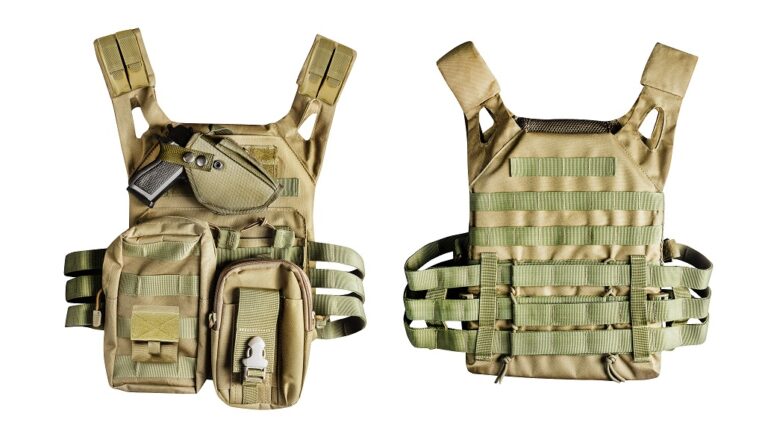
The MOLLE system — Modular Lightweight Load-Carrying Equipment — is the standardized webbing-and-attachment framework used across U.S. military branches, law enforcement agencies, and EMS teams to configure gear for specific mission requirements.
Understanding how it is built — to spec, at scale, with consistent dimensional tolerances — is what matters for OEM engineers and government procurement teams evaluating a contract sewing partner.
Key Takeaways
- The Core Difference: PALS (Pouch Attachment Ladder System) refers specifically to the underlying grid geometry and hardware standard, while MOLLE is the overarching load-carrying system that utilizes the PALS grid.
- Precision and Interoperability: A standard MOLLE grid requires strict manufacturing tolerances: 1-inch wide nylon webbing, 1-inch vertical row spacing, and 1.5-inch center-to-center bartack stitch intervals. Even minor deviations will prevent pouches from threading properly.
- Sewn vs. Laser-Cut: Traditional sewn PALS webbing remains the military standard due to its high load capacity, field-repairability, and straightforward path to Berry Amendment compliance. Laser-cut laminate offers a lighter profile but cannot be repaired in the field if it tears.
- Beyond the Military: MOLLE has expanded heavily into law enforcement, EMS, search-and-rescue, and OEM industrial applications (like portable diagnostic and instrumentation cases) due to its universal modularity.
What Does MOLLE Stand For, and What Does It Do?
MOLLE = Modular Lightweight Load-Carrying Equipment.
It’s called modular because users can add or remove gear as needed, and lightweight because the design eliminates the need for permanent sewn-on pockets.
At its core, MOLLE is a simple idea: a grid of durable webbing straps, typically one-inch-wide nylon stitched onto packs or vests at fixed intervals. This grid forms attachment points for any compatible accessory, allowing users to build a customized loadout that fits their mission or activity.
Adoption extends well beyond the military. Law enforcement agencies — particularly SWAT and tactical units — rely on MOLLE-compatible plate carriers and duty vests. EMS and search-and-rescue teams use MOLLE attachment points on medical bags and response kits. Industrial field teams and OEM equipment manufacturers have adopted the same attachment geometry for portable diagnostic cases, instrumentation carriers, and tool rolls where modular organization matters.
How the MOLLE System Works
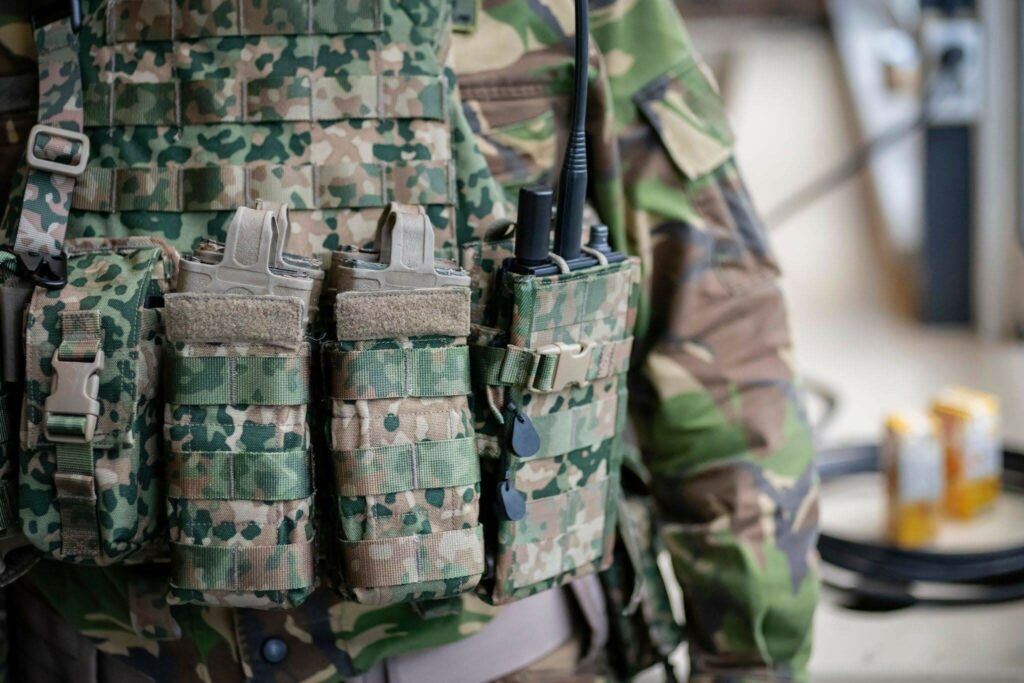
If you’ve ever wondered “how does the MOLLE system work?” or “how do I use MOLLE webbing?” the answer lies in the relationship between two components:
- PALS Webbing (“Pouch Attachment Ladder System”) – Horizontal rows of 1-inch webbing stitched to equipment every 1.5 inches vertically.
- MOLLE Attachment Straps – Straps or clips on the back of a pouch that weave through the PALS webbing to lock accessories securely in place.
This weaving process distributes weight evenly and prevents pouches from shifting, even under heavy movement. Because each loop interlocks, the system resists sagging far better than hook-and-loop or snap attachments.
Three attachment strap variants are common in current production. Traditional woven straps with snap or tuck tabs are the lightest option and work across most load conditions.
MALICE clips — rigid polymer fasteners widely used in military and tactical gear — are used on heavier pouches where a woven strap might shift under dynamic load. SlickStick-style rigid stiffeners thread like a traditional strap but provide added lateral rigidity to prevent the pouch from rotating.
How to Use and Weave MOLLE Webbing
Attaching a MOLLE-compatible pouch to a PALS grid is a repeatable six-step process:
- Position the pouch against the carrier or pack at the desired location, aligning the attachment straps with the PALS webbing rows.
- Feed the first strap over the top webbing row from outside to inside (toward the base fabric).
- Pass the strap under the second webbing row, threading it between the webbing strip and the base fabric.
- Continue the over-under pattern down through each successive row until the strap exits at the bottom.
- Repeat with any remaining attachment straps, maintaining the same over-under sequence on adjacent columns.
- Secure each strap with its snap, tuck tab, or clip to lock the assembly.
Correct weaving creates mechanical friction across multiple contact points; the pouch will not shift laterally or vertically under load. A strap woven through only one row, or routed inconsistently, defeats this retention mechanism entirely.
For a detailed look at the webbing grid itself, see our military-grade sewing capabilities.
MOLLE vs. PALS: What’s the Difference?
The two terms appear interchangeably in gear specifications, procurement documents, and product listings, which creates confusion for engineers and contracting officers working from formal spec language.
PALS is the hardware standard: the precise webbing grid geometry that defines row spacing, bartack intervals, and webbing width. The governing commercial item description is CID A-A-55301A, which specifies Type III nylon webbing requirements for military applications.
MOLLE is the broader system — the load-carrying equipment program that uses PALS webbing as its attachment foundation. It encompasses vests, packs, belts, and accessories designed around the PALS grid geometry.
In practice, a contractor writing a specification for a military pouch will reference PALS grid dimensions and A-A-55301A webbing requirements. A program manager describing the overall kit will use MOLLE. Both terms point to the same dimensional standard. For manufacturers, the operative question is always dimensional compliance — not which term appears on the drawing.
Traditional MOLLE Webbing vs. Laser-Cut MOLLE
Two distinct construction methods can produce a MOLLE-compatible attachment surface, and the choice between them has real consequences for weight, durability, repairability, and compliance path.
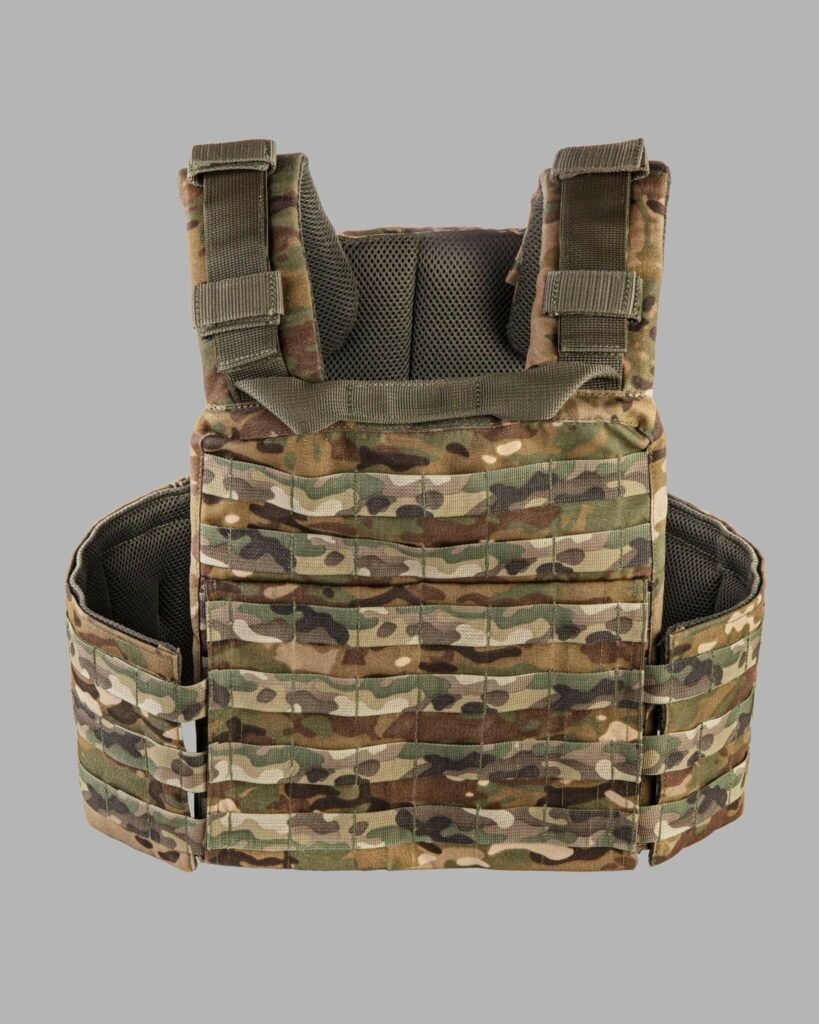
Traditional sewn PALS webbing uses 1-inch nylon webbing strips stitched horizontally onto a base fabric in rows, bartacked at 1.5-inch intervals. This is the original DoD-specified method. Sewn webbing handles high loads well because the bartack stitching distributes force across multiple thread contacts.
It is field-repairable — a damaged strip can be re-stitched with standard thread in austere conditions. When domestic webbing and thread are specified, sewn PALS is fully compatible with Berry Amendment procurement requirements.
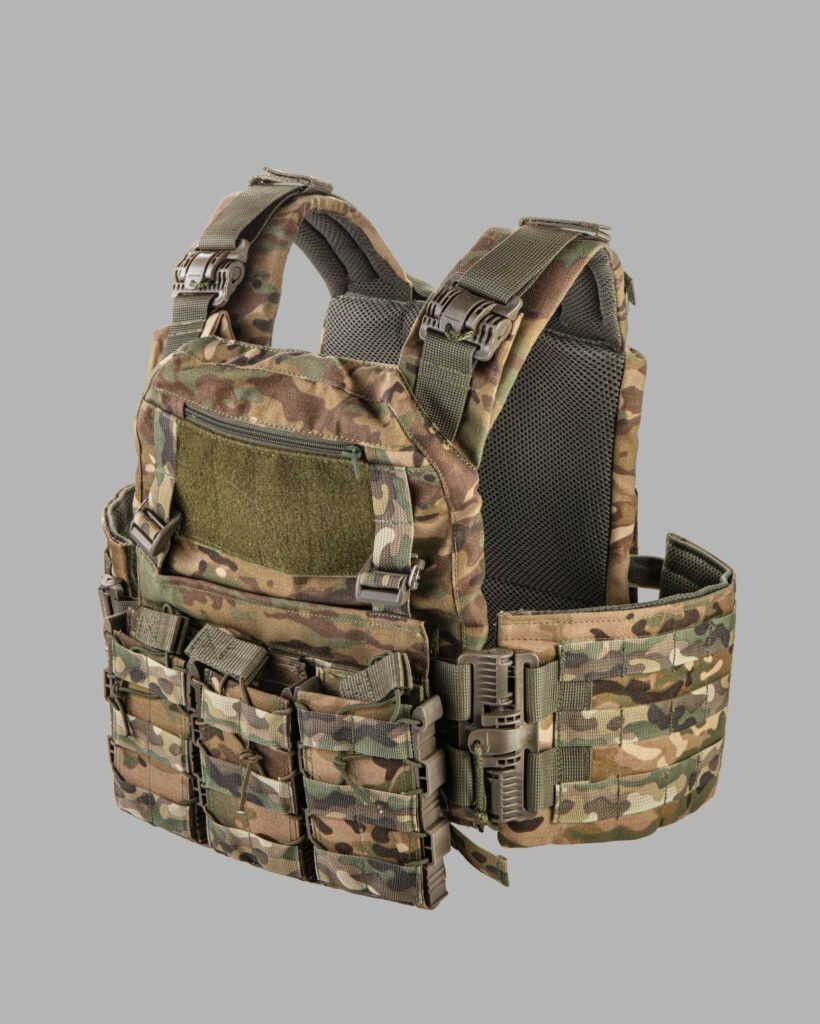
Laser-cut MOLLE eliminates the external webbing strips entirely. Slots are cut directly into a reinforced laminate panel, typically a Cordura® composite, Hypalon, or similar high-strength laminate, creating the same attachment geometry through precision-cut openings in the base material itself.
The result is a lighter, lower-profile surface with reduced snag potential. The tradeoff is that load capacity depends entirely on the laminate’s cut-edge integrity; a base material that delaminates or tears at the slot edge will fail without warning and is more difficult to repair in the field.
| Factor | Traditional Sewn PALS | Laser-Cut MOLLE |
|---|---|---|
| Weight | Heavier (added webbing strips) | Lighter (no external webbing) |
| Durability under heavy load | High — bartack stitching distributes force | Dependent on laminate edge strength |
| Field repairability | Yes — re-stitchable in the field | No — laminate cuts cannot be field-repaired |
| DoD / Berry compliance path | Established — domestic webbing and thread available | Requires domestic laminate sourcing; less precedent in DoD programs |
| Typical applications | Military load-bearing vests, packs, pouches | Commercial tactical, law enforcement, lightweight carriers |
Our manufacturing capability is centered on traditional sewn PALS webbing — the construction method that DoD programs have specified for decades and that carries the clearest compliance path for Berry Amendment contracts.
MOLLE Manufacturing Specifications: What Precision Actually Requires
Most published content on the MOLLE system describes how end users attach pouches. Almost none of it addresses what a contract manufacturer must control to produce a PALS-compliant grid that will perform consistently across a production run. These are the dimensional specifications that govern every MOLLE-compatible piece we produce:
- Webbing width: 1 inch (25.4 mm), tolerance ±1/16 inch. Webbing wider than this tolerance will not thread correctly through standard attachment straps; narrower webbing creates slack that allows lateral pouch movement under load.
- Vertical row spacing: 1-inch gap between the bottom edge of one webbing row and the top edge of the next. Deviation here shifts the slot height and prevents multi-row attachment straps from threading cleanly.
- Bartack stitch interval: 1.5 inches (38.1 mm) center-to-center, acceptable range 35–40 mm. These bartacks define the attachment slots. Inconsistent interval spacing means a pouch designed for a 1.5-inch slot grid will skip or bunch on a non-conforming surface.
- Thread specification: High-tenacity bonded nylon, TEX 70 or greater. Standard polyester sewing thread does not carry the load required at each bartack point in a high-stress application. Thread grade is not a cosmetic choice.
- Stitch pattern: Box-X or bartack at each 1.5-inch interval. A single stitch line across the webbing is not structurally equivalent and will not hold under repeated dynamic loading.
- Webbing material: Type III nylon per CID A-A-55301A for military-grade applications, with a minimum breaking strength of 1,200 lbs.
When these specifications drift in production, the failures are specific and predictable. Mismatched row spacing prevents pouches from threading — the strap bottoms out or gaps against the base fabric rather than weaving cleanly. Under-spec thread causes bartack failure at contact points when the attached pouch carries weight over rough terrain or under impact load.
Dimensional variation across a run creates interoperability failures at the accessory level: a pouch made to one set of tools will not seat correctly on a carrier made to another.
These are process discipline issues. We monitor stitch spacing, web tension, and bartack placement through template checks on every production run to ensure dimensional consistency from the first unit to the last.
How MOLLE Webbing Is Made
Behind every reliable MOLLE setup is strong manufacturing.
The webbing must hold significant weight and withstand abrasion, moisture, and UV exposure. Most military-grade gear uses heavy-duty nylon 6/6 or polyester webbing, double-stitched or bar-tacked at every stress point.
In manufacturing, precision is critical: if the stitch spacing is off by even a few millimeters, attachments may not fit correctly. Factories producing tactical or military gear follow strict spacing standards and use industrial sewing machines calibrated for consistent web tension.
At Fieldtex, our sewing teams integrate PALS webbing into backpacks, vests, and holsters for defense and law-enforcement applications, reinforcing each join with multiple bar tacks for long-term durability. Our sourcing practices support Berry-compliant production for military programs. Learn more about our military sewing services.
Why the MOLLE System Matters
The MOLLE design solves a universal problem: how to carry different tools, safely and comfortably, in changing conditions.
- Customizable: Add or remove pouches without redesigning the gear.
- Balanced: Even weight distribution reduces fatigue and injury risk.
- Durable: Reinforced stitching and standardized spacing maintain integrity in the field.
- Universal: Any MOLLE-compatible gear fits across packs, vests, and rigs from different manufacturers.
Because of its modular nature, MOLLE has outlasted earlier systems like ALICE and continues to evolve as new materials and attachment methods appear.