
When the Marine Corps makes a uniform change, it rarely stays confined to appearance alone. It sends a ripple through procurement pipelines, textile sourcing, and product design across the entire military supply chain.
That’s exactly what’s happening in 2024.
The decision to move away from MultiCam and return to MARPAT camouflage with OD green gear isn’t just a visual reset—it’s a strategic shift. And from our perspective as a contract sewing manufacturer, it’s already reshaping how military gear is designed, sourced, and produced in real time.
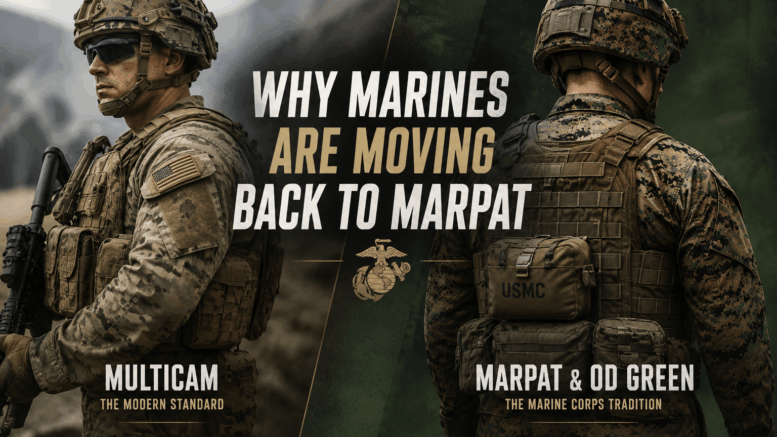
Why the Marine Corps Is Leaving MultiCam Behind
The shift originates from a directive issued by Marine Special Operations Command (MARSOC), calling for the discontinuation of MultiCam uniforms and equipment. In its place, Marines are returning to flame-resistant organizational gear (FROG) in MARPAT patterns, paired with OD green load-bearing systems.
For years, MultiCam served as a unifying pattern across Special Operations Forces (SOF), improving interoperability between units. But that standardization came at a cost: identity.
Now, the Marine Corps is reasserting something that has always set it apart, visual distinction.
And they’re willing to invest heavily to do it.
This transition requires significant reinvestment in uniforms and gear, but the Corps is making it clear: distinctiveness and control over its own systems outweigh the efficiencies of standardization.
MARPAT vs MultiCam: What’s the Difference?
At a glance, camouflage patterns might seem interchangeable—but they serve very different purposes.
MARPAT (Marine Pattern):
- Digitized camouflage unique to the Marine Corps
- Designed for specific environments (woodland and desert variants)
- Reinforces Marine Corps identity and ownership
MultiCam:
- Widely used across U.S. and allied forces
- Designed for versatility across multiple terrains
- Prioritizes interoperability over uniqueness
The key difference isn’t just performance, it’s ownership. MARPAT belongs to the Marine Corps. MultiCam belongs to everyone.
And that distinction matters more than most people realize.
Why Pattern Identity Matters More Than You Think
Camouflage isn’t just about concealment—it’s about recognition, cohesion, and operational clarity.
When Marines operate alongside other units wearing the same pattern, that distinction can blur. Internally, that impacts identity and pride. Operationally, it can introduce unnecessary ambiguity.
We’ve heard this echoed repeatedly in conversations with former Marines and industry partners: the Corps wants to look like the Corps.
From a manufacturing standpoint, that decision has real consequences. A pattern change affects:
- Fabric sourcing and printing processes
- Supplier qualification and compliance standards
- Inventory forecasting and material obsolescence
- Product lifecycle planning
In other words, this isn’t a cosmetic change—it’s a system-wide reset.
Performance Still Drives the Future Uniform
While identity is a major factor, performance hasn’t taken a back seat.
In fact, the Marine Corps has been actively developing next-generation uniform systems that go well beyond pattern changes. These include:
- Flame-resistant, no-melt/no-drip fabrics
- Improved breathability and moisture management
- Enhanced infrared signature reduction
- Lighter materials with increased durability
This is an important point: the move away from MultiCam isn’t a step backward. It’s an evolution—combining advanced textile technology with a pattern that reinforces Marine Corps identity.
What We’re Seeing on the Manufacturing Side
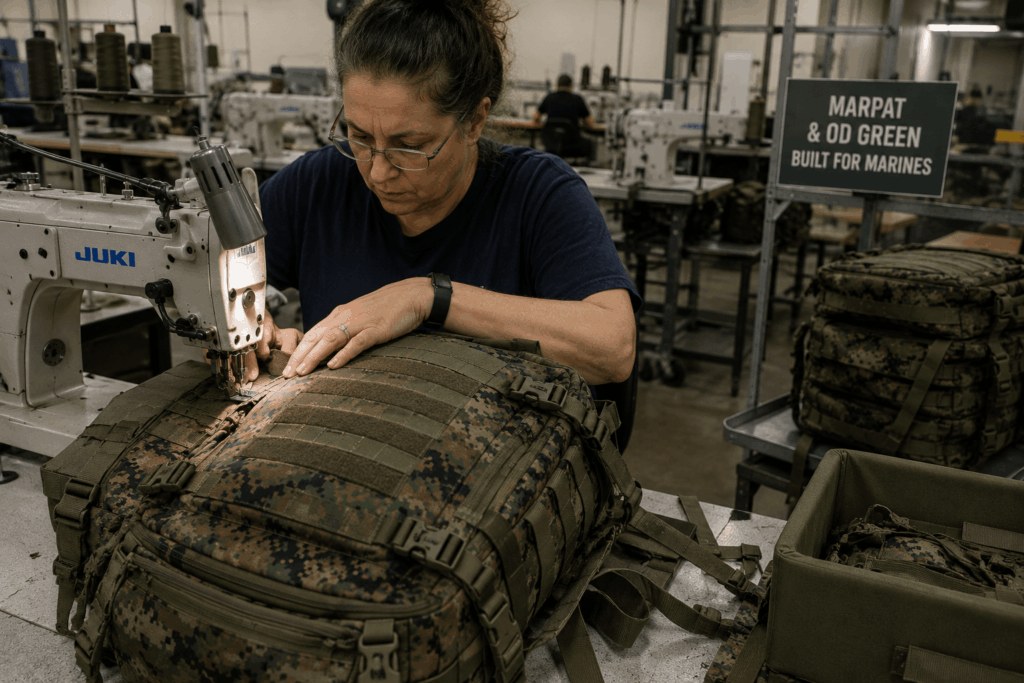
From where we sit, the impact has been immediate—and tangible.
Over the past six months, we’ve watched customer requirements shift in real time.
In one case, a customer paused an active MultiCam production run to transition materials mid-cycle—something we rarely see unless driven by urgent operational changes.
Across the board, we’ve seen:
- Increased demand for OD green materials replacing MultiCam
- Requests for MARPAT-compatible gear systems
- Design adjustments to align with updated loadout standards
Even when the core product: like a backpack or tactical pouch, remains the same, the materials and compliance requirements can change dramatically.
For example, switching from MultiCam to MARPAT isn’t just a print swap. It often requires requalifying suppliers, adjusting dye processes, and ensuring the final product meets strict military specifications.
These are not small changes.
Why This Change Matters Beyond Uniforms
It’s easy to think of this as a uniform update—but the implications go much deeper.
This shift affects:
1. Supply Chains
Materials that were standard six months ago are quickly becoming obsolete, forcing manufacturers to pivot sourcing strategies.
2. Procurement Cycles
Contracts and product specifications are being updated to reflect new requirements, accelerating redesign timelines.
3. Product Development
Gear must now align with MARPAT systems and OD green loadouts, impacting everything from color matching to modular compatibility.
In military manufacturing, “small changes” rarely stay small for long.
The Bigger Takeaway for Military Textile Production
If there’s one lesson in all of this, it’s adaptability.
Requirements can shift quickly—sometimes faster than production cycles are designed to handle. Companies that can pivot sourcing, update designs, and maintain compliance without slowing down are the ones that stay competitive.
From our perspective, this transition reinforces a core reality of military manufacturing:
Flexibility isn’t optional, it’s essential.
The Marine Corps’ move away from MultiCam is about more than aesthetics. It reflects a deliberate balance between identity, performance, and long-term strategy.
And as this transition continues, it will shape not just uniforms, but the entire ecosystem that supports them.
Need Help Adapting to Changing Military Specifications?
If you’re navigating evolving military requirements, whether it’s MARPAT compatibility, OD green systems, or new textile performance standards, we can help.
Our team works closely with military and defense clients to adapt products quickly, maintain compliance, and keep production moving without disruption.