
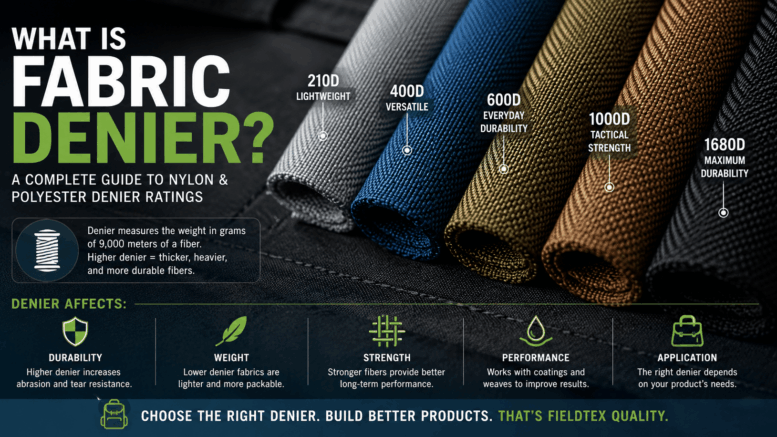
If you’ve researched backpacks, tactical gear, outdoor fabrics, or industrial textiles, you’ve probably seen terms like 400D nylon, 600D polyester, or 1000D Cordura®. That “D” stands for denier, one of the most common measurements used in textile manufacturing.
But what is fabric denier exactly, and why does it matter?
Denier affects the durability, weight, flexibility, and feel of a fabric. Higher denier fabrics are generally thicker and more abrasion resistant, while lower denier fabrics are lighter and more flexible. However, denier is only one part of overall fabric performance, and understanding how it works can help manufacturers and consumers choose the right material for a specific product.
At Fieldtex, we manufacture custom bags, tactical gear, EMS cases, and industrial sewn products, so fabric denier plays a major role in how we design products for real-world use.
In this guide, we’ll explain:
- what denier fabric means,
- how denier nylon is measured,
- the difference between higher and lower denier fabrics,
- and how manufacturers choose the right material for bags and carrying cases.
What Does Denier Mean in Fabric?
Denier is a unit of measurement used to describe the thickness and weight of individual fibers in a fabric.
Technically, denier measures the linear mass density of a fiber, based on how much 9,000 meters of that fiber weighs in grams.
For example:
- If 9,000 meters of fiber weighs 1 gram, it is 1 denier.
- If 9,000 meters weighs 500 grams, it is 500 denier (500D).
In simple terms:
Higher denier fabrics use thicker, heavier fibers.
That’s why a 1000D tactical fabric feels heavier and more rugged than lightweight 210D nylon.
The denier system originally came from silk manufacturing, where a single strand of silk was approximately 1 denier. Today, the same measurement is commonly used for synthetic fabrics like nylon and polyester.
What Is Denier Nylon?
Denier nylon refers to nylon fabrics categorized by the thickness and weight of their fibers.
Nylon is one of the most common materials measured in denier because it offers:
- excellent abrasion resistance,
- long-term durability,
- flexibility,
- and tear resistance.
That’s why nylon fabrics are commonly used in:
- tactical bags,
- military gear,
- outdoor products,
- backpacks,
- carrying cases,
- and luggage.
Some of the most common nylon deniers include:
- 210D nylon
- 400D nylon
- 500D Cordura®
- 1000D Cordura®
- 1050D ballistic nylon
- 1680D ballistic nylon
As the denier increases, the fabric generally becomes:
- heavier,
- thicker,
- stiffer,
- and more abrasion resistant.
However, that does not automatically mean it’s always the best choice.
Does Higher Denier Mean Stronger Fabric?
Not necessarily.
One of the biggest misconceptions about denier fabric is that a 1000D fabric is automatically twice as strong as a 500D fabric. In reality, denier measures the weight of the fibers themselves — not the total durability of the finished textile.
Fabric performance also depends on:
- weave density,
- coatings,
- thread count,
- fiber quality,
- and fabric construction.
For example, a tightly woven 500D Cordura® fabric may outperform a lower-quality 1000D fabric in certain applications.
This is why experienced manufacturers evaluate much more than just denier when selecting materials.
Common Fabric Deniers Explained
Different denier fabrics are designed for different types of products. Lightweight fabrics are ideal for portability and flexibility, while higher denier materials are typically used for heavy-duty applications.
| Fabric | Common Uses | Durability | Weight |
|---|---|---|---|
| 210D Nylon | Pack liners, lightweight bags | Moderate | Very Light |
| 400D Nylon | Soft cases, outdoor gear | Medium | Light |
| 600D Polyester | School bags, luggage | Medium-High | Medium |
| 500D Cordura® | Tactical backpacks | High | Medium |
| 1000D Cordura® | Military gear, industrial bags | Very High | Heavy |
| 1050D Ballistic Nylon | EMS and equipment cases | Extreme | Heavy |
Many products combine multiple deniers to balance durability and weight. For example, a tactical backpack may use lighter fabrics in low-wear areas and reinforced 1000D panels in high-abrasion zones.
What Matters Besides Denier?
While denier is important, it’s only one factor in fabric performance.
The weave of the fabric affects how tightly fibers are packed together, which impacts abrasion resistance and structural stability. Coatings like PU, PVC, or TPU can improve water resistance and durability. Ripstop construction can help prevent small tears from spreading.
Fiber type also matters. Nylon generally provides better abrasion resistance and flexibility, while polyester offers improved UV resistance and lower cost.
This is why two fabrics with the same denier can perform very differently in real-world applications.
Higher vs Lower Denier Fabrics
Choosing between lower and higher denier fabrics depends entirely on how the finished product will be used.
Lower denier fabrics are often selected for:
- lightweight backpacks,
- rain covers,
- travel products,
- and packable outdoor gear.
These materials improve flexibility and reduce overall product weight.
Higher denier fabrics are commonly used for:
- tactical bags,
- EMS cases,
- military equipment,
- and industrial carrying systems.
These fabrics prioritize abrasion resistance, puncture resistance, and long-term durability over weight savings.
For example, a hiking backpack may use lighter denier nylon to reduce fatigue during long-distance use, while a military drag bag may require 1000D Cordura® or ballistic nylon to survive repeated abrasion and rough handling.
How Manufacturers Choose Fabric Denier
At Fieldtex, fabric denier is selected based on the product’s intended use, weight requirements, and durability expectations.
For example:
- lightweight carrying cases may prioritize flexibility and portability,
- while tactical and EMS products require heavier abrasion-resistant materials.
Manufacturers also consider:
- product weight,
- user comfort,
- sewing complexity,
- coating requirements,
- and shipping costs.
Higher denier fabrics improve durability, but they also add weight and stiffness. The best fabric choice is usually a balance between performance, comfort, and long-term product reliability.
Fieldtex regularly works with materials like:
- 400D nylon,
- 600D polyester,
- 1000D Cordura®,
- and 1050D ballistic nylon
depending on the application and customer requirements.
Last Note on Fabric Denier
Denier is one of the most important measurements in textile manufacturing because it directly affects the durability and performance of a fabric.
While higher denier fabrics are generally thicker and more abrasion resistant, denier alone does not determine overall fabric strength. Weave construction, coatings, fiber type, and intended application all play an important role in how a fabric performs.
Understanding denier helps manufacturers choose the right materials for products ranging from lightweight backpacks to military-grade tactical gear.
At Fieldtex, we manufacture custom bags, tactical products, carrying cases, and industrial sewn products using high-performance materials designed for demanding real-world applications.