
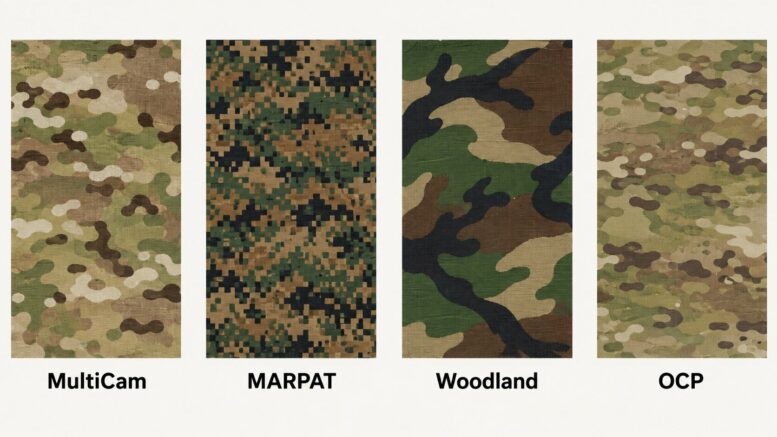
Two camouflage patterns can look nearly identical in a spec sheet photo and still represent two different licensing structures, two different procurement paths, and two different answers to one important question: will this match what’s already issued?
That confusion costs time in a program where the wrong pattern call can mean a failed inspection, mismatched gear, or an expensive reprint.
This camouflage guide breaks down the military camo patterns buyers encounter most often, including MultiCam, MARPAT, OCP, and Woodland, while explaining how OCP relates to MultiCam and where Woodland fits as the predecessor to today’s digital camouflage.
You’ll also learn when Coyote, Olive Drab, and Tan make more sense than a printed pattern, with practical considerations for matching existing uniforms, specifying materials, and getting the finish right before production begins.
Key Takeaways
- Camouflage patterns are designed for specific conditions. Environment, viewing distance, color, contrast, and pattern scale all influence how a pattern performs.
- MultiCam and MARPAT take different approaches. MultiCam is designed to work across varied terrain, while MARPAT uses separate Woodland and Desert variants for specific environments.
- OCP and MultiCam are not the same pattern. They share a common Scorpion lineage but were developed separately, with differences in pattern structure, appearance, and licensing.
- Woodland remains relevant. Although it was phased out of standard front-line uniform issue, Woodland and modernized variants still appear on military equipment and in specialized applications.
- Solid colors can be the right specification. Coyote, Olive Drab, and Tan can provide a practical alternative when terrain-specific camouflage isn’t required or when matching existing gear and components is the priority.
- Fieldtex Cases can turn your pattern specification into finished gear. We source the camouflage fabric and sew it into custom products, with options for labeling, patches, identification panels, and other program-specific details.
What Drives a Camouflage Pattern’s Design
A camouflage pattern is far from being a stylistic choice. It is engineered around a specific environment, viewing distance, and mission profile, not a stylistic choice.
A pattern worn for a dense green forest will look very different from the one intended for desert terrain, while camouflage meant to conceal equipment at close range requires different micro-details from a pattern viewed from several hundred yards away.
Before a pattern is approved for issue, factors such as color count, shape scale, contrast, and visual density are carefully tuned to suit these conditions. Even small changes can affect how effectively a pattern breaks up an object’s outline or blends with its surroundings.
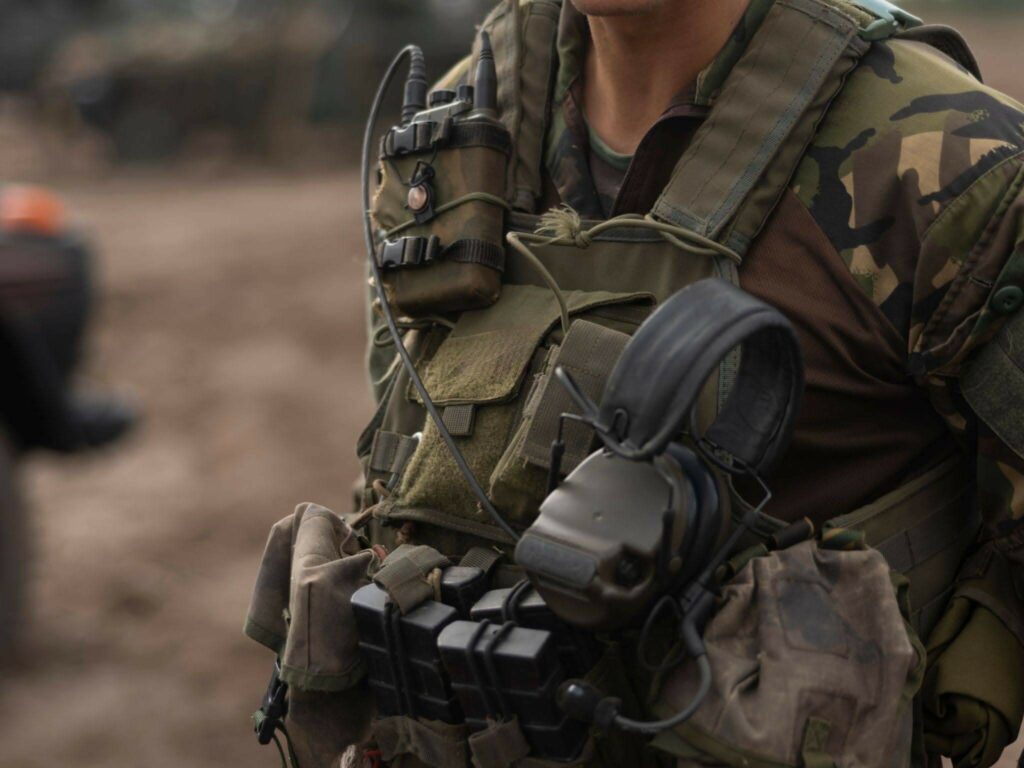
That’s why military equipment uses multiple types of camouflage, each designed for different operational requirements. MultiCam, MARPAT, OCP, and Woodland are all military camo patterns, but they were developed at different times, by different organizations, and for different environments and applications.
If you want to ensure you get the right pattern, it takes more than simply understanding how these camouflage patterns differ. You also need to know where each pattern is used, how it relates to existing uniforms and equipment, and what to consider when specifying it for production.
MultiCam vs. MARPAT Military Camo Patterns
MultiCam and MARPAT solve the terrain problem in opposite ways.
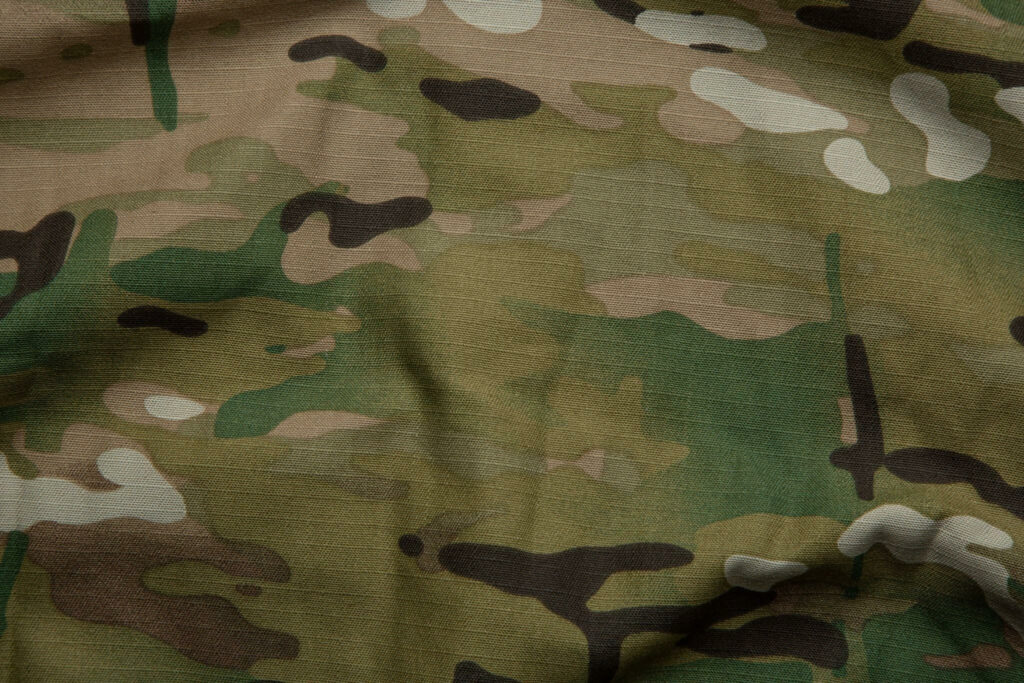
The MultiCam pattern, designed by Crye Precision and unveiled in 2002 in a joint effort with the Army’s Natick Soldier Center, was developed for use across a range of environments.
Its seven-color, multi-tonal palette combines a tan-to-brown gradient base layered with green tones and dark brown and cream shapes. Everything combined, the pattern is engineered to blend across desert, woodland, and transitional terrain.
MARPAT takes the opposite approach. Developed for the U.S. Marine Corps between 2000 and 2001 and fielded starting in 2002, MARPAT uses small, pixelated “digital” shapes rather than large blocks of color.
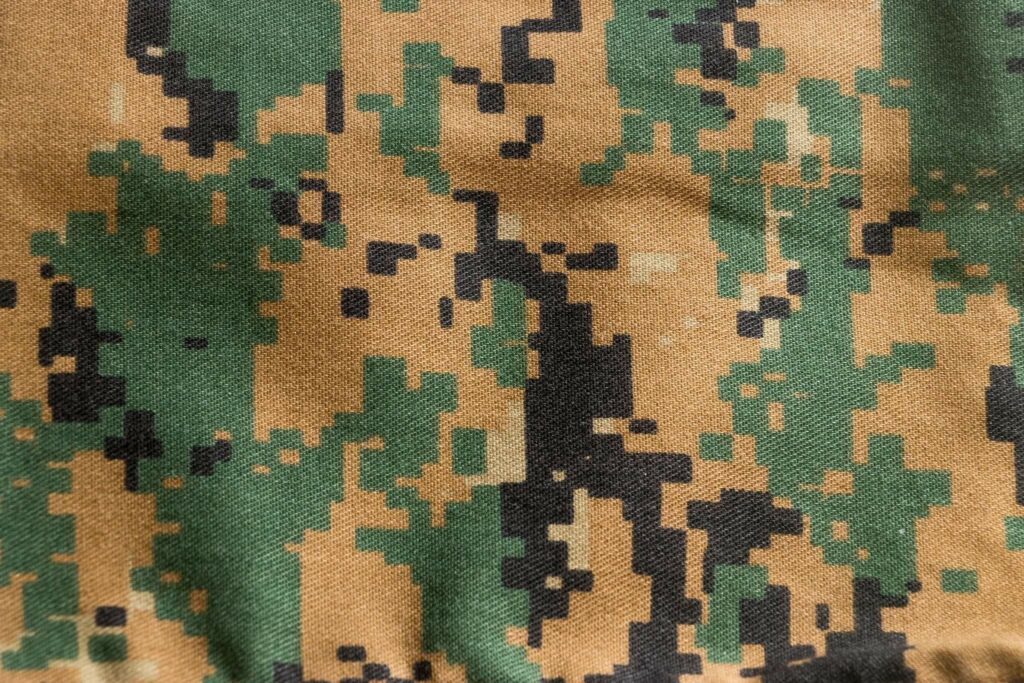
That micropattern design breaks up the visual outline of a shape at multiple viewing distances. Instead of one universal version, MARPAT ships in dedicated Woodland and Desert variants, each color-tuned to a specific environment rather than built to flex across all of them.
| Key distinction: MultiCam is built to perform across multiple environments with one pattern. MARPAT uses separate Woodland and Desert variants, each optimized for one specific terrain. |
|---|
OCP vs. MultiCam Camouflage Patterns
This is the comparison that gets misstated most often, so it helps to start with the history. In 2002, the Army’s Natick Soldier Research, Development and Engineering Center and Crye Precision worked together on an early camouflage pattern called Scorpion.
The two organizations later took the pattern in different directions. Crye Precision developed its version commercially into MultiCam, while the Army continued developing its own version. In 2009, the Army’s research center modified the pattern into what became known as Scorpion W2.
The Army adopted Scorpion W2 as the Operational Camouflage Pattern (OCP) starting in 2014, with distribution to soldiers beginning in April 2015. The decision was partly driven by cost. Crye Precision’s then-CEO said the company would have charged the Army a one-time royalty of about $700,000 for a family of MultiCam-based patterns. When the two sides could not agree on licensing terms, the Army chose Scorpion W2 instead, which the Army had the licensing rights to use without paying an outside company royalties.
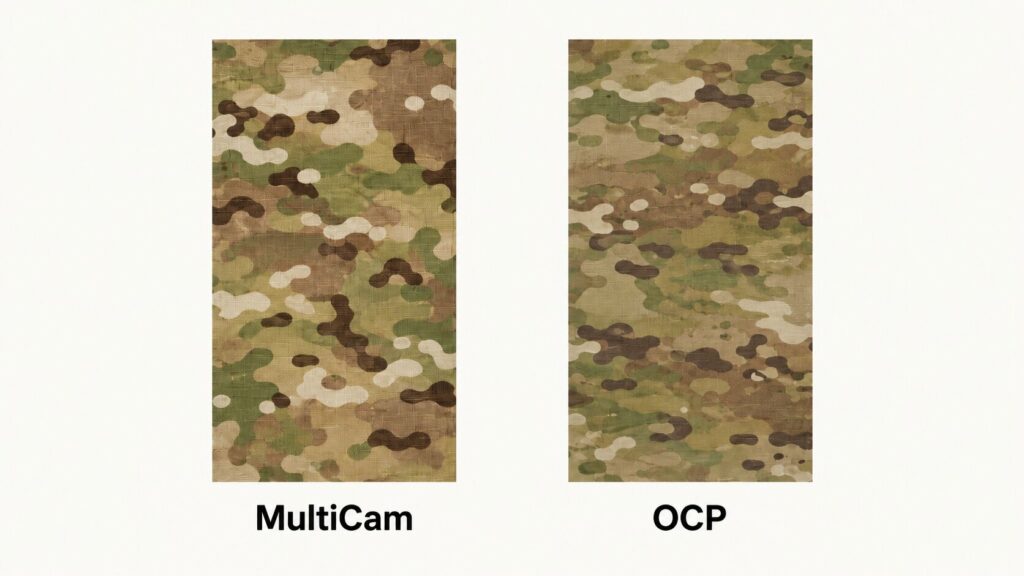
That shared history explains why OCP and MultiCam look similar but are not the same pattern. OCP generally has darker overall tones and a lower pattern density, while MultiCam has more pronounced vertical elements and a more vertically oriented appearance. OCP tends to read as more horizontal by comparison.
| Common misconception: OCP is often called “the Army’s version of MultiCam,” but it’s a separately modified pattern that shares a common ancestor with MultiCam. It is not a direct copy or update of MultiCam itself. |
|---|
Woodland Camo: The Original Digital-Era Predecessor
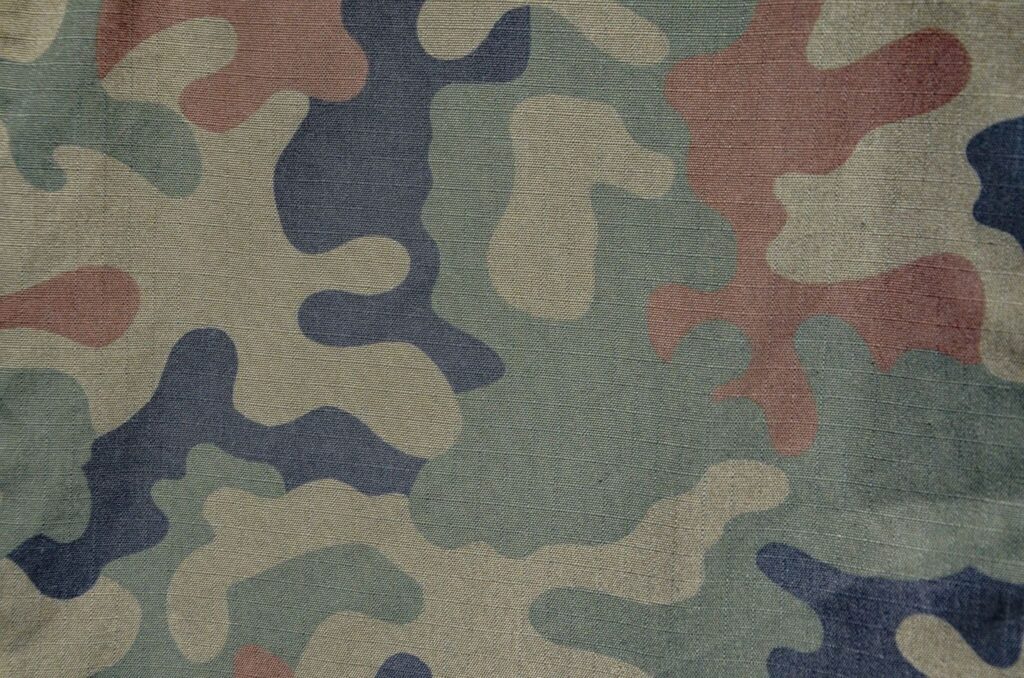
Woodland predates every digital pattern on this list. Adopted in 1981 as part of the Battle Dress Uniform, it’s a four-color, high-contrast pattern in green, brown, sand, and black, built with large disruptive shapes rather than pixels.
The military phased it out of front-line issue between 2005 and 2012 as the services moved to digital patterns, specifically: the Army to the Universal Camouflage Pattern and later OCP; the Marines to MARPAT; and the Air Force and Navy to their own digital uniforms.
Woodland didn’t disappear from use. It still shows up on body armor covers and MOPP suits awaiting replacement, and modernized Woodland variants remain standard for some special operations units.
Neutral and Solid Options: Coyote, Olive Drab, and Tan
Not every program calls for a printed pattern. Coyote, Olive Drab, and Tan are solid colors that pair naturally with camouflage components on the same product, work for gear that needs low visibility without active terrain-matching concealment, or match a branch’s or unit’s standard where a printed pattern isn’t specified.
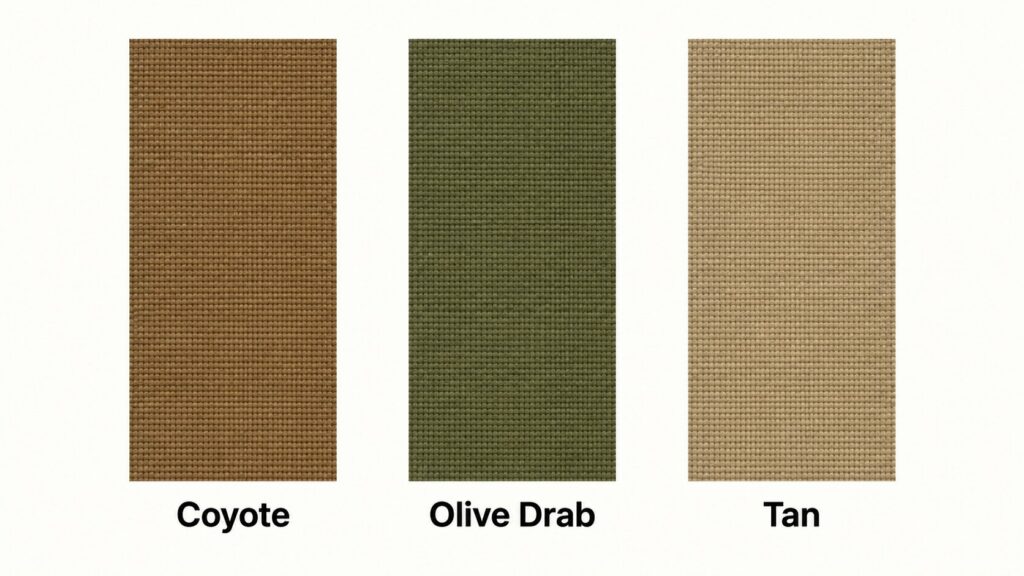
These three solids sit alongside our camouflage options as standard color choices, not as a fallback when a pattern isn’t available.
A holster, a webbing component, or a pouch finished in Coyote will pair with a MultiCam or OCP main body without visually competing with it, a detail worth specifying deliberately rather than defaulting to whichever camo print is already on hand.
It’s also the more practical call for hardware and trim pieces that would be expensive to pattern-match precisely across a small component, where a solid color reads as intentional and a partial pattern reads as a mistake.
How Fieldtex Sources and Sews Camouflage Fabrics
Once you know which pattern your program requires, the next step is getting the right fabric and turning it into gear that meets your specifications.
Fieldtex works with OEMs and procurement teams to source camouflage and neutral fabrics and sew them into custom products, with the flexibility to incorporate labeling, patches, identification panels, and other program-specific details.
Our military-grade sewing services give you a single manufacturing partner for everything from material sourcing and pattern matching to final construction.
Tell us which pattern or color your program requires, and our team will source the right fabric and build it into your custom-sewn product.
Request a quote, and we’ll turn it around within 48 hours.
FAQ: Camouflage Patterns
MultiCam is a multi-tonal pattern engineered to perform across varied terrain with a single design, while MARPAT uses pixelated, digital-style shapes in dedicated Woodland and Desert variants, each built for one specific environment. The two patterns come from different design philosophies: one flexible pattern versus two terrain-specific ones.
No. OCP is based on Scorpion W2, a pattern the Army’s own lab modified from an earlier joint Army-Crye design. It shares a common ancestor with MultiCam and looks similar at a glance, but it developed on a separate track and isn’t a direct copy or update of MultiCam.
Cost and licensing terms drove the decision. Crye Precision would have charged a licensing royalty for a MultiCam-based family of patterns, and when negotiations didn’t resolve, the Army selected Scorpion W2 instead, since it already owned the rights to that pattern outright.
Yes. Woodland was phased out of front-line uniform issue between 2005 and 2012, but it remains in use on body armor covers, MOPP suits, and modernized variants worn by some special operations units, and it’s still a valid spec for green, forested-environment applications.
Solid colors like Coyote, Olive Drab, and Tan make sense when a product needs low visibility without active terrain-matching concealment, or when it needs to match a program’s non-camouflage standard rather than a printed pattern.
Resources
- https://monocle.com/business/crye-precision-multicam-military-camouflage/
- https://www.military.com/feature/2025/10/29/it-time-marines-ditch-digis.html
- https://www.army.mil/article/130999/Army_statement_on_the_Operational_Camouflage_Uniform/
- https://taskandpurpose.com/news/army-cant-escape-camouflage-controversy/