
Medical wearables are no longer a niche category. From continuous glucose monitors mounted on flexible substrates to compression sleeves embedded with biosensors, the segment is expanding fast — and so are the manufacturing tolerances required to produce them reliably.
CNC fabric cutting has become a critical process for any contract manufacturer serious about medical-grade soft goods. When a sensor must align within a fraction of a millimeter to deliver accurate readings, the method used to cut the surrounding textile is not a secondary concern. It is a primary one.
The Intersection of Soft Goods and Medical Technology
Medical wearables span a wide range of form factors:
- Continuous glucose monitoring patches mounted on flexible substrates
- Cardiac rhythm monitors that use dry electrodes integrated into textile panels
- Rehabilitation orthoses with built-in compression and sensor zones
- Smart compression garments for post-surgical recovery and chronic condition management
- Wearable drug delivery systems that require precise fabric construction for consistent adhesion
What these products share is a dependence on precisely constructed textile components that interface directly with the human body. The medical industry’s shift toward soft, textile-based interfaces reflects a clinical reality — rigid housings reduce patient compliance. A device a patient won’t wear consistently is a device that doesn’t work.
Why Traditional Cutting Methods Fall Short
Flexible, well-fitted soft goods solve the compliance problem, but they introduce a different manufacturing challenge: textiles are far more difficult to cut with consistent precision than rigid materials. Traditional approaches carry significant limitations:
- Die-cutting is economical at high volume but requires expensive tooling changes for each design iteration and struggles with multi-layer composite constructions.
- Manual cutting introduces operator variability that no inspection protocol can fully eliminate; blade pressure, material handling, and fatigue all affect output.
- Neither method provides the process documentation that FDA requirements or ISO 13485 quality management frameworks demand.
For components that must meet regulatory standards, a more controlled process is required from the first cut to the last.
What Is CNC Fabric Cutting in the Medical Industry?
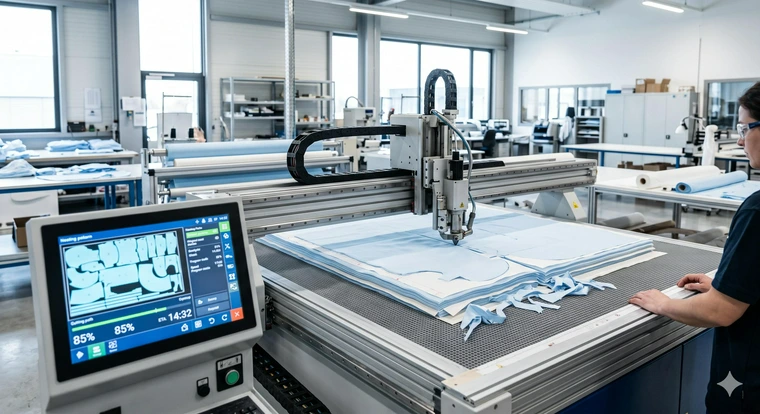
Computer Numerical Control (CNC) fabric cutting translates a digital CAD file directly into physical cuts, using software-driven motion control to guide a cutting head across a textile with sub-millimeter repeatability. The machine follows a defined toolpath — no interpretation, no drift, no fatigue. Every cut matches the digital model.
Knife vs. Laser: Choosing the Right CNC Tool for Medical Textiles
Two primary tool types are relevant for medical applications, and the choice depends on the fabric construction:
- Oscillating or rotary knife systems cut most woven and nonwoven fabrics cleanly without introducing heat, critical for thermoplastic laminates, moisture-wicking layers, and conductive knits where heat-affected zones could damage electronic thread pathways.
- CO₂ laser systems offer finer kerf widths and can cut and seal synthetic edges simultaneously, reducing finishing steps. They are not appropriate for conductive textiles or fabrics where thermal damage would compromise material performance.
The CNC Test: Validating Before Production
Before a program moves to full production, manufacturers run a CNC test — a prototype cut sequence used to validate that tolerances, edge quality, and material handling all perform within specification.
For medical applications, this step is not optional. It is the point at which process parameters are locked, documented, and made repeatable. Our prototype sewing services include exactly this validation stage, giving medical device OEMs a documented record of cut performance before production begins.
4 Key Benefits of CNC Precision in Medical Wearables
Unmatched Dimensional Accuracy
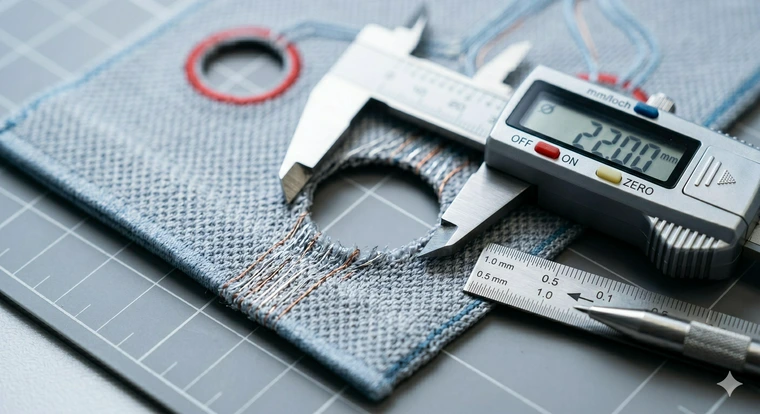
A wearable ECG monitor that positions dry electrodes 2mm off-center from the intended anatomical location will produce degraded signal quality. The textile carrier for those electrodes must be cut to exact dimensions, every time, across every unit in a production run. CNC achieves this through closed-loop positioning systems that hold positional accuracy to tolerances that manual methods cannot match at scale.
For body-mapped garments — where panel shapes are contoured to specific anatomical zones — CNC also eliminates the accumulated error that occurs when operators handle and reposition flexible materials between cuts.
Clean Edges and Material Integrity
Frayed edges on a medical textile are not just an aesthetic problem. The consequences are measurable:
- Loose fibers migrating under a sensor disrupt electrical contact and affect signal accuracy.
- On wound-contact garments, fiber migration presents a contamination risk that cannot be addressed after the fact.
- On laminated composites, a ragged edge compromises the bond line of any subsequent heat-sealing or ultrasonic welding operation.
CNC knife systems, properly configured for a given fabric construction, produce clean, consistent edge profiles. The edge quality is controlled and documented rather than dependent on blade sharpness and operator technique.
Complex Geometries Without Custom Tooling
Many medical wearable components require internal cutouts, non-linear panel edges, and asymmetric shapes that are not achievable with standard die tooling at a reasonable cost. Consider what a single production panel might need:
- Precisely placed apertures for skin ventilation
- Cutouts for electrode contact points at defined anatomical locations
- Curved seam allowances matched to thoracic or limb anatomy across multiple size grades
- Internal channels for sensor wire routing
CNC handles these geometries directly from the CAD file. Design changes require a software update, not a new die; a distinction that has a direct impact on the speed and cost of iterations during clinical development.
Repeatability for Regulatory Compliance
FDA-registered medical device manufacturing requires process documentation that demonstrates consistent output. CNC cutting provides a machine-generated record of each production run — toolpaths, cut counts, material lot numbers — that supports the traceability requirements of a quality management system structured around ISO 13485 principles.
We structure our medical soft goods manufacturing processes to provide exactly this traceability and documentation, giving device manufacturers the records they need to satisfy regulatory requirements at audit.
Advanced Materials: The Challenge of Cutting Medical Textiles
Medical textiles are not standard apparel fabrics. The materials that make wearable devices functional also make them difficult to cut without specialized process knowledge.
Conductive and E-Textile Fabrics
Conductive knits and e-textiles use silver-coated fibers or interwoven metallic threads to transmit biosignals. A laser system that chars the edge of a standard polyester knit will also damage the conductive pathway in a smart fabric, potentially creating an open circuit that only surfaces during functional testing.
Knife-cut systems are generally preferred for these materials, with blade geometry and cutting speed selected specifically for the fabric construction.
Multi-Layer Composite Constructions
A typical medical wearable panel might combine:
- A moisture-wicking inner layer for skin comfort and perspiration management
- A foam or gel padding layer for sensor coupling or pressure distribution
- A durable outer shell for structural integrity and abrasion resistance
Each layer has a different density, thickness, and cut resistance. CNC systems with variable cutting force and depth control can process these composites in a single pass without delamination, provided the program parameters are correctly set for each layer combination.
Material Cost and Nesting Efficiency
Medical-grade antimicrobial fabrics, conductive textiles, and biocompatible laminates can cost multiples of standard technical fabrics. CNC nesting software optimizes panel placement across the fabric roll to minimize waste. A meaningful cost control measure when raw material represents the largest line item in unit cost.
The CNC Test: Prototyping Medical Wearable Components for Safety
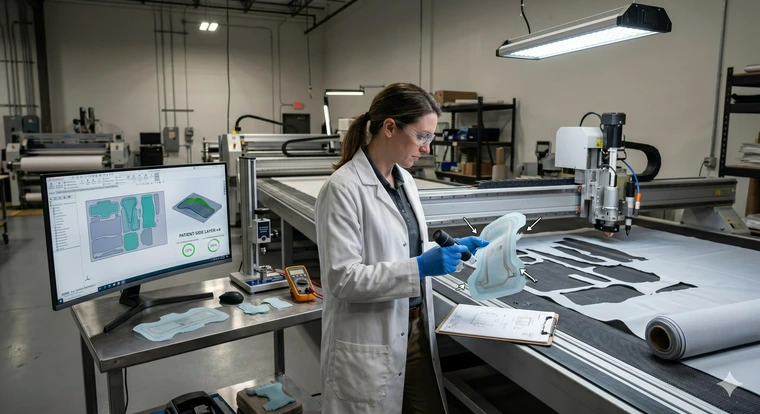
The CNC test phase is where tolerances get validated against real materials, not just CAD geometry. A panel that cuts cleanly in simulation may behave differently when actual fabric is fed through; stretch, weave density, coating adhesion, and layer registration all affect cut quality in ways that only physical testing can reveal.
What the Prototyping Stage Accomplishes
- Process validation: Cutting parameters are tested against the actual production material, not a proxy.
- Documentation generation: The prototype run produces the process records that support design freeze and regulatory submission.
- Size grade verification: Each graded pattern size is tested to confirm that dimensional accuracy holds across the full size range, not just the base size.
- Rapid iteration: Toolpath adjustments, blade type changes, or speed modifications can be made quickly based on test results, compressing the development timeline without compromising the final process record.
For medical device development programs, this stage is not about slowing the program down. It is about ensuring that the production process is locked correctly before volume commitments are made.
Future Trends: Automated Medical Textile Manufacturing
The growth of remote patient monitoring is placing new demands on medical textile manufacturing. Wearable devices for continuous vital sign monitoring, ambulatory cardiac telemetry, and post-surgical recovery tracking are moving from clinical pilots to production programs. Volumes are increasing, and so is the complexity of the textile components involved.
AI-Assisted Nesting and Material Efficiency
As AI-assisted nesting software matures, material utilization rates continue to improve, reducing both cost and waste across large production runs. For manufacturers supplying medical device OEMs, this directly affects the economics of domestic production, where labor and material costs are higher than offshore alternatives. Precision nesting closes that gap in a way that manual layout cannot.

Sustainability as a Procurement Criterion
Sustainability is becoming a procurement criterion in the medical sector as device manufacturers face pressure to reduce the environmental footprint of their supply chains. CNC nesting reduces fabric waste structurally; not through post-production recycling, but by using less material per unit in the first place. For expensive medical-grade textiles, that reduction carries both environmental and financial value.
The trajectory is clear: as smart garment technology matures and remote monitoring programs scale, automated precision cutting will be a baseline capability for any contract manufacturer operating in the medical soft goods space.
CNC Precision Is a Patient Safety Decision
A production run of medical wearables is only as reliable as the least controlled step in the manufacturing process. For soft goods components, CNC fabric cutting eliminates the variability that manual and die-cut methods introduce, and it does so in a way that generates the process documentation that FDA-registered manufacturing requires.
For medical device OEMs evaluating contract manufacturers, the question is not whether CNC cutting is worth the investment. It is whether the manufacturer you are working with has the process knowledge and equipment configuration to apply it correctly to your specific materials and tolerances. That requires experience with medical textiles — not just access to a CNC machine.
Filedtex Gives You That
We have been producing precision-sewn soft goods at our Rochester, New York facility since 1973. Our processes are structured to support customers operating within ISO 13485 quality management frameworks, and our FDA-registered facility provides the documentation infrastructure that medical device programs require.
If you are developing a medical wearable and need a manufacturing partner who can take your design from CNC test to full production run, request a quote, and our engineering team will respond within 48 hours.