
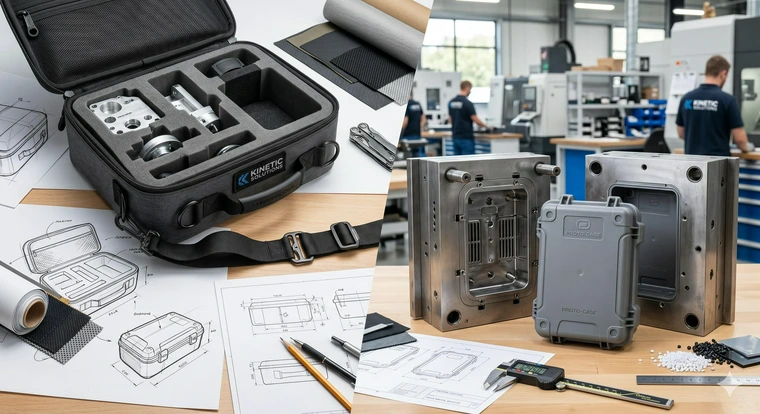
Choosing between soft-sided cases and injection molding is one of those decisions that looks simple on the surface until you’re six months into a product launch and realize the manufacturing method is fighting your design at every turn.
For engineers, product designers, and procurement leads, this choice touches cost, lead time, production volume, design flexibility, and long-term performance. Get it wrong, and you’re either paying for tooling you can’t amortize or shipping a product that doesn’t hold up in the field.
This article breaks down both methods, highlights key differences, and gives you a practical framework for making the right call.
What Is Injection Molding?
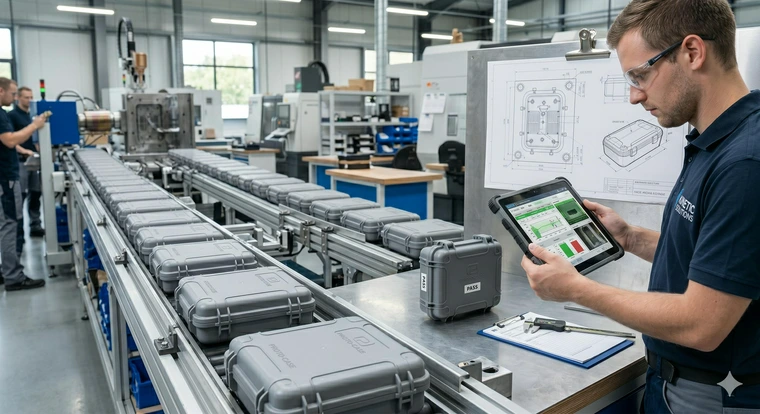
Injection molding is a manufacturing process where molten plastic is injected into a precisely machined mold under high pressure. Once cooled, the mold opens and ejects a solid, rigid part with consistent geometry across every unit. The process is highly repeatable, which is exactly why it dominates industries that need identical parts at scale.
The trade-off is upfront cost. Tooling a mold can run from tens of thousands to hundreds of thousands of dollars, depending on part complexity, material, and tolerances.
That investment only makes economic sense when production volume is high enough to spread the cost per unit down to an acceptable level. For low-to-medium volume runs, custom injection molding can be prohibitively expensive before you’ve shipped a single unit.
What Are Soft-Sided Cases?
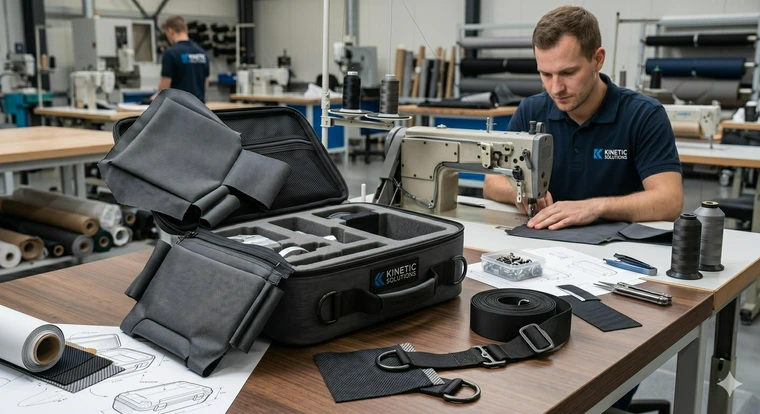
Soft-sided cases are constructed from sewn textile materials, typically nylon, polyester, or canvas combined with foam padding, webbing, reinforced stress points, and hardware like zippers, buckles, and D-rings. Unlike rigid enclosures, the structure comes from layered material selection and construction technique rather than a fixed mold geometry.
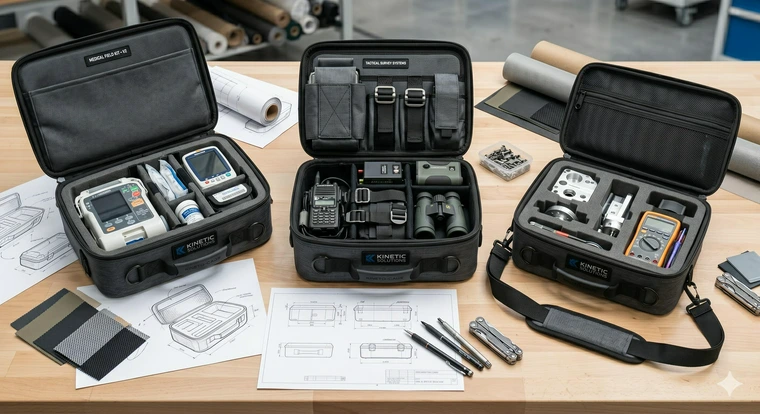
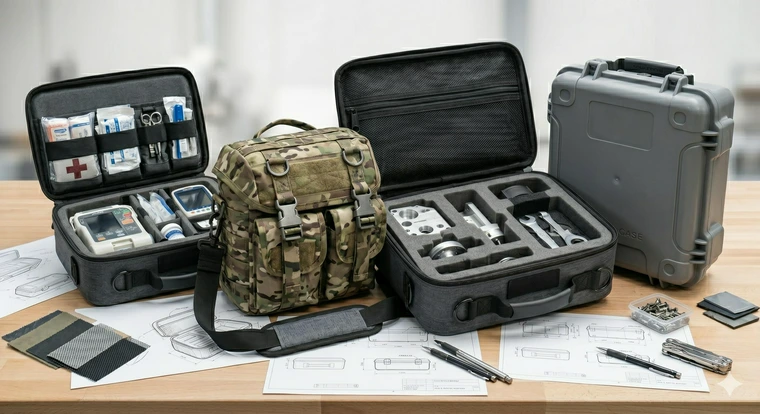
That construction approach opens up a wide range of design capabilities. Custom soft-sided carrying cases can be built with compartmentalized interiors, integrated padding cut to specific tool or device profiles, modular layouts, and adjustable internal configurations that a molded shell simply cannot replicate without significant redesign cost. The case adapts to what goes inside it, not the other way around.
Soft-sided cases are also lightweight relative to comparable rigid enclosures, and they absorb and distribute impact rather than concentrating it at stress points the way rigid plastics can.
Key Differences: Soft-Sided Cases vs. Injection Molding
| Factor | Injection Molding | Soft-Sided Cases |
| Material | Rigid plastics | Fabrics, foam, webbing |
| Tooling Cost | High upfront | Low to moderate |
| Production Volume | Best for large runs | Flexible for low–mid volume |
| Design Flexibility | Limited after tooling | Highly customizable |
| Weight | Heavier | Lightweight |
| Impact Handling | Can crack under stress | Absorbs impact |
When Injection Molding Makes More Sense
Injection molding is the right call when your product demands a rigid, uniform structure and your production volumes justify the tooling investment. It excels in situations where:
- You’re producing thousands to millions of identical units
- The application requires a hard, rigid structure that holds a fixed shape under load
- Tight dimensional tolerances are non-negotiable – every part must be identical
- Manufacturing efficiency at scale is the primary cost driver
The cost structure follows a predictable pattern: high upfront tooling expense, followed by a relatively low cost per unit once the mold is amortized. That math works in your favor at volume. At low or mid-level production runs, the per-unit cost can remain high enough to make the process economically impractical compared to alternatives.
Injection molding is the better choice when production volume justifies the tooling investment — and when the geometry of your product genuinely requires a rigid enclosure.
When Soft-Sided Cases Are the Better Choice
Soft-sided cases are the stronger option when your product needs flexibility, cushioned protection, or an interior layout that can’t be defined by a fixed mold. They make practical sense when:
- You’re working with low to medium production volumes, where tooling costs would be disproportionate
- The contents require cushioning, padding, or vibration isolation rather than rigid containment
- Custom interior layouts are required — medical kits, military field gear, precision instruments, or tool sets with varied dimensions
- Weight is a constraint, particularly for carried or wearable applications
- Your design is still evolving, and you need to make changes between production runs without scrapping expensive tooling
We design and manufacture custom soft-sided cases for medical, military, and industrial applications where flexibility, protection, and fast design changes are essential. That last point — design iteration — is where soft goods manufacturing offers a structural advantage that’s easy to underestimate at the start of a program.
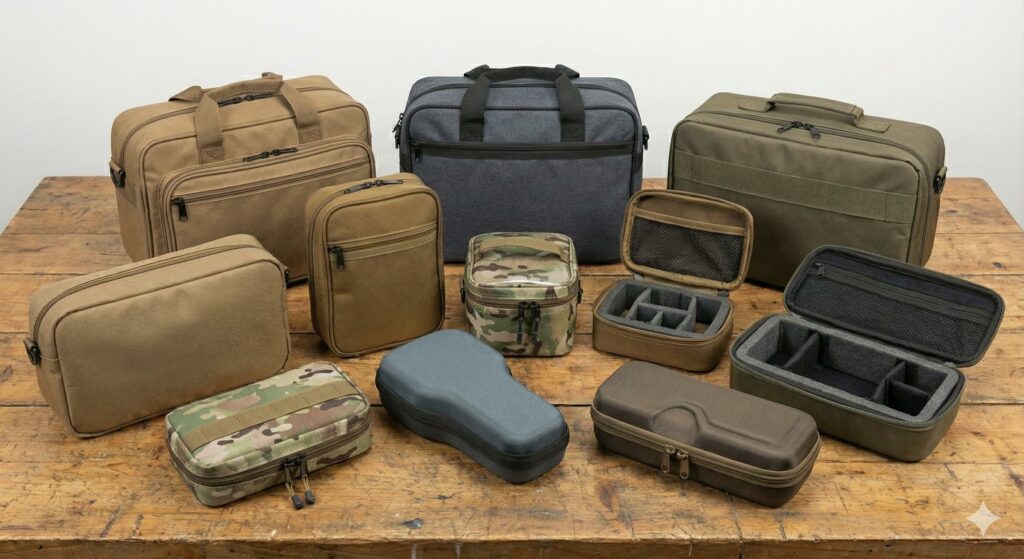
Source: https://www.fieldtexcases.com/custom-soft-sided-cases.html
Engineers and product teams who have worked with both methods consistently note that soft-sided cases are lighter, handle impact by absorbing and distributing force rather than concentrating it, and adapt to varied contents far more readily than fixed-shell cases. When the product or its contents are likely to change over the product’s lifecycle, that adaptability has real dollar value.
Cost Comparison: Tooling vs. Production Flexibility
Cost comparisons between soft-sided cases and custom injection molding are most useful when you look at the full picture across a production run — not just per-unit cost in isolation.
Injection molding:
- High initial tooling cost — molds can run from $10,000 to well over $100,000, depending on part complexity and material requirements
- Low cost per unit at scale once tooling is amortized
- Any design change after the mold is cut typically requires new tooling or expensive mold modification
Soft-sided cases:
- Low startup cost — pattern development and sampling are a fraction of injection mold tooling
- Per-unit costs are somewhat higher at very large volumes compared to mature injection-molded production
- No mold investment means design changes between runs are operationally straightforward and cost-effective
For programs where volumes are uncertain, where design changes are expected, or where the product needs to go to market quickly, the absence of a large tooling commitment is a meaningful financial advantage.
Design for Manufacturability Considerations
Design for manufacturability looks quite different depending on which method you’re working with.
Injection molding imposes hard design constraints early in the process. Uniform wall thickness is critical to prevent warping and sink marks during cooling. Sharp internal corners create stress concentration points and can cause part failure. Draft angles must be built into vertical surfaces so the part releases cleanly from the mold.
Complex undercuts or internal features that can’t be addressed with side actions add cost and complexity. For designers not experienced with injection molding, these constraints can require significant redesign, and if the mold has already been cut, that redesign is expensive.
Soft goods manufacturing is more forgiving of iterative design. Patterns can be adjusted between sampling rounds. Material substitutions, such as a heavier denier fabric, a different foam density, or a repositioned zipper, can be tested without scrapping tooling.
Geometry limitations are far less rigid: curved profiles, asymmetric layouts, and multi-pocket configurations that would be prohibitively complex in a molded part are routine in cut-and-sew manufacturing.
That design flexibility doesn’t mean soft goods are without discipline. Material selection, seam construction, stress point reinforcement, and hardware specification all require careful engineering, particularly for military or medical applications where performance requirements are defined and documented. But the cost of getting it wrong during development is lower, and the path to correction is shorter.
Real-World Use Cases
The clearest way to understand which method fits a given application is to look at where each one actually performs.
Injection molding is well-suited for:
- Consumer electronics housings and shells where aesthetic consistency across millions of units is required
- Rigid equipment enclosures where dimensional stability under load is critical
- Standardized hard-shell containers produced at high volume with infrequent design changes
Soft-sided cases are the practical choice for:
- Medical kits and EMS bags where the internal layout must conform to specific device or instrument sets
- Military gear bags, tactical pouches, and field equipment cases requiring MOLLE compatibility, ballistic materials, or custom load-bearing configurations
- Protective transport cases for instruments, tools, or electronics where the padding profile matters as much as outer protection
- Industrial field kits where operators carry varied tools, and the case must be organized for specific workflows
Our military soft goods and medical soft goods capabilities reflect exactly these demands – applications where a fixed rigid enclosure would fail to meet operational requirements, and where the ability to design to a specific use case is the whole point.
How to Choose the Right Manufacturing Method
The decision comes down to a few concrete variables:
- High volume + rigid structure + design stability: Injection molding is likely the right answer. The tooling cost is justifiable, and the consistency it produces at scale is a genuine advantage.
- Custom layout + flexible protection + low-to-mid volume + design iteration: Soft-sided cases are the stronger choice. Lower startup cost, faster design cycles, and a construction method that can accommodate complex interior requirements without expensive tooling changes.
- Weight or portability is a constraint: Soft goods win by a significant margin in most carried-load applications.
- Timeline is compressed: Prototype development for soft-sided cases moves faster than mold tooling. It’s a meaningful advantage when programs have fixed delivery dates.
Final Thoughts
Neither method is inherently superior. Injection molding is an excellent technology for the problems it was designed to solve – rigid, high-volume, dimensionally consistent parts.
Soft-sided cases solve a different set of problems: adaptable protection, lightweight construction, complex interior organization, and cost-effective production at scales where tooling investment doesn’t make sense.
The practical question is whether your product’s requirements align with what each method actually delivers.
Volume, geometry, design maturity, weight constraints, and application environment all factor into that assessment. Matching the manufacturing method to those requirements rather than defaulting to one approach is what design for manufacturability actually means in practice.
If your application points toward a soft-sided solution, we can help you move from concept to production. Request a quote or reach out to discuss your project requirements. Our engineering team reviews every inquiry and responds within 48 hours.