
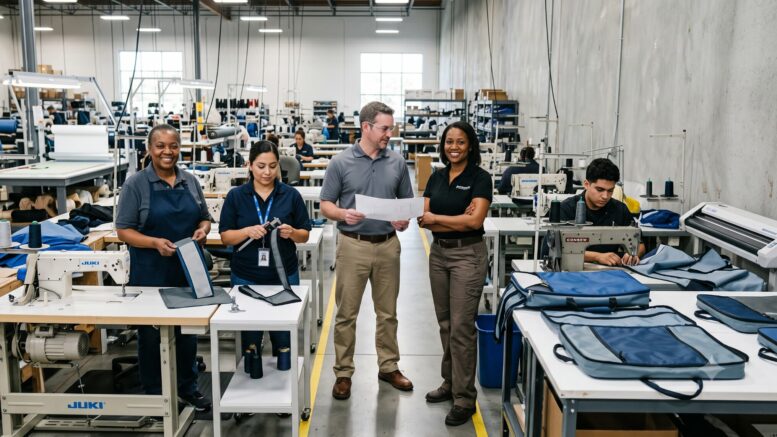
Selecting a partner for contract medical sewing for OEMs involves far more than finding a shop with available machines and a competitive unit price.
At Fieldtex Cases, we work with medical device OEMs, diagnostic equipment manufacturers, and healthcare product companies to produce sewn soft goods cases, covers, straps, harnesses, wearable holders, and field-use bags with the traceability, inspection documentation, and process controls their programs require.
This article covers:
- How to evaluate a sewing partner’s real capabilities
- What quality documentation your program may require
- When sewing is the right production process — and when it is not
- What questions to ask before awarding a contract
What Medical Device OEMs Should Expect From a Sewing Partner
A contract sewing partner worth qualifying is not simply a cut-and-sew vendor that executes patterns. For medical OEM work, the partner needs to read and interpret technical drawings, understand material specifications, apply DFM thinking to construction, and produce to documented quality requirements. Consistently, across lots and over time.
The term medical textile manufacturer is broad. It can mean anything from implantable fiber manufacturers operating under strict biocompatibility standards to contractors producing portable device cases, EMS bags, and diagnostic equipment covers.
The regulatory requirements that apply depend entirely on the product’s intended use, whether it is considered part of a finished medical device, and what the OEM’s quality agreement specifies.
Not every sewn product used in a healthcare setting is a regulated medical device, but many are components of one, and that distinction drives documentation expectations.
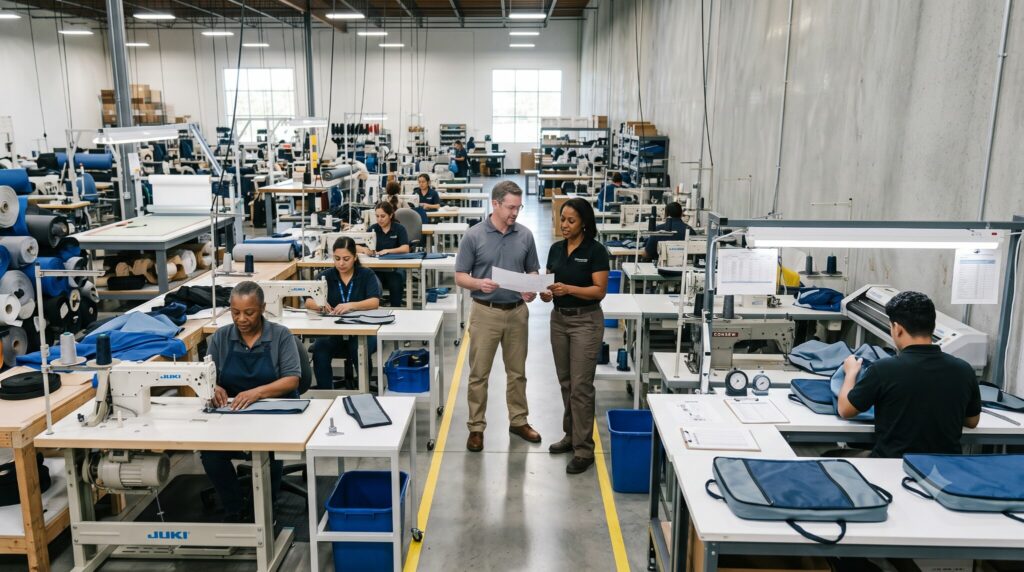
Sewn medical soft goods we commonly support include:
- Portable medical device cases and transport cases
- Diagnostic equipment covers and protective enclosures
- Wearable device holders and body-worn components
- Straps, harnesses, and load-bearing assembly systems
- EMS bags, trauma bags, and field-use medical kits
- Organizer inserts, soft packs, and compartmented pouches
- Covers for clinical and field equipment
As the eCFR’s Quality Management System Regulation notes, QMSR requirements apply to finished devices, while component manufacturers are encouraged to consider applicable provisions where appropriate. In practice, that means OEM customers typically flow down relevant quality expectations through supplier qualification controls and quality agreements.
Start With Application Fit: Is Sewing the Right Process?
A reliable OEM partner should be direct about whether sewing is appropriate for the application before quoting production. Sewing is well-suited to flexible, padded, wearable, and protective soft goods where the seam carries structural or organizational load, but does not need to create a sterile, liquid-tight, or airtight barrier.
When fluid containment or seal integrity is the primary performance requirement, welding or RF sealing is typically the better process.
| Requirement | Sewing May Fit When | Welding or Sealing May Be Better When |
|---|---|---|
| Flexibility | Product needs movement, comfort, or soft structure | The product must maintain a sealed chamber |
| Durability | Reinforced seams, bartacks, and webbing carry stress loads | Seam must resist liquid or air leakage under pressure |
| Cleaning | Materials tolerate wipe-down or surface cleaning protocols | The product needs barrier integrity after aggressive cleaning |
| Patient or user comfort | Wearable component must avoid rigid edges or hard surfaces | Direct fluid containment is required |
| Prototype iteration | Fit, access, strap placement, or padding need iterative testing | Seal validation is the primary requirement |
A partner who quotes immediately without asking these questions is not equipped for medical OEM work. Process selection should precede pricing, not follow it.
Quality Systems Matter More Than Machine Count
Industrial sewing equipment is a baseline. What separates a production sewing shop from a qualified OEM partner is whether it can produce the same product to the same specification across every lot, and prove it with records.
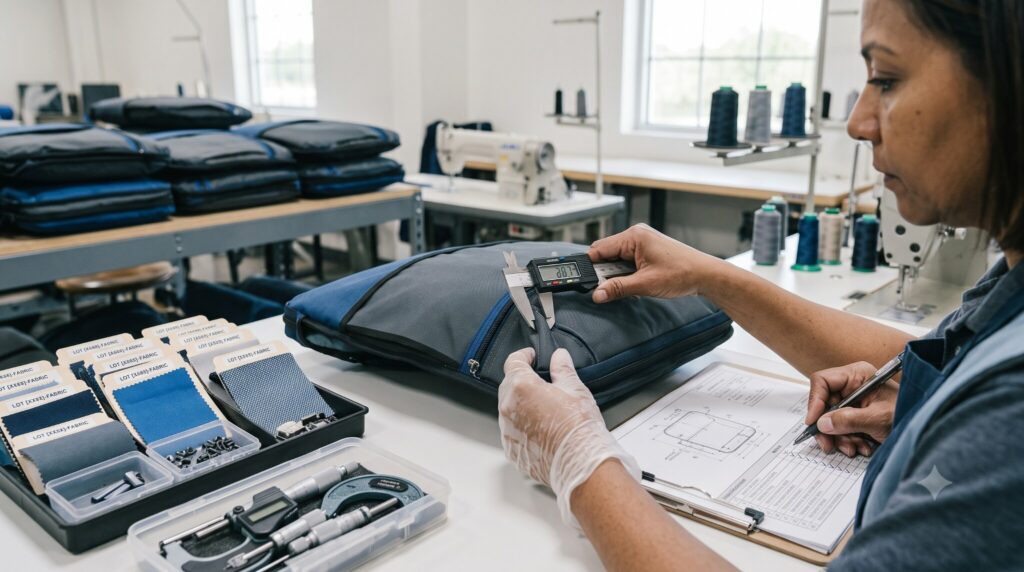
The quality system infrastructure matters: documented processes, incoming material controls, operator training, in-process inspection checkpoints, nonconformance handling, lot traceability, change control procedures, and calibration records, where applicable. These are the mechanisms that make production repeatable and give your quality team something to audit.
FDA’s Quality Management System Regulation, which became effective February 2, 2026, incorporates ISO 13485:2016 by reference as the framework for medical device quality management. ISO 13485 is the internationally recognized QMS standard for medical device design and manufacturing, emphasizing customer and regulatory requirements, risk management, and process validation.
What This Means for Sewn Components
Even when a sewing contractor is not the legal manufacturer of the finished medical device, OEM customers routinely flow down ISO 13485-aligned documentation expectations through supplier qualification programs, purchasing controls, and formal quality agreements.
Your sewing partner does not need to be the finished device manufacturer, but they need to operate with systems that can satisfy your quality agreement requirements and survive a supplier audit.
We support medical device manufacturers with ISO 13485-aligned sewing services and the documentation required to meet their regulatory obligations. Our processes are structured to support customers operating within ISO 13485 quality management frameworks, and we provide the traceability, documentation, and process controls that medical OEMs need to satisfy those requirements.
Documentation to Ask for Before Production
Before production begins, request documentation that demonstrates the supplier’s ability to control the process. At minimum, ask for:
- Bill of materials and approved material list
- Lot traceability records for fabric, foam, webbing, thread, and hardware
- Incoming inspection records
- First article inspection report
- In-process inspection records
- Final inspection report
- Calibration records for relevant equipment
- SOPs or traveler documentation for each operation
- Deviation and nonconformance process
- Change control procedure
- Testing support documentation, such as tensile strength or fit test data, where required
We support all of the above for applicable programs: lot traceability, calibration records, first article inspections, in-process QC checkpoints, travelers, and testing support are part of how we run production for medical OEM customers.
What a Good OEM Sewing Partner Should Be Able to Make
Capability breadth matters when your program spans multiple product types. The ability to develop, prototype, and produce a range of sewn medical soft goods under one quality system simplifies supplier qualification and reduces the coordination burden on your engineering and procurement teams.
Medical Device Carrying Cases and Covers
Protective cases and device covers for portable or diagnostic equipment demand dimensional consistency across production runs. Fit tolerance, internal padding, hardware attachment, cleanability, and clear labeling placement are construction decisions that affect every unit.
We produce custom soft-sided cases built to your drawings, with inspection documentation to match.
Wearable Holders, Straps, and Harnesses
Body-worn medical equipment creates specific construction requirements: load distribution, adjustability, reinforced attachment points, comfortable edge finishing, and wear durability. We apply bartack reinforcement, select thread weights appropriate for the expected load, and work with your team on fit testing before production scales.
EMS Bags, Trauma Bags, and Organizer Inserts
Field-use medical bags must perform under rough handling. Compartment layout, fast-access closures, moisture-resistant liners, reinforced carry handles, and high-visibility interior organization are all construction variables that affect clinical performance.
Our medical soft goods production spans the full range from simple inserts to multi-compartment field kits.
Custom Soft Goods for Portable Equipment
Many medical OEMs manufacture portable diagnostic, monitoring, or therapeutic devices that ship with or require a carrying system. Bags, cases, backpacks, shoulder straps, and equipment covers all fall within our production scope. If you are building a device that needs a sewn accessory, whether it is included in the finished device package or sold separately, we can develop it alongside your hardware program.
Red Flags When Choosing a Contract Medical Sewing Partner
Most of the risk in a bad supplier selection becomes visible only after production has started. These warning signs are worth catching during qualification:
- The supplier cannot clearly explain its inspection process or what gets recorded
- Compliance language is vague — “medical grade” or “ISO compliant” without supporting documentation
- Lot traceability is not supported or is handled informally
- Prototypes and production builds use different materials or methods without a documented transition
- Material substitutions are made without a formal approval process
- There is no documented nonconformance or corrective action process
- ISO 13485, FDA registration, or “medical grade” claims cannot be verified with current documentation
- The team cannot discuss cleaning protocols, chemical exposure, or the product’s use environment
- A quote is provided without asking about intended use, tolerances, load requirements, or quality obligations
- Sample capacity does not translate to production volume
Buyer Checklist: Questions to Ask Before Awarding the Program
These questions should go into every RFQ or supplier qualification conversation for contract sewing services for medical OEMs:
- Have you manufactured similar sewn medical soft goods before, and can you provide product examples?
- Can you support contract sewing services for medical OEMs from prototype through production under one quality system?
- What quality management system do you operate under?
- Are you FDA registered, ISO 9001 certified, or ISO 13485 certified, and can you provide current documentation?
- What ISO 13485-aligned documentation can you generate if required by our quality agreement?
- How do you control materials — fabric, thread, foam, webbing, and hardware — by lot number?
- Do you provide first article inspections and in-process inspection records as a standard deliverable?
- How do you handle engineering changes or approved material substitutions?
- Can you support design for manufacturability review during the prototype phase?
- What sewing, cutting, reinforcement, and assembly capabilities do you operate in-house?
- What production volumes can you support, and what is your lead time at those volumes?
- What information do you need from us to quote accurately: drawings, BOM, samples, or quality requirements?
How Fieldtex Supports Medical OEM Sewing Programs
Fieldtex Cases is a U.S.-based contract sewing manufacturer operating out of an 86,000 sq ft facility in Rochester, New York. We are FDA-registered and have supported medical, defense, and industrial soft goods programs for more than 50 years. Our 125+ skilled operators produce from prototype through full production runs without minimum order requirements.
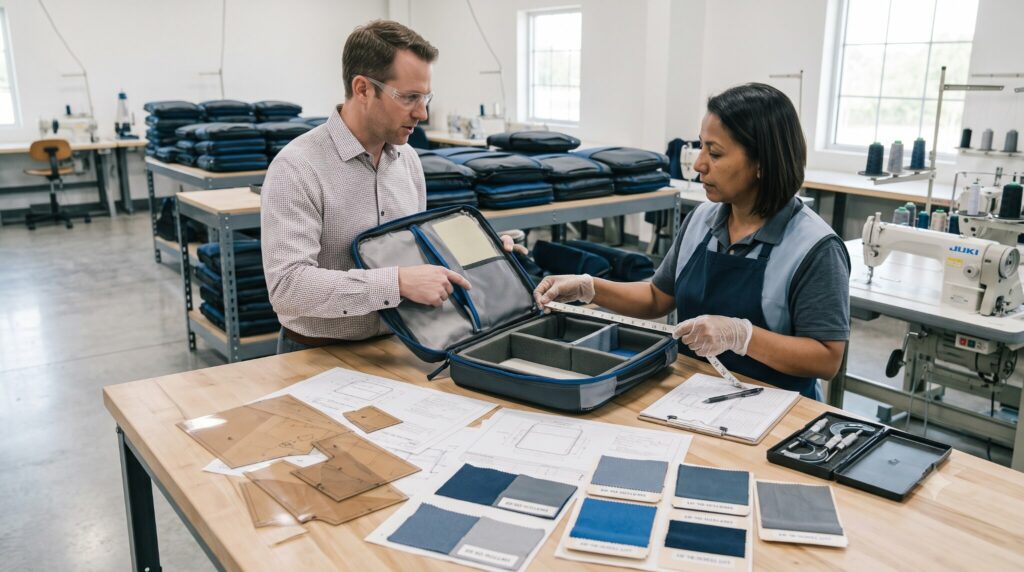
For medical OEM customers, we bring full in-house capability: soft goods design and engineering, CAD patterning, cutting, sewing, assembly, and quality control under one roof.
| Our processes are structured to support customers operating within ISO 13485 quality management frameworks, and we provide the documentation controls that medical device OEMs need to satisfy their supplier qualification requirements. |
Explore our medical sewing services or our prototype and sampling capabilities for more details on what we can support.
Send us your drawings, sample, BOM, target volume, and documentation requirements. We will assess manufacturability, material fit, quality expectations, and production feasibility, and get you a quote within 48 hours.
FAQ: Contract Medical Sewing for OEMs
Contract medical sewing for OEMs is outsourced sewing and soft goods manufacturing performed for medical device companies, diagnostic equipment manufacturers, and healthcare product brands. The scope typically includes portable device cases, diagnostic covers, protective straps, wearable holders, harnesses, field-use bags, organizer inserts, and custom pouches.
No. Whether ISO 13485-level controls apply depends on whether the sewn item is part of a finished medical device, how it affects device performance or patient safety, and what the OEM’s own quality system requires. OEM customers, however, may still require ISO 13485-aligned documentation from suppliers through quality agreements, regardless of whether the component itself is regulated.
At minimum: a bill of materials, material traceability records, incoming inspection documentation, first article inspection reports, in-process inspection records, final inspection reports, calibration records for relevant equipment, SOPs or traveler documentation, a nonconformance and corrective action process, a change control procedure, and testing support documentation where required by your quality agreement.
Yes — and a strong partner should. We support CAD patterning, material selection, stitch planning, load-point reinforcement design, prototype builds, fit checks, and DFM improvements before production begins. Catching construction issues at the prototype stage is significantly less costly than correcting them after tooling and production runs are underway. See our prototype sewing services for more.
Sources:
1. “Federal Register :: Request Access.” Unblock.Federalregister.Gov, https://www.ecfr.gov/current/title-21/chapter-I/subchapter-H/part-820. Accessed 16 July 2026.
2. Center. “Quality Management System Regulation.” U.S. Food and Drug Administration, 2026, https://www.fda.gov/medical-devices/postmarket-requirements-devices/quality-management-system-regulation-qmsr. Accessed 16 July 2026.