
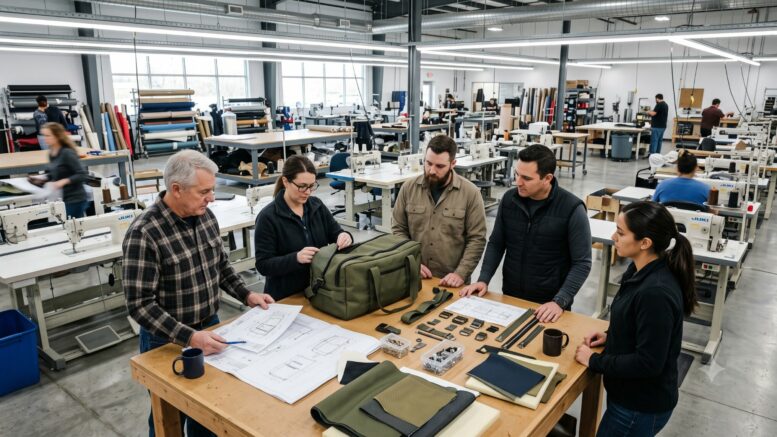
Hitting a target unit cost in custom bag manufacturing is rarely a simple negotiation. The real question is whether the cost reduction holds up once the product is in the field.
A bag that comes in under budget but fails at a seam, collapses under load, or requires rework after delivery is not cheaper; it is more expensive when the full picture is accounted for.
The most reliable way to reduce manufacturing cost is to engineer it out of the design. That means examining how the product is cut, sewn, assembled, and inspected, and identifying where complexity, material choices, or construction decisions add cost without improving performance.
As a custom case manufacturer and contract sewing partner, we help customers review designs for manufacturability, durability, and repeatable production before a single panel is cut.
What follows is a practical breakdown of where costs originate and how to reduce them without weakening the product.
Where Unit Cost Comes From in Custom Bag Manufacturing
Unit cost is not a single number. It is the sum of several interdependent variables. Two bags that look nearly identical in a rendering can quote very differently depending on how they are built. Understanding each cost driver is the first step toward managing them.
| Cost Driver | What It Includes | Why It Matters |
|---|---|---|
| Materials | Fabric, foam, mesh, lining, webbing, thread | Impacts durability, yield, and sourcing stability |
| Labor | Cutting, sewing, binding, finishing, assembly | Complex designs take more minutes per unit |
| Components | Buckles, zippers, hook-and-loop, snaps, labels | Custom parts add cost and lead time |
| Quality | Inspection, rework, testing, documentation | Poor quality creates hidden downstream cost |
| Logistics | Packaging, storage, shipping | Bulky designs may increase landed cost |
Every line on that table is a lever. Pull the wrong one, and you trade a short-term price reduction for a longer-term performance problem.
Start With Design for Manufacturability
Design for manufacturability — DFM — means building the product so it can be cut, sewn, assembled, and inspected efficiently and consistently at scale.
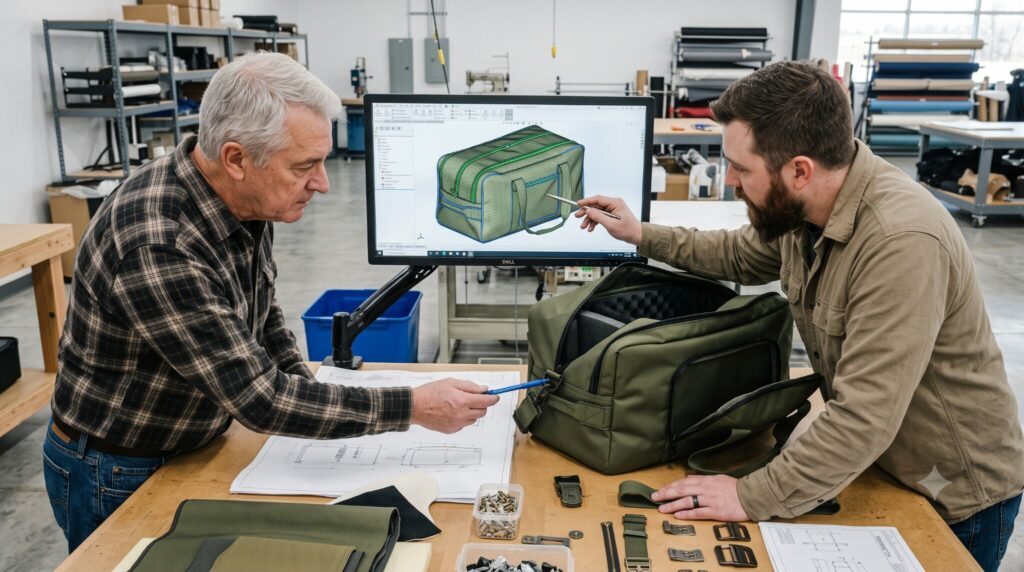
A bag that looks clean in a CAD rendering may still carry significant hidden labor if it includes tight curves, multiple unnecessary layers, seams that operators cannot easily reach, non-standard hardware, or binding paths that require multiple passes.
DFM does not mean cheapening a product. It means removing complexity that does not improve how the product protects, handles, loads, or allows access.
Simplify the Build Without Removing Function
Several construction decisions commonly add cost without improving field performance:
- Internal pockets that duplicate function or are rarely used in the application
- Multiple unique panels where shared or mirrored panels would perform identically
- Decorative topstitching that does not reinforce load-bearing seams
- Custom pull tabs or zipper pulls where standard alternatives meet the same specification
- Closure systems that duplicate each other unnecessarily
- Stitch paths that require repositioning the assembly mid-operation
Each of these adds minutes per unit. At any meaningful volume, minutes become a high cost.
Design Around the Production Process
Cost drops when the design fits the realities of how the product is actually built. Before we create patterns, we review load points, wear areas, access requirements, and how operators will handle each assembly step.
A seam placed one inch in the wrong direction can add a repositioning step that multiplies across thousands of units. Getting this right at the design stage costs far less than correcting it after sampling.
Choose Materials by Performance Need, Not Habit
Material selection is one of the most consequential decisions in custom bag manufacturing, and it is often made on habit rather than analysis.
Buyers who spec 1,000-denier Cordura for a low-abrasion indoor application are over-engineering and overspending. Buyers who spec a light vinyl for an outdoor industrial enclosure are under-engineering and creating future failure risk.
The decision should be driven by use case, load, wear pattern, cleaning requirements, compliance obligations, and expected service life. Key material decisions include:
- Exterior fabric: Cordura, ballistic nylon, vinyl, canvas, and coated fabrics each carry different price points and performance profiles. Match the material to the environment.
- Lining: Premium linings add cost; use them only where abrasion resistance, cleanability, or aesthetics are a documented requirement.
- Foam: Density and thickness should reflect actual impact protection needs — not a general assumption that more foam is better.
- Webbing: Align width, weave construction, and tensile rating to the actual load the strap or handle must bear.
- Thread: Choose thread based on seam load, abrasion exposure, UV resistance, and environmental conditions. Bonded nylon thread performs differently from polyester in moisture-exposed applications.
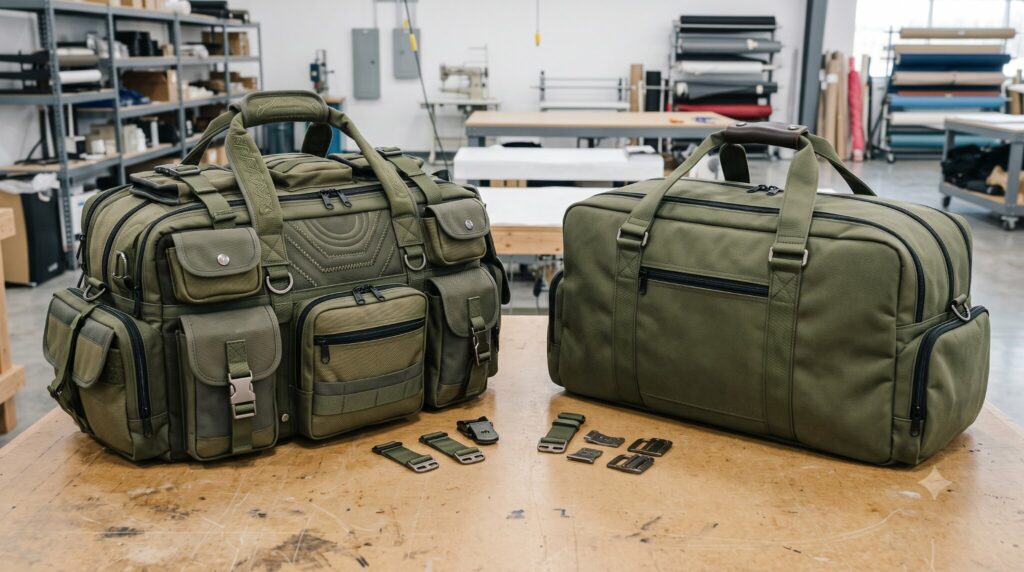
- Hardware: Use standard buckle families, zipper sizes, and snap configurations wherever they meet functional requirements.
Over-engineering wastes material budget. Under-engineering creates returns, field failures, and redesign work. Neither is the right outcome.
Improve Material Yield Through Smarter Patterning
Fabric waste can become a meaningful cost driver, particularly in products with complex shapes or mixed-width materials.
In cut-and-sew manufacturing, the efficiency of the cutting layout (how panels nest against each other on a roll of fabric) directly affects how much material is consumed per unit.
Decisions that improve yield include:
- CAD pattern development that allows efficient nesting before any material is cut
- Standardized panel shapes that repeat across the product, reducing unique cut files
- Designing parts to fit available roll widths rather than requiring special-order fabric
- Minimizing left/right part confusion that leads to mislaid cuts and scrap
- Avoiding material changes mid-product that create separate cutting setups
- Reducing the number of oddly shaped one-off pieces that leave difficult-to-use remnants
For cases, covers, straps, and backpacks specifically, grain direction and panel orientation matter — both for appearance and for load-bearing performance. Poor nesting decisions can waste 15–25% of material per roll in complex products. That waste has a direct unit cost impact at any volume.
Reduce Labor Minutes Without Weakening the Product
Labor time is among the largest cost drivers in sewn goods. Every additional pocket, zipper, binding pass, bartack, label placement, foam insert, and hardware attachment adds operator time.
The question is not whether a feature adds time — all features do — but whether the time it adds is justified by the function it delivers.
Remove Nonessential Features
Common examples in OEM case manufacturing where features add cost without proportional functional return:
- Multiple internal dividers in a case that holds one piece of equipment
- Redundant closure systems where a single closure meets the security requirement
- Decorative topstitching on panels that carry no load and face no abrasion
- Three separate branding label placements, where one satisfies the requirement
- Custom-molded pull tabs where a standard D-ring or webbing pull performs identically
Keep Reinforcement Where It Matters
Removing reinforcement from stress points to reduce price is a false economy. When a handle attachment fails, or a corner seam opens under load, the cost of the failure (in returns, replacements, rework, or reputation) typically exceeds whatever was saved in production.
Instead, target reinforcement precisely: bartacks at attachment points, Box-X stitching on handle webs, reinforced X-tacks at load-bearing junction panels, and seam placement that distributes stress across the assembly.
Our heavy-duty sewing capabilities include bartack, Box-X, multi-needle seams, binding, foam integration, and multi-layer assemblies — applied where the design requires them, not uniformly across every feature.
Standardize Components Where Possible
Custom components increase unit cost, sourcing lead time, and supply chain risk. In many industrial and medical applications, standard components are preferable not only because they are cheaper to source, but because they are proven in field conditions, easier to replace, and less likely to introduce a single-source dependency.
Consider standardizing across:
- Webbing widths — 1-inch, 1.5-inch, and 2-inch are widely available in multiple specifications
- Zipper coil sizes and slider configurations
- Buckle families — using one buckle family across a product line simplifies sourcing
- Hook-and-loop widths and grades
- Foam thicknesses — working within standard sheet thicknesses avoids custom cutting costs
- Label placements — a single defined location reduces setup variation
If three related cases in a product family can share the same webbing, buckle, and zipper specifications, the buyer reduces procurement complexity, simplifies kitting, and improves production repeatability without compromising field performance.
Prototype With Production-Grade Materials
A prototype built with substitute fabric, temporary hardware, or simplified construction is useful for checking dimensions.
It is not useful for validating durability, operator ergonomics, or production efficiency. Cost and quality problems that are invisible in a stand-in prototype tend to surface in production, at a point when corrections are expensive.
Production-grade prototyping should test:
- Fit and dimensional accuracy against the customer’s equipment or interface
- Load distribution under actual or simulated field conditions
- Access and handling ergonomics
- Hardware function under repeated use
- Seam integrity at stress points
- Foam thickness and density adequacy for the protection requirement
- Cleanability and material performance in the operating environment
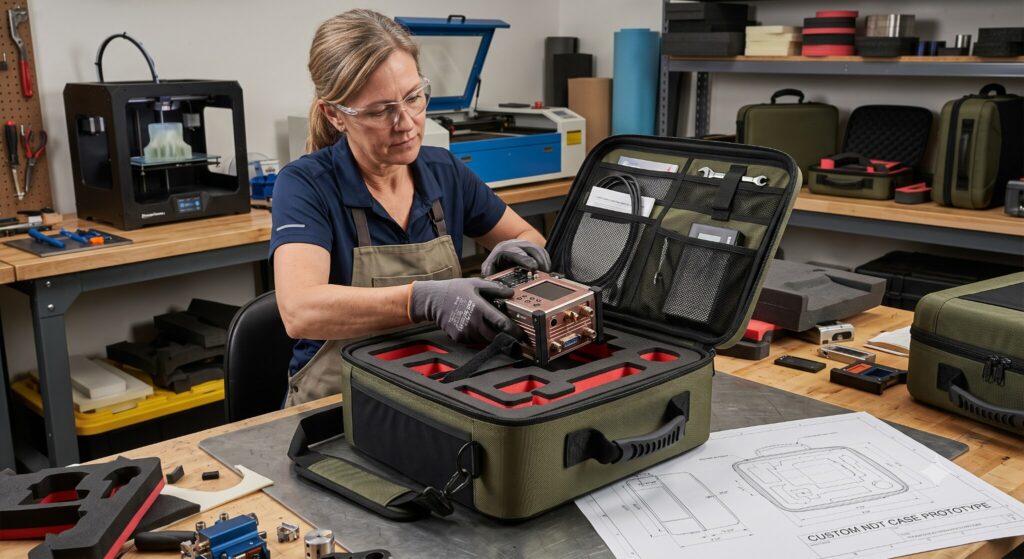
Our prototype-to-production process uses materials and construction methods that mirror final production. When you bring us a concept, we build prototypes that give you a reliable read on both form and durability, not an optimistic approximation of them.
Control Quality to Avoid Hidden Costs
The cheapest production quote can become the most expensive outcome if it produces inconsistent units, scrap, rework, or field failures. Quality control is a cost-management mechanism. Catching a defect in-process costs a fraction of catching it after final assembly, and a fraction of what it costs when a customer catches it in the field.
Effective quality control in sewn goods manufacturing includes:
- In-process inspections at critical build steps
- Final inspection against the approved golden samples
- Dimensional checks for panel size, handle placement, and closure alignment
- Seam strength verification at defined intervals
- Stitch count and uniformity checks
- Documentation and traceability for medical and government applications
- Change control processes for materials and components across production runs
Our quality systems and in-process inspection procedures are structured to give customers consistent output and to catch variance before it ships.
Think in Terms of Total Cost, Not Just Unit Price
Procurement decisions based purely on quoted unit prices routinely result in higher total costs. The calculation should include:
- Sampling rounds and engineering time to correct preventable design issues
- Freight, duties, and import compliance costs (where applicable)
- Inventory carrying cost for longer offshore lead times
- Defect rates and the cost of rework or replacement
- Communication overhead when troubleshooting quality issues across time zones
- Supply chain risk from single-source components or international logistics uncertainty
Domestic contract sewing does not always produce the lowest quoted unit price. What it can reduce is communication delay, quality troubleshooting time, and supply chain uncertainty: factors that often cost more in practice than the per-unit price differential suggests.
That comparison is worth doing with real numbers before a sourcing decision is made.
What to Ask a Custom Case Manufacturer Before Approving a Quote
Use this checklist when evaluating a quote or initiating a DFM conversation with a contract sewing partner:
- Can you review the design for manufacturability before final pricing?
- Which features are driving the most labor time per unit?
- Are any materials over-specified for the actual use case?
- Can standard hardware meet the same performance requirement?
- Can the pattern be adjusted to improve material yield?
- Which reinforcements are structurally critical and which are optional?
- What inspection steps are included in the quoted price?
- What specific changes would lower the cost without affecting durability?
- Can you support production-grade prototyping before volume build?
- What documentation will be provided with production runs?
A manufacturer who can answer these questions specifically is one who understands the economics of sewn goods production well enough to help you manage them.
How Fieldtex Helps Reduce Manufacturing Cost Without Cutting Corners
Our process is structured to find cost reduction opportunities before they become production problems. When you bring us a design, drawing, sample, or BOM, we work through a defined sequence:
- Requirements review: Intended use, load conditions, environment, quantity, compliance needs, and service life expectations are documented before any design work begins.
- DFM review: We assess construction complexity, panel count, seam placement, hardware selection, and operator access, identifying where the design is increasing cost without boosting performance.
- Material selection: Fabric, foam, webbing, and hardware are chosen based on actual performance requirements, not default specifications.
- Prototype build: We produce sewn prototypes using production-equivalent materials and construction, giving you a reliable test of fit, function, and durability.
- Pattern and cutting optimization: CAD patterns are developed and nested to minimize material waste and ensure consistent repeatability across production runs.
- Production planning: Work is sequenced to move efficiently through cutting, kitting, sewing, and assembly without unnecessary handling or repositioning.
- Quality control: In-process and final inspections verify consistency before any unit ships.
- Scale-up support: We support customers from first production runs through repeat orders, with documented processes that ensure consistency across production cycles.
If you have drawings, a prototype, a tech pack, or a target unit cost, send it to us. We will tell you where we can reduce cost and where the design needs to hold what it has.
FAQ: Reducing Custom Bag Manufacturing Cost
Focus on DFM, simpler construction where function permits, material selection matched to actual performance requirements, improved pattern yield, standard components, and early production-grade prototyping.
The places to protect are load points, wear areas, and seam attachments that carry structural function; the places to simplify are decorative or redundant features that do not affect field performance.
The primary drivers are material selection, labor time per unit, construction complexity, custom hardware, multiple fabric layers, tight tolerances, low production volume, and the cost of rework or inspection when quality systems are not in place.
Volume has a meaningful effect: per-unit setup cost drops significantly as quantities increase.
Yes, provided they have the engineering capability to conduct a genuine DFM review. A manufacturer who only quotes as-drawn cannot identify where the design is carrying avoidable cost.
A full-service contract sewing partner can review construction, suggest material alternatives, standardize components, and test prototypes before volume production, all of which reduces cost and production risk.
No. Cheaper fabric can increase scrap during cutting, introduce inconsistency in sewing behavior, create field failure risk, or require redesign.
The right fabric is the one that meets the load, wear, cleaning, environmental, and service-life requirements at the lowest price point that achieves that performance, which is not always the cheapest material available.
As early as possible: ideally, before final drawings, BOMs, and production specs are locked. DFM is most effective when it can influence panel geometry, material specification, and component selection.
By the time a product is fully detailed and sampled, many cost reduction opportunities have already been designed out. Early-stage review costs little and saves significantly.