
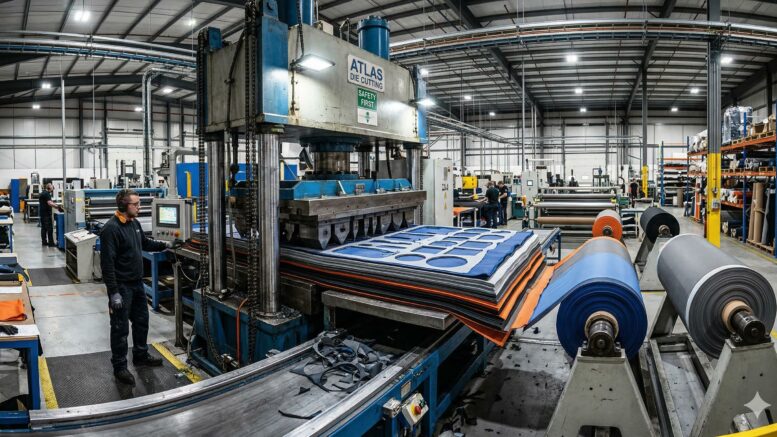
Before a single seam gets sewn, every component in a soft goods product has to be cut. How you cut those components determines how cleanly the rest of your production runs. Die cutting is one of the core methods available before industrial sewing, and understanding how it works, where it performs well, and where it falls short will help you make smarter tooling decisions early in your project.
This article covers what die cutting is, how a die press works, how it stacks up against CNC cutting, where it fits in a cut-and-sew workflow, and which soft goods applications benefit most from it.
What Is Die Cutting? The Simple Definition
Die cutting is a manufacturing process that uses a custom-shaped tool (the “die”) and a press to cut repeated shapes from sheet material with uniform force. Feed the material, cycle the press, and you get the same shape every time.
That last part is the point. Industrial die cutting is not the same as the craft die cutting you see in scrapbooking or hobby applications, where the machines are small, and the materials are thin paper or foam. Industrial die cutting uses steel tooling, hydraulic or mechanical presses, and significantly higher cutting forces designed to handle rigid laminates, thick vinyl, coated fabrics, and stacked layers of technical textile.
The two outcomes production engineers care about are repeatability and throughput. A well-maintained die produces consistent parts at high speed with minimal operator-to-operator variation.
Die cutting is a strong fit when:
- You are running medium-to-high volumes of the same component
- The part has a fixed, approved geometry that is unlikely to change between runs
- Consistent edge quality matters for downstream sewing operations
- The material responds well to pressure cutting (vinyl, laminates, non-wovens, coated fabrics)
- You need to kit and bundle cut parts efficiently for a sewing line
How Industrial Fabric Die Cutting Works
The Die (Tooling)
The die is the custom cutting tool. In most soft goods converting, that means a steel rule die: a sharpened steel blade (“rule”) bent into the shape of your part and pressed into a carrier board, usually wood or high-density composite. Ejection foam or rubber surrounds the blade and pushes the cut material free after each press cycle.
Steel rule dies are cost-effective to produce, adaptable to complex curves and compound shapes, and can be made relatively quickly compared to machined tooling. For parts with tight geometry that need to hold across hundreds of thousands of cycles, matched metal dies (male and female hardened metal tooling) are an option. They carry a higher upfront cost but deliver tighter dimensional control over longer tooling life.
The Press
The press applies a uniform downward force across the die to drive the blade through the material. Common press configurations used in soft goods and industrial converting include:
- Swing arm (clicker) presses: The cutting head swings over the material and descends. Common for smaller part runs and lower-volume operations.
- Traveling head presses: The head traverses across a stationary table, allowing more efficient use of wide material rolls or sheets.
- Flatbed presses: The die is mounted on a flat platen, and the full die strikes in a single press cycle. Suited for larger dies or multi-part die layouts.
All three work on the same principle: controlled force, consistent depth, same output every cycle.
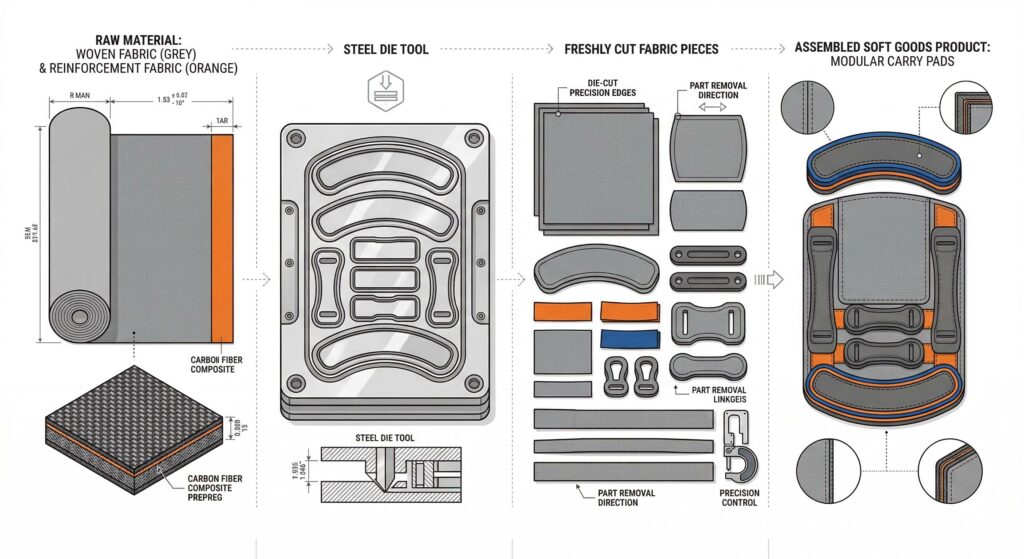
Where Die Cutting Fits in a Cut-and-Sew Workflow
Die cutting is a pre-sewing operation. In a typical cut-and-sew production chain, it sits here:
Pattern finalized → Cutting method selected → Material cut (die or CNC) → Parts kitted and bundled → Sewing line → QC and inspection
Choosing your cutting method early matters because it affects everything downstream. When cut parts arrive at the sewing line with consistent dimensions and clean edges, operators spend less time adjusting and more time sewing. Inconsistent cuts create misalignment at seams, problems with bound edges, poorly positioned clear windows, and bundles that don’t stack evenly.
For operations running a sewing line at volume, a die press can become a reliable upstream feeder: one operator cycling the press can keep pace with multiple sewing stations. That throughput balance is worth thinking through when you are planning a new production program.
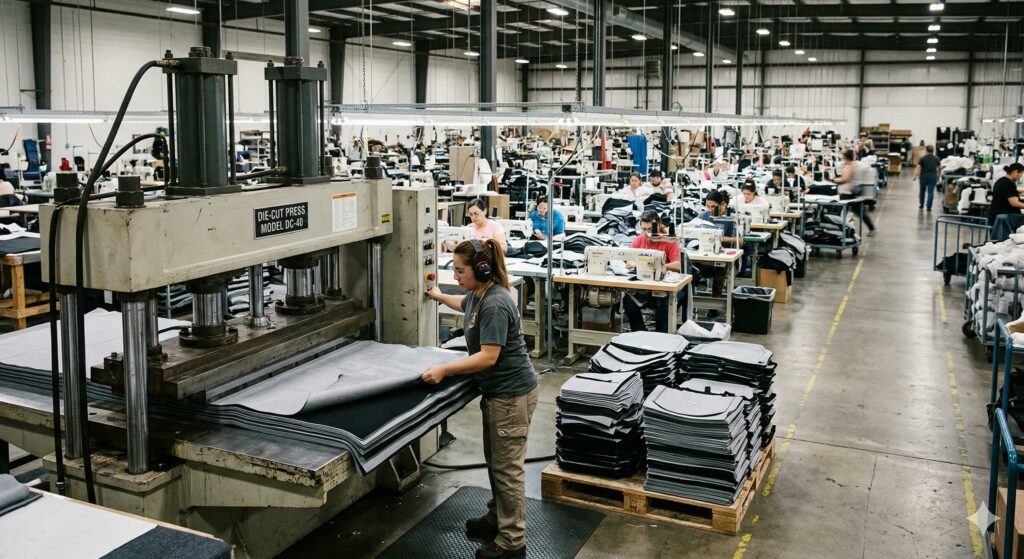
Die Press vs. CNC Cutting for Industrial Sewing Projects
Choosing between a die press and a CNC knife cutter comes down to your geometry, your volume, and how often your design changes. Neither method is universally superior. Here is a side-by-side comparison:
| Factor | Die Press | CNC Knife Cutting | Laser Cutting (Optional) |
|---|---|---|---|
| Best for | Fixed geometry, high-repeat parts | Variable geometry, short runs, complex nesting | Thin to mid-weight materials, fine detail |
| Setup and changeover | Tooling must be fabricated per part; changeover is fast once die exists | No hard tooling; file-driven, immediate changeover | No hard tooling; file-driven |
| Unit cost at volume | Low unit cost once tooling is amortized | Higher per-piece cost at scale | Variable; slower cycle time per part |
| Prototyping friendliness | Lower; tooling cost makes iteration expensive | High; modify file, cut immediately | High; same flexibility as CNC |
| Material behavior | Handles thick vinyl, layered laminates, stiff coated fabrics well | Strong across material types; some materials require special blades | Not ideal for thick or heat-sensitive materials |
| Edge quality | Clean, consistent on appropriate materials | Good; can vary with blade wear or material slippage | Sealed edge (can be beneficial or a problem, depending on the material) |
| Typical constraints | Die storage, tooling lead time, tooling wear over cycles | Nesting software required; blade management; slower throughput per part at volume | Equipment cost; material limitations |
The industry trend toward digital cutting systems reflects the flexibility CNC offers for complex nesting and frequent changeover. Many manufacturers run both: a die press for high-volume standard components and a CNC cutter for variable-geometry parts and prototyping. That combination lets you optimize each cutting operation for what it does best.
Best Soft Goods Use Cases for Fabric Die Cutting
Die cutting shows up across a wide range of sewn goods applications, particularly anywhere a compact, repeatable shape needs to be produced in quantity. The parts that benefit most are small-to-mid-size components where hand or CNC cutting introduces too much variability.
High-value applications include:
- Clear vinyl windows for ID holders, credential cases, and holsters (consistent cut geometry is critical for alignment during sewing and finished appearance)
- Reinforcement patches in stress points, corners, or load-bearing areas of tactical, medical, or industrial soft goods
- Rounded corners and curved cutouts where CNC knife cutting on thick material can leave edge inconsistencies
- Repeat small components such as label panels, loop tabs, drain grommets, or webbing channels that would slow down a CNC table if run individually
| Part Type | Material Examples | Why Die Cutting Helps | When CNC May Be Better |
|---|---|---|---|
| Clear vinyl windows | PVC vinyl, urethane laminates | Consistent cut-to-cut dimensions, clean, optically clear edge | Low volume, frequent size changes |
| Reinforcement patches | Nylon, Cordura, Dyneema composite | Repeatability across large kit quantities | Complex shape with frequent engineering changes |
| Drain/grommet openings | Coated nylon, vinyl-coated polyester | Precise round or oval cutouts; fast cycle time | One-off custom sizes |
| Label and ID panels | PVC, TPU laminates, woven labels | High volume, consistent size for sewing fixture alignment | Variable sizing across SKUs |
| Corner radius components | Technical textiles, laminates | Clean curves without blade wander | Very large panels |
Die cutting is widely used across industrial converting for exactly these reasons: consistent shape, repeatable edge, and high throughput. In soft goods, those same properties translate directly into sewing efficiency and finished product quality.
Design and Production Considerations That Affect Die Cutting Results
A good die and a working press are necessary, but not sufficient. Several production variables affect whether die cutting delivers the results you need.
Material thickness and stack behavior
Die cutting can handle single-layer cuts or stacked multiple layers, but stack behavior changes with material. Thick or spongy materials may compress unevenly under the die. Test cuts at production stack height before committing tooling dimensions.
Grain direction and textile consistency
For woven technical textiles, grain direction can affect how the cut edge behaves and how the part lays during sewing. This is not always a factor, but for structured fabrics or parts with directional stretch, it is worth evaluating during first-article review.
Part nesting and material waste
Die position on the material sheet determines yield. More efficient nesting reduces waste, but die size and shape constrain your options. This is one area where CNC cutting with nesting software has an efficiency advantage over fixed-tool die cutting, particularly on expensive technical materials.
Die maintenance and blade wear
Steel rule blades dull over production cycles. A worn blade produces dragged or ragged edges rather than clean cuts, which shows up in sewing quality and finished-product appearance. Establish a maintenance interval based on material type and production volume, and inspect dies regularly.
First-article approval and ongoing QC
Before running production quantities, cut a first-article batch and verify dimensions, edge quality, and sewing-line fit. Build a re-inspection trigger into your production schedule so worn tooling gets caught before it affects a large run.
When Die Cutting Is Not the Right Choice
Die cutting is not the right answer for every project. Understanding its limits is as important as understanding its strengths.
Low volume with frequent design changes
If you are still iterating on part geometry, hard tooling is a liability. CNC cutting lets you modify a file and recut immediately without scrapping tooling investment. Save die fabrication for the production-intent design.
Large, one-off panel cuts
Die cutting is optimized for smaller-to-mid-size repeating shapes. Very large panels or one-off custom shapes are usually better handled on a CNC table.
Materials with special constraints
Some materials stretch, compress, or distort under press force in ways that a blade approach cannot fully control. Heat-sensitive materials may require laser or ultrasonic cutting instead. When in doubt, run trials before committing to a cutting method.
Being honest about these tradeoffs builds more reliable production programs and better supplier relationships. If CNC is the right tool, use it.
Fieldtex Perspective: Where Die Cutting Delivers the Biggest Payoff
From a production standpoint, die cutting earns its place when you need the same shape, cut the same way, every single time, at speed.
At Fieldtex, the clearest example is clear vinyl window components. Thick clear vinyl is a material that cuts cleanly under a die and less predictably with a knife on a CNC table at high volume. The die delivers a consistent optical edge and exact dimensions that align reliably during sewing.
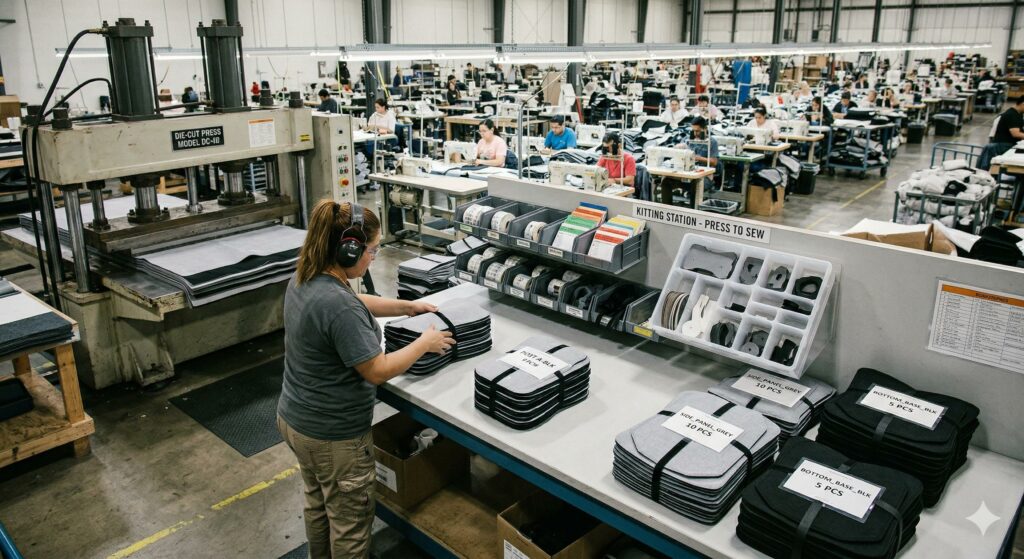
The same logic applies to any high-repeat component: reinforcement patches, cutout panels, drain openings, loop tabs. The die press acts as a quality lock on that part geometry, so the sewing line can run without constant adjustment.
If you are building a sewn product and trying to decide whether die cutting or CNC cutting is the right approach for your components, the answer usually comes down to volume, geometry complexity, and how stable your design is. We are happy to sanity-check the approach before you commit to tooling.
Review our case work to see how these decisions play out in production.
Explore Fieldtex’s Fabric Cutting Capabilities
FAQ: Industrial Fabric Die Cutting
What is die cutting in manufacturing?
A process using a custom-shaped tool (the die) and a press to cut repeating shapes from material. The die matches the part geometry; the press drives it through. Result: consistent, repeatable parts at speed.
What is the difference between die cutting and CNC cutting?
Die cutting uses fixed physical tooling to cut the same shape repeatedly. CNC uses a computer-guided blade with no hard tooling. Die cutting wins on unit cost at volume; CNC wins on flexibility and prototyping.
What is a steel rule die?
A cutting tool made from sharpened steel blade bent to the part shape and mounted in a carrier board. The most common die type in soft goods manufacturing due to low tooling cost and adaptability to complex shapes.
Can die cutting handle thick vinyl or layered materials?
Yes, provided the die is sharp and press force is adequate. Test cut quality at production stack height before finalizing tooling dimensions — standard practice for thick or layered material jobs.
Is die cutting only for high-volume production?
It’s most cost-efficient at medium-to-high volumes since tooling cost is fixed. At low volumes, CNC is usually smarter. But if the same component runs across multiple programs over time, tooling amortizes quickly.
How do I know if my part should be die cut?
Ask three questions: Is the geometry finalized? Are you running it in repeating quantities? Does cut consistency matter for sewing performance? If yes to all three, die cutting is worth evaluating.