
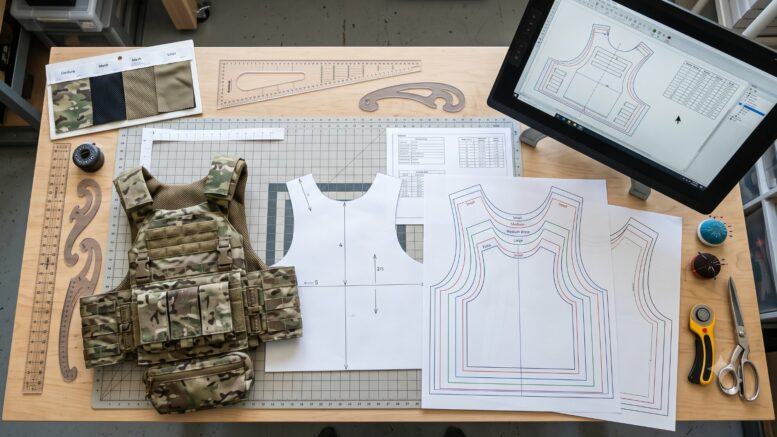
A tactical vest prototype can be built from a single pattern. Production cannot. The moment a program moves from one approved sample to a full manufacturing run, sizing and grading become the engineering foundation that determines whether the vest fits the intended user population, maintains its functional geometry across sizes, and passes dimensional inspection at scale.
This guide is written for OEM product developers, procurement engineers, and program managers sourcing tactical vests, plate carriers, load-bearing soft goods, or similar sewn assemblies.
It covers what measurements drive sizing decisions, how base patterns become graded size runs, which vest features cannot simply scale up or down, and how fit sets, tolerances, and QA inspection reduce production risk before the first full run is committed.
What Tactical Vest Sizing Means in Production
Production sizing is the system that connects the intended user population to a repeatable sewn product. It is a framework of related specifications that a manufacturer must control from pattern development through final inspection.
These are the core terms engineers and buyers need when discussing vest sizing with a sewing manufacturer:
| Term | What It Means | Why It Matters in Production |
|---|---|---|
| Body measurement | The user’s physical dimension | Defines the intended fit range |
| Finished measurement | The actual sewn product dimension | Used for production QA pass/fail |
| Ease | Extra space added beyond body size | Allows movement, gear, armor, and layering |
| Grade rule | The size-to-size pattern change at each pattern point | Controls repeatability across the size run |
| Tolerance | The allowable dimensional variation in finished goods | Determines what passes and what fails inspection |
Adjustability – through straps, buckles, hook-and-loop panels, cummerbunds, and side closures – extends the fit range within a given size but does not eliminate the need for accurate base sizing.
Coverage zones, the areas of the body the vest must sit on to perform its function correctly, need to be specified as finished garment measurements before grading begins, not assumed from the prototype.
Why Grading Soft Goods Is More Than Scaling a Pattern
Grading is the process of changing a base pattern into multiple production sizes. For simple soft goods, a proportional scale can work. For tactical vests, it rarely does – and applying one without analysis is one of the most reliable ways to create a vest that fits the middle of the size range correctly and fails at the extremes.
The problem is that a tactical vest is not a uniform shape. It carries pockets, webbing, hardware, reinforcement, inserts, and structural features, each with its own functional geometry. Scaling the whole pattern by a percentage changes dimensions that should not change, while leaving others unchanged that should have moved.
Specific grading decisions that cannot be treated as simple proportional steps:
- Front and back panels typically need different grade rules because torso proportions do not scale uniformly front-to-back.
- Shoulder straps may need length adjustment without moving the buckle or hardware placement out of position.
- Side panels and cummerbunds often carry the majority of the adjustment range – they may need more change per size than the body panels.
- Pocket openings must remain usable regardless of size; a pocket scaled down with a small size may become too narrow for the intended contents.
- MOLLE/PALS fields need their row alignment maintained – the webbing geometry is defined by function, not body proportion.
- Plate or insert pockets may be driven by insert dimensions, not garment scaling logic.
- Reinforcement points – bartacks, Box-X stitches, reinforced seams – must land on load-bearing stress points in every size, not drift with the scale.
- Multi-layer seams, bound edges, foam, and structural materials can each affect finished measurements after sewing, compounding any grade errors.
Production principle: Fit zones can change by size. Functional zones need controlled geometry.
This distinction between dimensions that should follow the user’s body and dimensions that must follow the vest’s function is the core engineering decision in soft goods design and grading. Getting it wrong at the pattern stage costs far more to fix after fabric, webbing, and hardware have been cut and assembled.
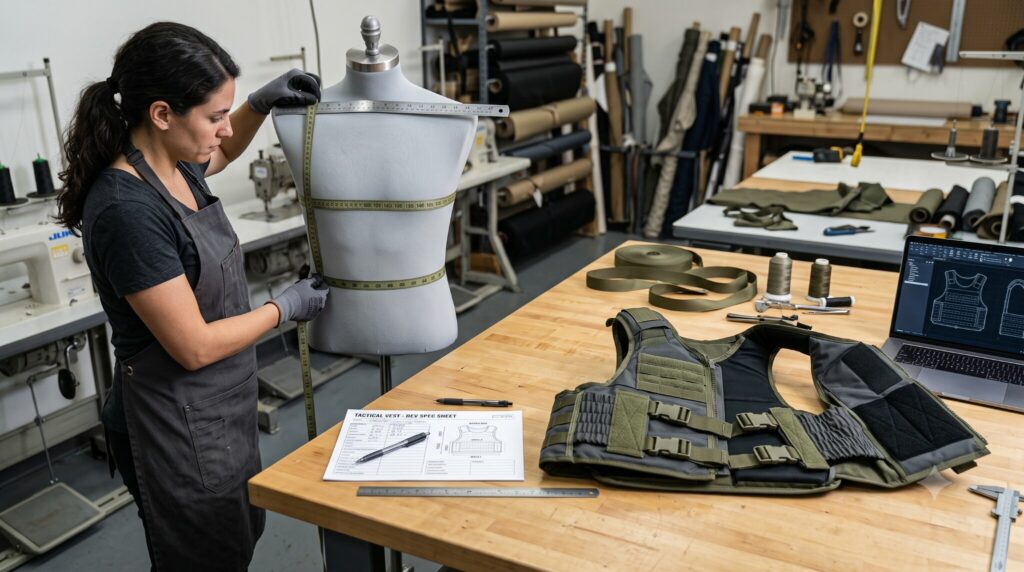
The Measurements That Drive Tactical Vest Sizing
Chest and Upper Torso
Chest circumference drives the width of front and back panels, the closure range, and how much ease is built in for the intended use.
A vest designed for light field use over a single uniform layer needs far less ease than one intended for cold-weather conditions, bulky undergarments, or use over soft armor.
Waist and Abdomen
Waist or abdomen circumference affects side panel width, cummerbund length, overlap range, and how far the closure system must reach.
Consumer vest sizing guides often use navel circumference to categorize sizes for protective and tactical vest categories, and that measurement logic carries into production, but for a manufacturer, the body measurement must become a finished garment specification with a defined tolerance range.
The adjustment range within a size must also be documented so that hardware, hook-and-loop, and side panel dimensions can be specified correctly.
Torso Length
Vertical fit is one of the most frequently underspecified dimensions in tactical vest development. A vest that runs too long can interfere with sitting, crouching, climbing, belt-mounted equipment, and vehicle use.
One that runs short affects coverage, pocket position, and load placement. Torso length should be graded and inspected independently from panel width.
Shoulder Width and Strap Geometry
Shoulder width affects weight distribution, mobility range, donning and doffing speed, and compatibility with packs, rifle slings, and other equipment worn concurrently.
Shoulder straps often need their length adjusted between sizes while keeping buckles, padding, and reinforcement patches in controlled positions. Drifting the hardware location with a simple grade rule can move a buckle off the shoulder, change how the load sits on the torso, or create a donning issue that only appears in the smallest or largest size.
Layering and Equipment Load
Tactical vest sizing must account for what the vest will be worn over and with. A vest for EMS response has different ease and adjustment requirements than one designed for extended military load carriage, and both differ from an industrial field vest worn over PPE.
The intended layering scenario, including uniform weight, undergarments, armor or protective inserts, and belt-mounted gear, should be documented in the product specification and factored into the ease allowance before patterns are developed.
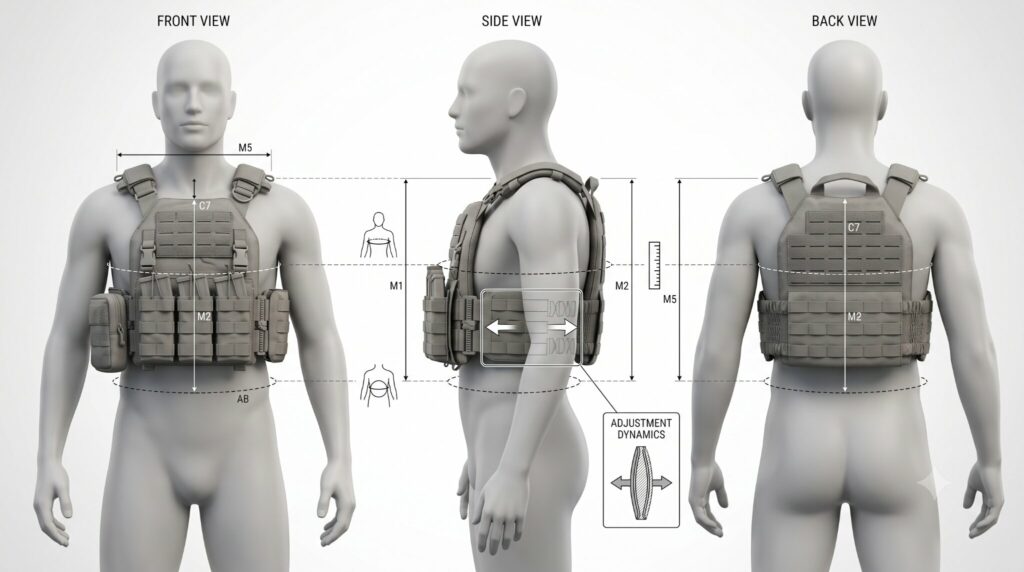
How a Base Pattern Becomes a Full Size Run
The grading process follows a logical sequence, and each step builds on decisions made in the one before it. Skipping steps or treating grading as a purely software-driven operation, rather than an engineering one, is where size runs go wrong.
- Define the base size. Select the size used to develop the first approved pattern. This is typically a median size from the target user range, not a manufacturer default.
- Identify the target user range. Use body measurements, user population data, or customer-provided requirements to set the outer limits of the size run.
- Define finished garment measurements. Convert body measurements to actual vest dimensions for each size, incorporating ease and adjustability requirements.
- Map fixed and variable zones. Identify which features follow the body panel grade, which need separate grading logic, and which must remain fixed regardless of size.
- Create grade rules. Specify how individual pattern points move between sizes. Different pattern points can, and often should, move by different amounts.
- Digitize and control patterns. CAD-based pattern development allows grade rules to be applied consistently, checked mathematically, and modified without redrawing by hand.
- Build a fit set. Produce samples across the size range, not just the base size, for physical validation before full production is approved.
- Revise before production. Adjust grade rules based on fit, measurement, and functional testing results. Approve the revised grade before cutting production material.
Our soft goods design and engineering process includes reviewing load points, wear areas, access needs, and handling requirements before patterns are created, followed by CAD/CAM pattern development, grading, material selection, prototyping, and design-for-manufacturing review.
Which Parts of a Tactical Vest Should Change by Size?
Different components follow different grading logic. The table below reflects how production decisions should be made for common vest components.
| Vest Component | Should It Grade? | Production Notes |
|---|---|---|
| Front body panel | Usually yes | Controls torso width and anterior coverage |
| Back body panel | Usually yes | Must align with shoulders, side seams, and load features |
| Shoulder straps | Yes, but carefully | Length may change while hardware placement stays controlled |
| Side panels/cummerbund | Often yes | Major driver of adjustment range; may grade more than body panels |
| MOLLE/PALS fields | Usually controlled, not freely scaled | Webbing layout must remain functionally aligned across sizes |
| Plate or insert pockets | Often fixed or specification-driven | Dimensions may be set by insert size, not garment scale |
| Radio/tool pockets | Sometimes | Must remain reachable and compatible with intended contents |
| Reinforcement patches | Must follow stress points | Should not drift away from load-bearing zones due to grading |
| Binding | Adjusts with perimeter | Allow for sewing behavior and tolerance stack-up across layers |
Functional Features That Must Survive Grading
MOLLE and Attachment Fields
MOLLE-compatible webbing fields require careful handling during grading because row spacing, stitch alignment, and the usable attachment channels within the field determine whether accessories can be fitted correctly.
A webbing layout that works on the base size can lose usable rows or shift attachment points out of alignment on the largest or smallest size if the field is scaled as part of the body panel without separate control. We build heavy-duty tactical sewn assemblies using programmable tackers, bartacks, and reinforced stitching configured to maintain MOLLE geometry across the full size run.
Pockets and Access Points
Pockets should not drift out of reach as the vest is graded, and pocket openings should not narrow below functional thresholds in smaller sizes.
Closure Systems and Adjustment Range
Adjustable straps, buckles, and hook-and-loop panels can reduce the number of discrete sizes in a product line, but they do not replace correct body panel proportions. A vest with adjustable side closures still requires accurate shoulder fit, correct front-to-back panel balance, and properly placed hardware across the size range.
Load-Bearing and Reinforcement Zones
Bartacks, Box-X stitches, and reinforced X-tacks must land at stress points – where straps attach to panels, where hardware interfaces with webbing, where carry handles transfer load.
Plate or Insert Pockets
If the vest includes pockets for plates, panels, stiffeners, or inserts, those pocket dimensions may be driven by the insert specification rather than normal garment grading logic.
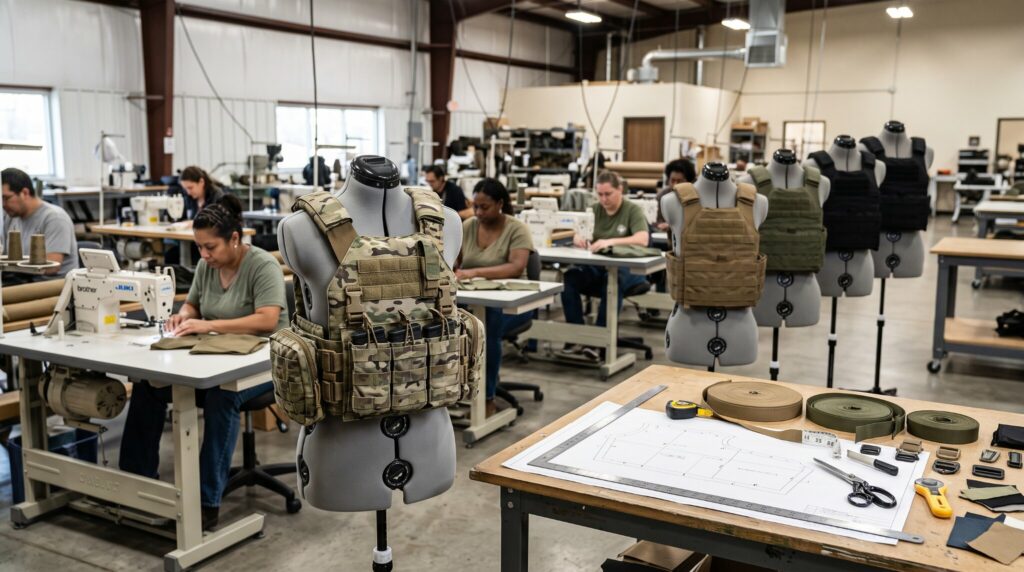
How Fit Sets Validate the Grade Before Production
A fit set is a small group of samples sewn across the size range to physically validate whether the grading works before production fabric is committed.
Approving only the base size sample before releasing a grade to production is one of the most common sources of costly rework in soft goods programs.
An effective fit-set process for tactical vests includes:
- Sampling at minimum the smallest, base, and largest sizes, and any long or short variants if they are part of the program
- Testing with the intended layering, tools, inserts, and equipment, the vest will be worn with
- Checking reach, mobility, seated posture, bending, donning, and doffing in each size
- Measuring finished samples against the approved spec sheet and tolerance table
- Reviewing MOLLE alignment, pocket position, hardware placement, and reinforcement location in all sizes
- Adjusting grade rules before releasing to production – never after
Our prototype sewing process is designed to produce functional pre-production samples that mirror final construction methods – materials, stitch types, hardware, and reinforcement – so that fit-set results reflect what production will actually deliver.
What OEMs Should Provide Before Grading Begins
The quality of a grading outcome depends directly on the completeness of the information provided at the start. These are the inputs that allow a manufacturer to develop an accurate grade and produce a reliable fit set:
- Existing physical sample, if available
- Sketches, CAD files, or tech pack
- Intended use case and operating environment
- Target user group and body measurement range
- Required size range, including any long/short variants
- Body measurement targets per size
- Finished garment measurements, if previously established
- Materials and hardware requirements or approved equivalents
- Expected layers or equipment worn concurrently with the vest
- Insert or plate dimensions, if applicable
- MOLLE/PALS or accessory compatibility requirements
- Reinforcement requirements and stitch type specifications
- Compliance or contract clauses, including Berry Amendment requirements if applicable
- Labeling, serialization, and packaging requirements
- Target order quantities and production timeline
Programs that arrive with this information move from review to prototype significantly faster than those that do not.
How Fieldtex Supports Tactical Vest Sizing and Grading
Fieldtex Cases has been manufacturing complex sewn assemblies from our Rochester, New York, facility since 1973. Our 86,000 sq ft facility runs 125+ skilled operators and supports programs from early prototype through production quantities exceeding 10,000 units.
For tactical vest programs specifically, we support:
- Requirements review and design-for-manufacturing analysis
- CAD pattern development and grade rule creation
- DFM review to identify construction or grading issues before they reach the cutting table
- Material and hardware selection, including Berry Amendment-compliant sourcing for U.S. government programs
- Prototype sewing and fit-set sampling across multiple sizes
- Heavy-duty sewing for reinforced webbing, multi-layer panels, and load-bearing assemblies
- MOLLE-compatible construction with programmable tackers, bartacks, and reinforced stress-point stitching
- Production sewing with dimensional inspection against approved spec sheets
- Documentation and traceability for programs where audit records are required
We do not manufacture off-the-shelf tactical vests – we build to your specification, your size range, and your program requirements. If tactical vest sizing and soft goods grading are the current challenge, bring us the program early.
Send us your sample, drawings, size range, and use case. Our engineering team will review the vest for manufacturability, grading logic, prototype development, and production readiness.
Request a quote or contact us directly to start the conversation
FAQs: Tactical Vest Sizing and Soft Goods Grading
Grading is the process of modifying a base vest pattern into a controlled set of production sizes. Each size is created by applying grade rules – specified dimensional changes at individual pattern points – rather than scaling the whole pattern proportionally.
No. Tactical vest sizing uses some of the same body measurements as apparel, but it also has to account for load-bearing features, equipment layers, structural inserts, pocket functionality, adjustability range, and reinforcement placement. Applying standard apparel grading logic to a tactical vest without modifying it for these features is one of the most common causes of size-run failures in soft goods programs.
Chest circumference, waist or abdomen circumference, torso length, and shoulder width are the primary body measurements. These must be translated into finished garment measurements along with ease allowances, adjustment ranges for closures, and component-level specifications for pockets, MOLLE fields, and hardware. All of these become inspection criteria during production QA.
No. Body panels typically grade with the size run, but components like plate pockets, MOLLE fields, and hardware placement often require controlled geometry; they may not change between sizes, or they may change according to separate rules independent of the body panel grade.
Adjustability reduces the number of discrete sizes in a product line, but it does not replace grading when the vest must fit a wide user population or maintain specific functional zones across different body types. A cummerbund that adjusts by 4 inches cannot compensate for a front panel that is the wrong width or a shoulder strap that is too short for the largest users. Adjustability and grading work together – neither substitutes for the other.