

A cut-and-sew RFQ that arrives with a photo, a rough description, and a target price range tells a manufacturer very little. It tells them nothing about the fabric weight, the seam construction, the hardware, the compliance requirements, or what failure in the field actually means.
The result is a quote built on assumptions, and quotes built on assumptions get revised, delayed, or rejected when sampling begins.
This article covers what to include in a cut-and-sew RFQ: the files and drawings you need, how to document materials and hardware, what quality and compliance requirements to specify, how to communicate quantities and timelines, and how to structure the whole thing so every supplier quotes the same product.
What Is an RFQ in Manufacturing?
RFQ stands for request for quotation. In manufacturing, it is a structured document that asks one or more suppliers to provide pricing, lead time, assumptions, and commercial terms for a clearly defined product or service.
The buyer specifies what needs to be made; the supplier specifies what it will cost and how long it will take.
It is worth distinguishing an RFQ from two related terms buyers sometimes use interchangeably. An RFP – request for proposal – is used when the solution is not fully defined, and the buyer wants suppliers to propose an approach.
A casual quote request is typically an email or phone call with minimal detail, useful for ballpark figures but rarely reliable for production planning.
An RFQ sits between those two: the specs are mostly known, and the buyer wants comparable pricing across suppliers.
In cut-and-sew manufacturing specifically, the quality of the RFQ determines the quality of the quote.
Why Cut and Sew RFQs Need More Detail Than a Generic Manufacturing RFQ
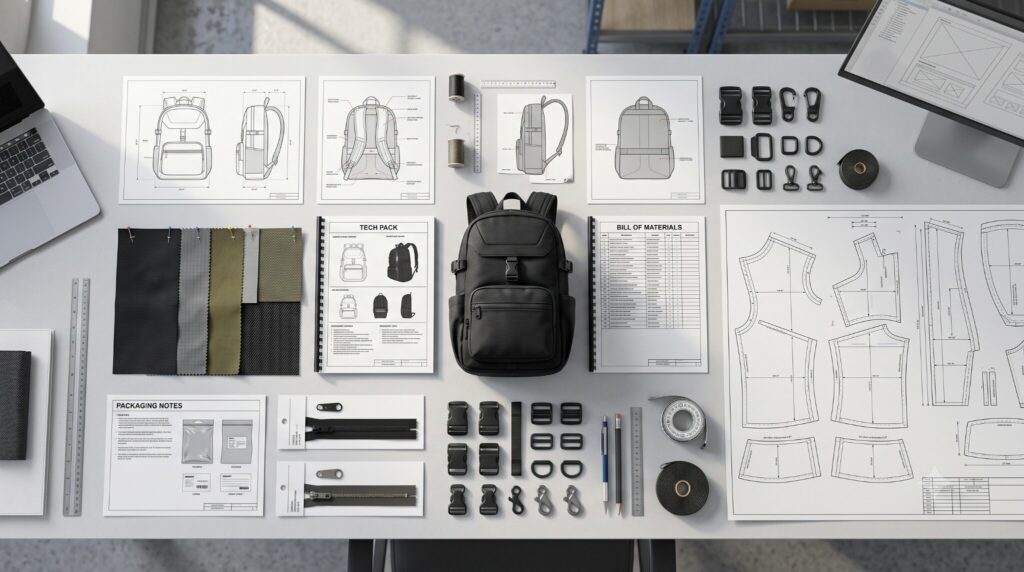
Pricing a sewn product accurately means accounting for panel count, fabric weight and coating, thread type, zipper brand and length, bar-tack placement, foam density and thickness, binding type, label placement, packaging requirements, and any compliance documentation the finished product must carry.
Each of those variables can move the cost significantly. A product quoted on assumed materials may require a full requote when the actual spec is confirmed.
The table below shows how a generic manufacturing RFQ translates into the specifics a cut-and-sew RFQ needs to capture:
| Generic RFQ Item | Cut and Sew Version |
|---|---|
| Material | Fabric type, coating, denier, color, stretch, foam, mesh, lining |
| Drawing | Tech pack, CAD pattern, sample, dimensions, tolerances |
| Process | Cutting, sewing, binding, bar tacking, hardware installation, finishing |
| Quality | Seam strength, stitch uniformity, dimensional checks, traceability |
| Packaging | Polybag, carton, labeling, kitting, private label, fulfillment |
The Cut and Sew RFQ Checklist: What to Include
Project Overview and End Use
Before a manufacturer can quote a sewn product accurately, they need to understand what the product does and where it will be used. A padded case for a diagnostic device used in a hospital environment has different requirements than a field-service pouch carried on a tool belt in an outdoor industrial setting, even if both look similar in a photograph.
Your project overview should identify the product type (carrying case, pouch, strap, cover, backpack, holster, wearable component, kit bag), the end-use environment (medical, defense, industrial, field service, aerospace, commercial equipment), and the performance requirements that environment creates.
Those might include abrasion resistance, exposure to weather or chemicals, load-bearing under repeated use, cleanability, flame resistance, or antimicrobial treatment requirements.
Drawings, Tech Pack, CAD Files, or Physical Sample
The more the manufacturer can see, the more accurate the quote. A tech pack is the most complete starting point; it documents finished dimensions, materials, construction details, stitch types, hardware specifications, labeling requirements, and packaging expectations in a single reference document. If you have one, attach it.
If a tech pack does not exist yet, provide whatever design documentation you have:
- CAD files or patterns,
- 2D drawings with dimensions,
- photographs from multiple angles,
- an existing physical sample,
- or a combination.
Include the revision level and date on any drawing, and note clearly what must match exactly versus what can be adjusted for manufacturability.
Dimension and tolerance communication matters even for flexible sewn products. Engineering drawing standards such as ASME Y14.5 define how dimensions and tolerances should be communicated on technical drawings. For soft goods, that translates directly into finished product dimensions, opening size, strap length, pocket depth, seam placement, and fit around the equipment or body the product must accommodate.
A dimension that is unclear on the drawing becomes an assumption in the quote.
Bill of Materials
A bill of materials is the product’s material recipe. For a sewn product, the BOM should list every component that goes into the finished item, not just the primary fabric.
A complete cut-and-sew BOM typically includes the outer shell fabric, lining fabric, foam or padding, mesh, webbing, thread, zippers, hook-and-loop, buckles, snaps, D-rings, grommets, and other hardware, labels, and packaging materials. For each item, include the weight, denier, coating, color, finish, preferred supplier, part number, and whether substitutions are acceptable.
“Cordura nylon” alone is not a material specification. 1,000-denier Cordura with a DWR coating in coyote brown, sourced from a Berry Amendment-compliant domestic mill, is a material specification.
Dimensions, Tolerances, and Fit Requirements
Sewn products flex, but their dimensions still have to be right. Your RFQ should include finished product dimensions, critical internal dimensions for equipment fit, pocket and opening dimensions, strap lengths, and allowable tolerances for each. If the product must mate with hardware, a bracket, a device chassis, or an existing kit, specify those mating requirements and provide the relevant device or equipment dimensions.
For example: if a diagnostic device must slide into a padded case with one-hand access, the manufacturer needs the device dimensions, expected clearance, foam thickness, and closure type, not just the outer dimensions of the case. That level of detail prevents a sample that looks right but does not function as intended.
Stitching, Seams, and Reinforcement
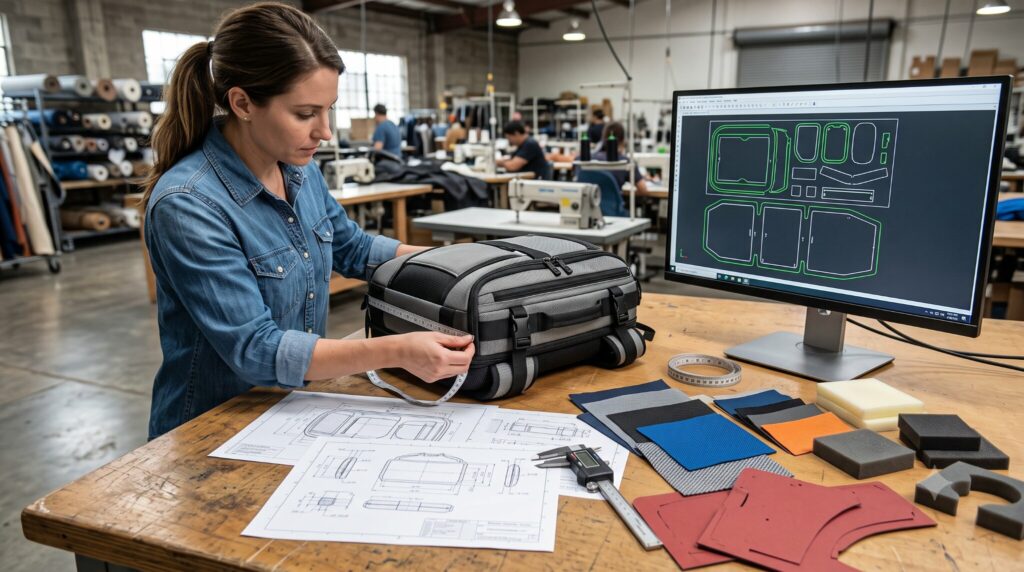
Sewing operations are a primary driver of labor time, and labor time is a primary driver of cost. The more clearly you define stitch and seam requirements, the more accurately a manufacturer can estimate the operations required to build the product.
ASTM D6193 covers stitches and seams used in sewn items, defining stitch and seam categories, their formation, and general purpose. For your RFQ, that translates into specifying stitch type where known, seam construction, stitches per inch, thread type and color, and the location of reinforcement points – bar tacks, Box-X stitches, or reinforced X-tacks – at load-bearing areas, stress points, and hardware attachment locations. Edge finishing, binding type, and seam sealing requirements should also be listed if they apply.
Hardware, Closures, and Components
Hardware drives cost, lead time, and sourcing risk in ways that fabric usually does not. A zipper specified by brand and model can be sourced predictably. An unspecified zipper leaves the manufacturer to price against an assumed product that may not match your performance requirements or visual standards.
List every hardware component by type, brand, size, and part number where possible:
- zipper brand, type, and length;
- pulls;
- buckles;
- snaps;
- hook-and-loop;
- D-rings;
- grommets;
- elastic;
- handles;
- shoulder straps;
- labels or patches;
- foam inserts;
- and any molded components.
If hardware can be substituted, say so. If it cannot – because it is mil-spec, because it is customer-furnished, or because it must match an existing product family – provide the approved part number and source.
Quantity, Forecast, and Production Stage
The same product may quote at a meaningfully different unit cost depending on whether you need three prototypes, a 200-unit pilot run, or a standing monthly production order. Setup time, tooling, pattern grading, and material minimums are real costs that spread differently across different volumes.
Your RFQ should state the prototype quantity, the first production order, your annual forecast, and your expected reorder cadence.
Request break pricing at the volumes that matter to your planning, for example, 100, 500, 1,000, and 5,000 units. Specify whether the quote should include setup, sampling, or non-recurring engineering costs as separate line items.
Quality, Compliance, and Documentation Requirements
Quality requirements belong in the RFQ, not in the purchase order after the quote has been accepted. Stating them upfront allows the manufacturer to scope the inspection and documentation work accurately.
Specify which of the following apply:
- first article inspection,
- in-process inspection,
- final inspection,
- dimensional report,
- certificate of conformance,
- material traceability,
- lot traceability,
- serialization and packaging inspection.
If the product is destined for a medical or device-adjacent application, indicate whether ISO 13485-aligned documentation or FDA-related records are required. If the product must meet Berry Amendment requirements or Made in USA standards, state that explicitly. It affects material sourcing and supplier selection from the start.
Packaging, Labeling, Kitting, and Shipping
Packaging is part of the manufactured product. It is not an afterthought. If the quote does not include packaging, the final invoice often does, and the difference can be significant.
Your RFQ should specify individual polybagging requirements, carton quantities and labeling, barcodes, instructions for use or inserts, kitting with other components, private label requirements, destination and shipping requirements, palletization, and any customer-specific packaging specs.
Timeline and Quote Deadline
Dates that matter to your program should appear in the RFQ. Specify the date you need the quote returned, your prototype deadline, your first article deadline, your production launch date, and your in-hands delivery requirement. Note which dates are hard constraints and which are flexible targets.
Aggressive timelines affect sourcing decisions, capacity allocation, and shipping options. A manufacturer who knows a program has a hard delivery date can plan accordingly.
How to Write a Manufacturing RFQ for Sewn Products Step by Step
- Define the product type, application, and end-use environment.
- Gather drawings, a tech pack, sample photos, or a physical sample – whatever design documentation exists.
- Build the bill of materials, including fabric, lining, foam, hardware, thread, labels, and packaging.
- Identify critical dimensions, internal fit requirements, and allowable tolerances.
- List stitch types, seam construction, reinforcement locations, and hardware specifications.
- State prototype quantity, first production order, annual forecast, and requested break pricing.
- Add compliance, quality, and inspection requirements, including traceability, documentation, and regulatory standards.
- Specify packaging, labeling, kitting, and shipping requirements.
- Clarify deadlines: quote return date, prototype, first article, and production launch.
- Ask each supplier to return a list of assumptions, any items excluded from scope, and any recommended design for manufacturability improvements.
That last step is worth emphasizing. Asking every supplier to return assumptions in the same format makes quote comparison meaningful. It surfaces where one supplier priced something another excluded, and it reveals which manufacturer actually read the RFQ.
RFQ Template for a Cut and Sew Manufacturer
- Project name:
- Product type:
- Application and end use:
- Current design status: Concept / Prototype / Existing product / Production-ready
- Files attached: Tech pack / CAD / Drawings / Sample photos / Physical sample
- Materials: (fabric type, denier, coating, color, weight, finish, supplier, part number, substitutions allowed)
- Hardware: (zipper brand/type/length, buckles, snaps, D-rings, hook-and-loop, grommets – include part numbers)
- Dimensions and tolerances: (finished product, critical internal dimensions, strap lengths, allowable tolerances)
- Stitching and seam requirements: (stitch type, seam construction, stitches per inch, thread, bar-tack, and reinforcement locations)
- Quality and inspection requirements: (first article, in-process, final, dimensional report, certificate of conformance)
- Compliance requirements: (ISO 13485-aligned documentation, Berry Amendment, Made in USA, FDA-related records, traceability)
- Packaging and labeling: (polybag, carton quantity, barcode, kitting, private label, IFUs)
- Quantity: Prototype / Pilot / First production order / Annual forecast
- Requested pricing breaks: (e.g., 100 / 500 / 1,000 / 5,000 units)
- Timeline: (quote return date, prototype deadline, production launch, in-hands delivery)
- Shipping destination:
- Allowed substitutions:
- Supplier questions: (list any open questions you want suppliers to answer)
- Decision criteria: Price / Lead time / Capability / Documentation / Domestic production / Quality system
When to Ask for DFM Feedback Before Final Pricing
If the design is still evolving, the RFQ can request a preliminary quote alongside a design for manufacturability review. This is not an unusual ask; it is how experienced manufacturers add value before production locks in decisions that are expensive to reverse.
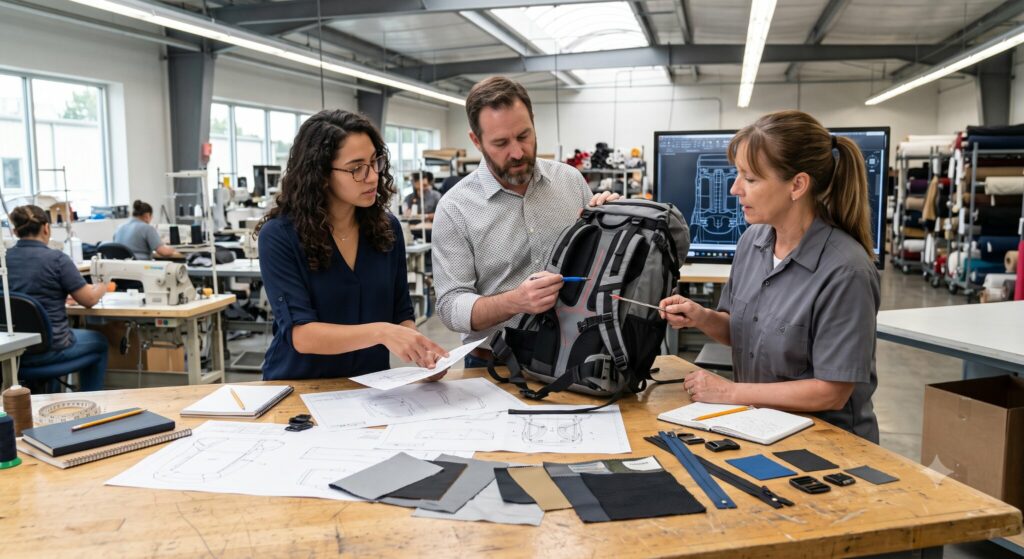
Our engineering team reviews load points, wear areas, access requirements, and handling demands before creating production patterns. We use CAD/CAM pattern development, material selection, prototyping, and DFM review as a structured process.
If you bring us a design that is close but not quite production-ready, that is a conversation we welcome early rather than late.
Learn more about our soft goods design and engineering capabilities.
How Fieldtex Helps Buyers Move From RFQ to Production
Send us a tech pack, a sample, drawings, a BOM, or any combination of the above, and we will review the project and identify the fastest path from quote to production.
We work across custom carrying cases, industrial straps, webbing assemblies, medical and EMS soft goods, military-grade sewn products, and heavy industrial applications.
We operate with a 48-hour quote turnaround for complete RFQs, run production from our 86,000 sq ft Rochester, New York facility, and carry FDA registration and Berry Amendment-compliant production capability for programs that require domestic sourcing and compliance documentation.
Send us your tech pack, sample, BOM, quantity requirements, and timeline, and we will review your cut-and-sew project and provide a clear path from quote to production.
Request a quote, and our team will respond within 48 hours
FAQs: Cut and Sew RFQs
An RFQ – request for quotation – is a structured document asking one or more suppliers to provide pricing, lead time, and commercial terms for a clearly defined product or service.
At minimum: a tech pack or physical sample, a bill of materials, drawings or dimensional documentation, material specs, hardware specifications, stitch and seam requirements, quantity and forecast, quality and inspection requirements, compliance requirements, packaging and labeling specs, and your delivery timeline. The checklist and template earlier in this article cover each element in detail.
Yes, a preliminary quote is possible with a physical sample, photographs, sketches, and a description of the intended use. The quote will be less precise, and the manufacturer may flag items that require clarification before production pricing can be confirmed.
Including a target price can be useful if it is framed as a design target rather than a ceiling. A manufacturer who knows the cost constraint can suggest material substitutions, construction simplifications, or tolerance adjustments that bring the product within range without compromising the performance requirements that matter.
A complete RFQ with a tech pack, BOM, dimensions, and clear quantity ranges can typically be reviewed and quoted faster than an incomplete submission that requires multiple rounds of clarification. Complex products, special compliance requirements, unusual materials, or the need to review a physical sample add time. We turn around quotes on complete submissions within 48 hours.