
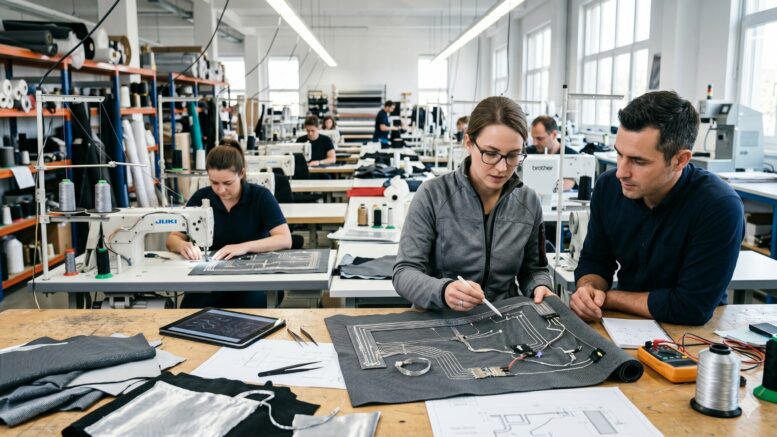
Smart fabrics and smart textiles have moved well beyond research labs. Product teams across medical device manufacturing, defense contracting, and industrial equipment are now exploring them for wearable monitoring systems, sensor-enabled equipment bags, heated field gear, and protective cases for portable electronics.
The technology has matured enough to be viable. The harder problem is manufacturability.
A sewn product built with smart textile fabrics still needs to be prototyped, tested, assembled at volume, cleaned in the field, and repaired without losing function.
This guide is written for designers, engineers, and procurement teams who need to understand what smart textiles are, what they demand from a manufacturing standpoint, and what to prepare before bringing a project to a contract sewing manufacturer.
What Are Smart Fabrics and Smart Textiles?
Smart textiles are fabrics or textile-based systems that provide functionality beyond conventional coverage, protection, or comfort. They may sense conditions, respond to stimuli, regulate temperature, conduct electricity, transmit data, or support embedded electronics, depending on construction and intended function.
Related terms include e-textiles, electronic textiles, functional fabrics, conductive fabrics, and technical textiles. These are not interchangeable. A 1,000-denier ballistic nylon pack cloth is technically engineered for performance, but it does not sense, respond, or interact with its environment.
Not every technical textile is smart. That distinction matters before writing a product specification or sending an RFQ.
Smart Fabrics vs. Technical Textiles vs. E-Textiles
| Term | Plain-English Meaning | Common Examples | Why It Matters in Manufacturing |
|---|---|---|---|
| Technical textiles | Engineered fabrics built for performance rather than aesthetics | Ballistic nylon, coated mesh, antimicrobial fabric, flame-resistant fabric | May require specialized sewing, cutting, bonding, or QA controls |
| Smart fabrics | Fabrics that sense, respond, regulate, or interact with environmental conditions | Temperature-regulating textiles, color-changing fabrics, moisture-adaptive materials | Product teams must define performance requirements before prototyping begins |
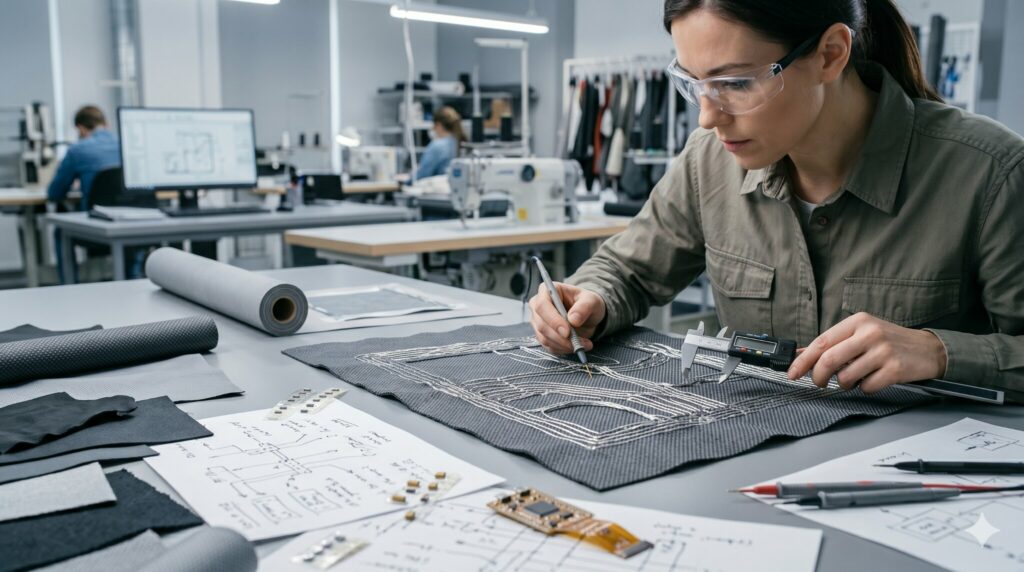
| E-textiles | Textile systems with electronic components or conductive pathways integrated into the fabric structure | Sensor-integrated wearables, heated soft goods, conductive yarn assemblies | Sewing methods, strain relief, connector placement, and cleaning requirements become critical design constraints |
Active vs. Passive Smart Textiles
Passive Smart Fabrics
Passive smart fabrics deliver enhanced functionality without powered input. Examples include:
- moisture-wicking fabrics,
- UV-resistant materials,
- antimicrobial textiles,
- and phase-change materials that absorb and release heat based on ambient temperature.
From a manufacturing standpoint, passive materials often behave similarly to conventional technical fabrics — the key considerations are coating durability, stitch compatibility, cleaning requirements, and lamination behavior.
Active Smart Textiles
Active smart textiles respond to the environment, user input, or electronic signals. This category includes:
- powered heating elements,
- pressure sensors,
- biometric monitoring systems,
- embedded LEDs,
- antennas,
- flexible cabling,
- and integrated circuits.
Manufacturing considerations expand significantly: component placement must be mapped, wire routing must account for bend radius, connectors need strain relief, and battery compartments may need to be accessible for servicing.
Why the Difference Matters for Product Specifications
Passive smart materials are often manufacturable with processes close to standard cut-and-sew production. Active materials require a detailed design package — electrical component locations, cleaning restrictions, hardware access points, and test requirements — before a manufacturer can produce an accurate quote or a useful prototype.
Procurement teams should not request a quote for a “smart fabric product” without specifying what function the fabric must perform and whether electronics are involved.
Common Smart Textile Functions in Portable Equipment
Sensing and Monitoring
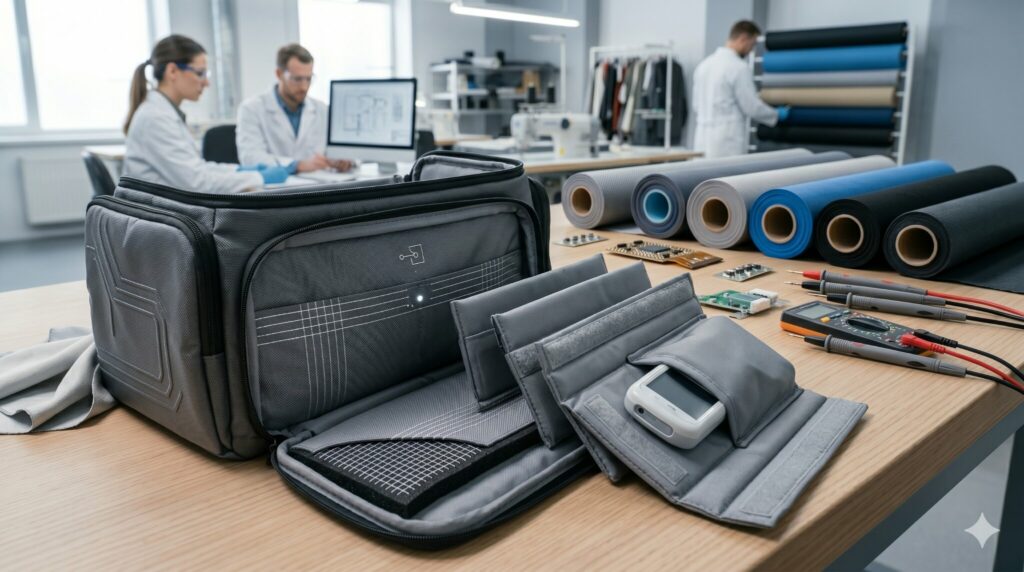
Pressure sensors, wear detection indicators, temperature sensors, and sensor-ready pockets or removable inserts are the most common integration points in sewn goods. Practical applications include wearable medical components, tactical load carriage harnesses, backpacks with embedded monitoring, and protective cases for portable diagnostic devices.
Temperature and Moisture Management
Phase-change materials, insulating liners, and moisture-adaptive fabrics are relevant wherever equipment needs a stable internal environment – medical or industrial equipment storage, field service packs, or protective covers for heat-sensitive electronics.
Material systems like Outlast’s phase-change technology, available as coatings, fibers, yarns, or matrix infusion compounds, illustrate how broadly these materials can be integrated into sewn constructions.
Conductivity, Connectivity, and Power Routing
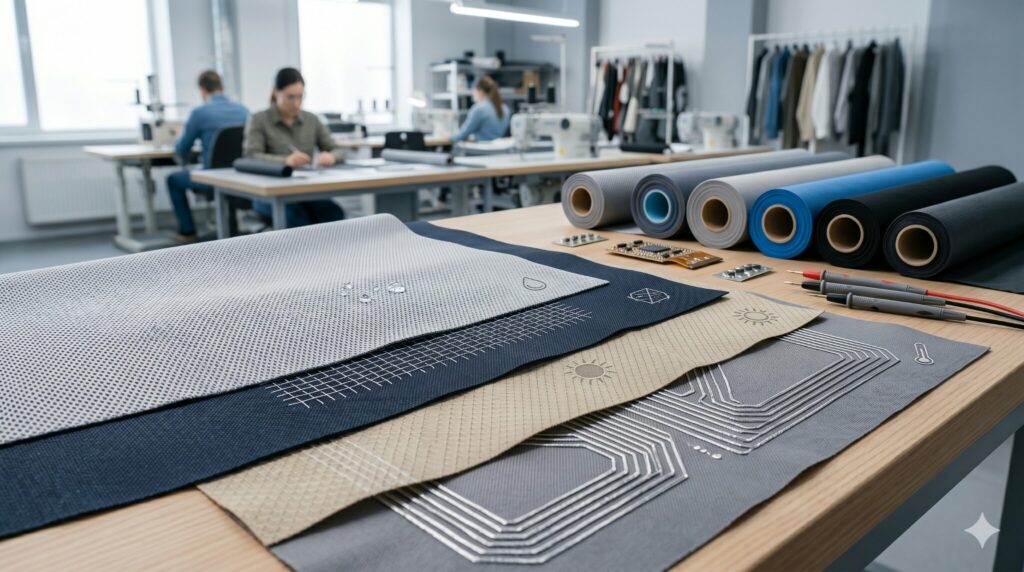
Conductive yarns, printed circuits, flexible electronics, cable channels, antenna structures, strain relief points, and connector access panels all require careful coordination with seam placement and construction method. Translating these components into a manufacturable sewn product means deciding where cables run, how connectors are reinforced, and how the product survives cleaning without damaging electrical pathways.
Where Smart Textile Fabrics Are Used
Medical and Healthcare Products
Wearable monitoring systems, soft goods around medical devices, and medical bags, device covers, and wearable holders are active development areas. For sewn components in medical programs, cleanability, material traceability, and documented inspection are baseline requirements.
We support medical device manufacturers with the process controls and documentation their programs require.
Defense and First Responder Gear
Sensor-integrated load carriage, temperature-aware packs, communication-enabled textiles, and rugged tactical soft goods are a growing demand area.
AFFOA — the Advanced Functional Fabrics of America operates as a Manufacturing Innovation Hub focused on technology-enabled fibers and textiles for both the Department of Defense and commercial advanced textile programs.
Industrial and Field Equipment
Protective covers, machine and tool cases, field service backpacks, sensor-ready pouches, and smart storage and transport solutions make up the industrial side of this market. These products typically combine technical fabric substrates with modular construction designed for serviceability as much as durability.
Design Requirements to Define Before Prototyping
| Requirement | What to Document | Why It Matters |
|---|---|---|
| End use | Who uses it, where, and under what conditions | Determines material, seam, and hardware choices |
| Smart function | Sensing, heating, cooling, conductivity, monitoring, or protection | Prevents vague specifications that cannot be quoted accurately |
| Electronics integration | Component locations, wiring paths, access points, battery placement | Avoids strain, bulk, and serviceability problems found late in development |
| Cleaning method | Wipe-down, machine wash, sterilization, or restricted cleaning | Directly affects material selection and construction methods |
| Flex and bend requirements | Expected movement, folding, compression, and repeated handling | Protects conductive paths and sensor placement from fatigue failure |
| Durability requirements | Abrasion, puncture, tensile strength, seam strength, drop protection | Supports real-world testing against defined thresholds |
| Production volume | Prototype, pilot run, or full production quantity | Affects patterning, tooling, sourcing, and QA setup |
| Documentation needs | BOM, inspection records, lot traceability, customer specs | Essential for medical, defense, and regulated industrial programs |
Manufacturing Challenges With Smart Textile Fabrics
Smart components change how fabric behaves during cutting and sewing. Conductive threads can break at tight stitch angles. Printed circuits have minimum bend radii that conflict with standard seam allowances. Coatings may not tolerate seam iron heat. Sensor layers placed too close to a seam can fail after repeated flexing.
The cleaning method must be defined early. A heated insert that requires machine washing needs a removable pocket with a cleanable outer shell. A medical device cover built for wipe-down cleaning requires material selection and seam construction that survives disinfectants without delaminating.
In most real-world programs, electronics need to be removable or serviceable, which means access panel placement, connector protection, and wire strain relief must be resolved in the design package before sewing begins.
How We Support Smart Textile Projects
Our soft goods design and engineering team works with customers from early-stage requirements through pattern development and material selection — reviewing load points, identifying hardware access needs, and flagging construction conflicts before they become prototype failures.
We build prototypes using production-relevant materials wherever possible, validating component placement, pocket access, strap routing, and enclosure fit before production begins.
Our 86,000-square-foot Rochester, New York facility runs in-process and final inspections under an ISO 9001:2015 quality management system with FDA registration. For programs requiring traceability and documented inspection at the sewn goods level, we support those requirements through our quality processes.
We handle the sewn assembly across a wide range of substrates — technical fabrics, foams, webbing, mesh, coated materials, and smart textile layers supplied by the customer or sourced through approved suppliers. Customers provide electronic component specifications, performance requirements, and any applicable regulatory requirements for active components.
FAQ About Smart Fabrics and Smart Textiles
What Is the Difference Between Smart Textiles and E-Textiles?
E-textiles refer specifically to textiles with electronic components or conductive pathways, such as conductive yarns, printed circuits, embedded sensors, or powered heating elements. Smart textiles are the broader category, covering both electronic and non-electronic responsive materials.
Are Smart Textile Fabrics Washable?
It depends on the construction. Some passive smart fabrics are machine washable within defined parameters. Active smart textiles with electronic components may require only wipe-down cleaning, removable electronics before washing, or restricted cleaning methods.
Cleaning requirements must be defined before product design is finalized they affect material selection, seam construction, pocket design, and hardware choices throughout the product.
Can Smart Fabrics Be Used in Medical Device Bags or Wearable Components?
Yes, but the use case determines the manufacturing requirements. Medical-related soft goods may need documented material compatibility, lot-level traceability, specific inspection records, and customer-defined quality requirements. We support medical device OEMs with process documentation and quality controls structured for those programs.
What Should I Send Before Prototyping a Smart Textile Product?
At minimum: drawings or dimensional sketches, target materials, smart component specifications including size and installation constraints, the intended use environment and cleaning method, target production volume, and any compliance requirements. If you have an existing product you are replacing or improving, send that too. The more context we have before the first conversation, the fewer revision cycles the prototype requires.
Turning Smart Textile Ideas Into Manufacturable Soft Goods
Smart fabrics and smart textiles offer real capability for product teams in medical, defense, and industrial markets. The technology only delivers value when the product is designed to be manufactured reliably.
We support OEMs from design and engineering through prototype sewing and into full contract sewing production. If you are developing a sewn product that incorporates smart textile fabrics and need a manufacturing partner who understands what the construction requires, request a quote and tell us about your project.