
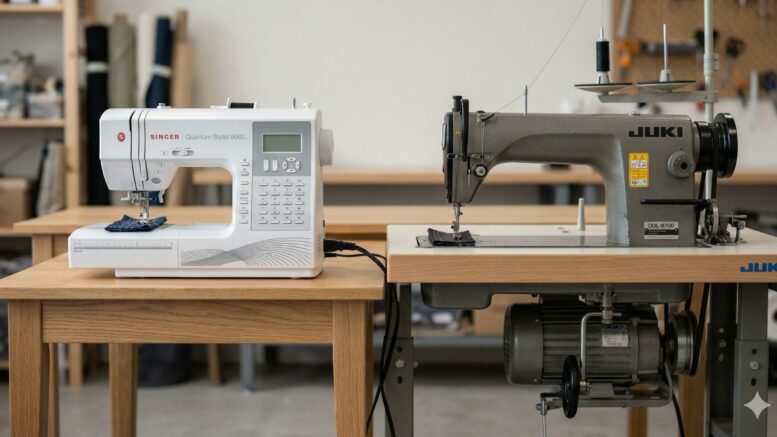
When comparing a heavy-duty sewing machine vs regular models, the difference is not just marketing — it’s motor torque, frame rigidity, duty cycle, and feed-system design, all of which determine whether a machine can handle stacked layers, webbing, or continuous production without quality loss.
What “Heavy Duty” Actually Means (And Why It Confuses People)
“Heavy duty” is frequently a consumer label applied to upgraded home machines; capability varies widely. For clarity, let’s split machines into three buckets:
- Regular domestic: Designed for light-to-medium fabrics and intermittent home use (quilting, garments, repairs).
- Heavy duty domestic: Reinforced motor, stronger feed, and a more robust frame than entry-level models — suitable for occasional thicker fabrics but still limited by duty cycle and industrial component compatibility.
- Industrial: Purpose-built for continuous runtime, high-speed repetition, high torque at low speeds, and single-purpose reliability (e.g., binding, topstitching, or sewing webbing).
If you are producing product for sale rather than hobby use, pay particular attention to duty cycle and component compatibility before investing in a “heavy duty” home machine.
Heavy Duty vs Regular Sewing Machine
This section examines the measurable specs that distinguish heavy-duty machines from regular domestic machines and how those specs affect real projects.
Motor Power and Punching Through Stacks
Heavy-duty domestics feature higher torque motors (e.g., Singer 4452: 60% stronger than standard, up to 1100 SPM with better low-speed control) vs. regular domestics (lower torque, e.g., 100-200W universal).
Look for motor ratings that emphasize torque (in Nm or labeled “high-torque” servo) and the ability to retain stitch consistency at low speeds. Variable-speed servo motors provide controllable torque; many domestic motors emphasize peak RPM but not sustained low-speed torque.
Frame and Internal Components (Vibration, Drift, Longevity)
Metal frames and reinforced internal mounts preserve needle-to-hook alignment over time. Machines with die-cast or welded metal frames reduce vibration-induced stitch drift and help maintain tolerances on repeated runs — a key factor for repeatability on production pieces.
Feed System and Presser Foot Performance
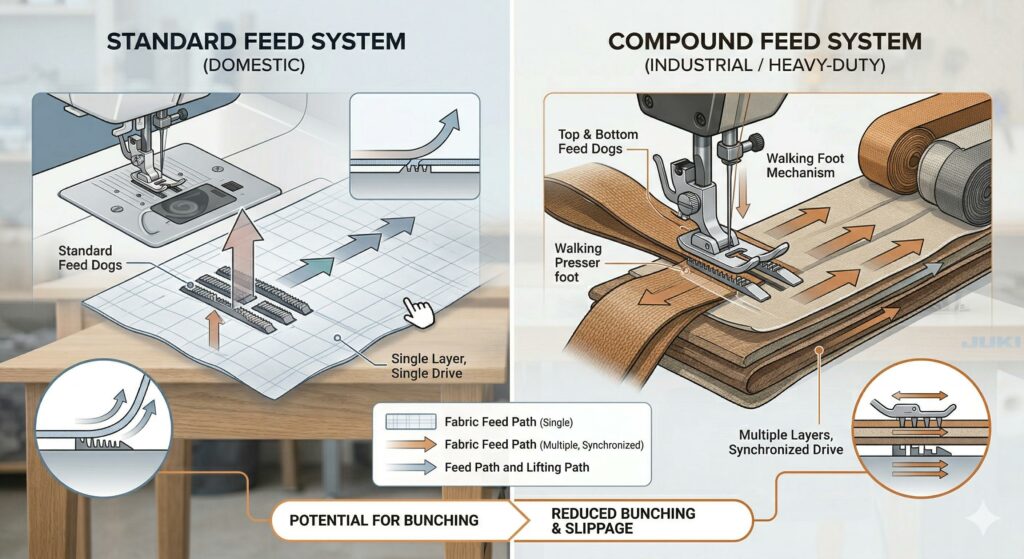
Layer creep, puckering, and shifting indicate inadequate feed systems. Better feed mechanisms (walking foot, compound feed, or improved feed dogs) control multi-layer assemblies such as canvas, denim, or laminated fabrics and reduce the amount of manual handling required during the stitch.
Duty Cycle and Overheating (The “Hidden” Separator)
Duty cycle is the percentage of time a machine can run before it needs rest or cooling. Regular domestic machines assume intermittent usage; heavy-duty domestic models increase that percentage but typically are not rated for sustained 8–10 hour runs, the way industrial machines are. Overheating affects motor performance and can cause inconsistent stitch quality and premature wear.
Needles, Thread, and Compatibility
Industrial machines often use industrial needle systems (DBx1, DPx5) with sturdier shanks and broader availability of heavy-gauge options. Domestic machines commonly accept 130/705 H needles, which limit how large a needle or how heavy a thread you can fit reliably. Needle system compatibility affects replacement availability, tooling options, and reproducibility across production runs.
| Feature | Regular Domestic | Heavy Duty Domestic | What It Changes in Real Life |
|---|---|---|---|
| Motor | Low/medium torque, lower continuous runtime | Higher torque, better low-speed control | Hemming denim vs piercing 3–4 layers of canvas without skipped stitches |
| Frame | Plastic or light metal, more vibration | Reinforced metal components | Consistent stitch alignment over multiple runs |
| Feed system | Standard feed dogs | Walking foot/compound feed options | Reduced layer shifting when sewing webbing or laminated fabrics |
| Needle compatibility | Domestic needle systems | Often accepts heavier needles but may still use domestic standards | Limits on needle size and thread weight affect seam strength |
| Duty cycle | Intermittent use | Longer sessions possible, but not continuous production-grade | Good for prototypes and small runs; not for daily high-volume production |
Heavy Duty Domestic vs Industrial Machines
When needs exceed occasional heavy work, the move from heavy-duty domestic to industrial is substantial — not incremental. Below are the major differences production managers should weigh.
Speed and Consistency
Industrial machines are engineered for high-speed repetition with consistent stitch length and quality across thousands of cycles. Heavy-duty domestic models increase durability but cannot match the repeatability or throughput of an industrial head and table setup.
Single-Purpose Strength vs Multi-Stitch Versatility
Domestic machines offer multiple stitch patterns and consumer features; industrial machines often focus on a single stitch and execute it exceptionally well. Production lines favor dedicated machines (e.g., binder, bar tack, or walking-foot heavy-duty heads) to reduce changeover and improve yield.
Workspace and Table Setup
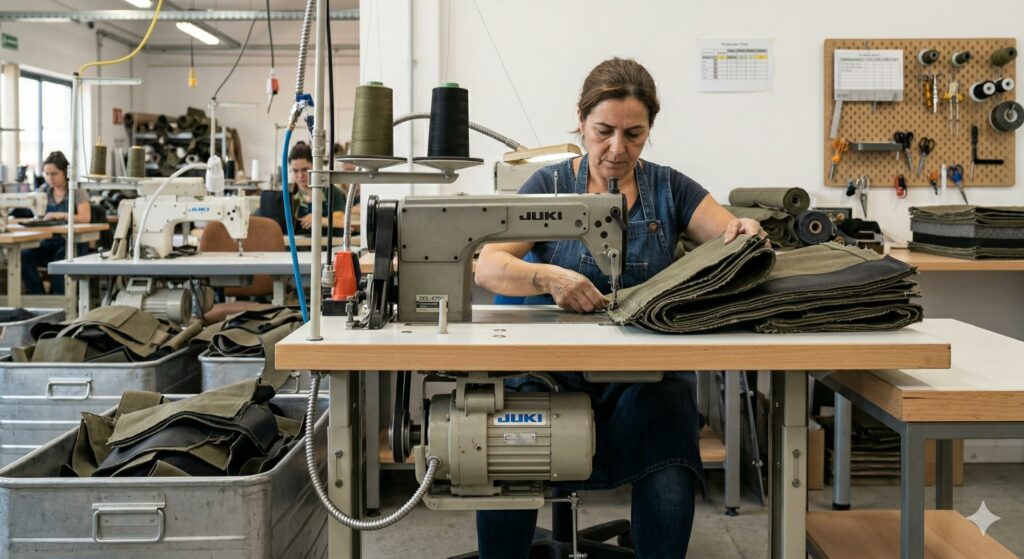
Industrial setups include purpose-built tables, integrated servo motors, and material-handling ergonomics. These reduce operator fatigue, improve control of large assemblies, and enable attachments for automated feeding or guided fixtures.
| Aspect | Heavy-Duty Domestic | Industrial |
|---|---|---|
| Continuous runtime | Longer sessions with breaks | Designed for continuous 8+ hour production |
| Typical stitch focus | Multi-stitch capability (consumer features) | Single-stitch optimization (straight stitch, zigzag variants when required) |
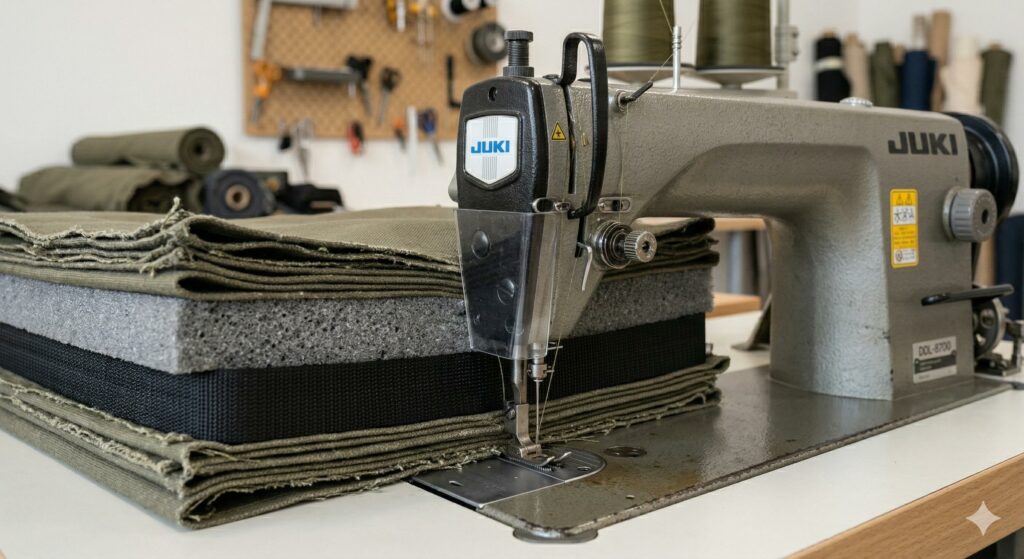
| Handling thick assemblies | Improved but limited | High-torque heads and specialty feet for layered webbing, foam, and laminated materials |
| Maintenance expectations | Lower-cost maintenance, more frequent failures under heavy load | Planned preventive maintenance, specialized technicians |
| Space requirements | Standard tabletop footprint | Dedicated floor space for tables, stands, and material handling |
| Best-fit user | Hobbyist, maker with occasional small runs | Production floor, contract manufacturer, OEMs |
What Projects Require Heavy-Duty?
To translate capability into projects, consider these practical examples.
- Heavy-duty domestic is usually sufficient for: occasional denim hemming, canvas tote prototypes, light upholstery repairs, and prototyping multi-layer garments.
- You will hit limits if you are doing: repeated webbing attachment across multiple layers, binding thick edges with foam-padded assemblies, or running daily batches of cases with consistent seam strength.
Self-check: If you answered “yes” to three or more of the statements below, you are likely in industrial or outsourcing territory:
- You sew thick stacks weekly (more than 10 assemblies).
- You require consistent seam strength and repeatability across batches.
- Your assemblies include webbing, heavy canvas, or foam layers.
- Your production schedule demands minimal downtime and predictable throughput.
- You need traceability and documented quality records for each run.
If three or more apply, consider industrial equipment or contract manufacturing rather than incremental upgrades to a domestic machine.
Buying Guide: How to Choose the Right Category in 10 Minutes
Ask these 6 questions
- Material type and thickness: single-layer fabrics or stacked assemblies?
- How many units per month: single prototypes or hundreds per month?
- Stitch type needs: straight stitch only or multiple decorative/functional stitches?
- Space and noise tolerance: can you accommodate industrial tables and noise?
- Budget: machine cost plus accessories, maintenance, and operator training?
- Quality requirements: do you need production-level repeatability and documented QA?
Decision Tree (quick flow)
If you sew thick stacks weekly + need consistent output → industrial machine or outsource to a contract sewing partner.
If you sew thick stacks rarely and can tolerate occasional rework → heavy-duty domestic.
If you sew mostly garments and want stitch versatility → regular domestic machine.
Cost Reality: Machine Price Is Not the Full Cost
Machine purchase price is only the start. Total ownership costs include needles, thread, special presser feet, maintenance contracts, downtime, and training. Factor in scrap and rework costs when quality varies between runs — material waste and missed delivery windows often exceed the premium paid for a production-grade solution.
For businesses moving from one-offs to repeatable product runs, cost-per-unit and predictable lead times typically favor either dedicated industrial equipment or partnering with a contract manufacturer that already carries the tooling and quality systems.
When Outsourcing Beats Upgrading Your Machine
Outsourcing becomes the more economical, lower-risk choice when you need repeatability, consistent QC, and the ability to scale without capital investment. Contract sewing removes the need to manage preventive maintenance, operator training, and the learning curve for new processes.
Signs You Should Outsource Your Soft Goods Manufacturing
- You spend more time fixing machines than building product.
- Seam quality varies run-to-run or operators produce inconsistent results.
- Lead times slip because production is constrained by equipment or operator availability.
- You need documented processes, lot traceability, or regulatory documentation for medical or defense programs.
Why Fieldtex Cases Is the Best for Serious Soft Goods Production
Fieldtex Cases is a U.S. contract sewing and industrial soft-goods manufacturer focused on prototype-to-production transitions. Fieldtex supports ISO 13485-compliant sewing services and operates FDA-registered production for regulated programs, offering domestic manufacturing capacity with experienced operators and documented quality systems.
Fieldtex’s capabilities include short-turn prototyping, scalability to production volumes, and manufacturing transparency suitable for OEMs and government contractors. If your program needs repeatable seams, traceability, and the ability to scale without downtime for equipment procurement, consider a contract partner that maintains production infrastructure and quality documentation.
contract sewing|heavy-duty sewing|prototype sewing|ISO 13485 sewing services
If your product is moving from one-offs to real runs, talk to Fieldtex Cases about taking it from prototype to production.
FAQ
Is a heavy duty sewing machine the same as an industrial machine?
No. A heavy-duty machine usually refers to a more robust domestic model with a stronger motor and improved feed, but it lacks industrial features like continuous-duty-rated heads, industrial needle systems, and production-grade fixtures. Industrial machines are built for sustained runtime, predictable repeatability, and simplified maintenance on a production floor.
Can a heavy duty machine sew leather or webbing?
It depends. Heavy-duty domestic machines can handle light leather and single-layer webbing if matched with proper needles and thread, but they commonly struggle with multi-layer webbing assemblies or foam-backed laminates. For consistent results on these materials, an industrial head or contract manufacturing is recommended.
What is the biggest upgrade from regular to heavy duty?
The most impactful upgrades are the feed system, motor torque at low speeds, and frame rigidity. Together, these changes improve the machine’s ability to handle thicker stacks and reduce skipped stitches. However, duty cycle remains a key limiter compared to industrial equipment.
When should I stop upgrading and outsource manufacturing?
Stop upgrading and outsource when you require consistent production volumes, documented quality control, or when equipment downtime and training costs exceed the cost of contract manufacturing. If seams vary between runs or lead times lengthen as you scale, outsourcing typically becomes the lower-risk option.
What should I look for if I plan to produce bags and cases?
Prioritize consistent feed systems, high-torque heads, compatibility with industrial needles and heavy thread, and a partner who can scale from prototype to production. For regulated products, ensure the manufacturer provides traceability, process documentation, and, where relevant, ISO 13485 or equivalent quality controls.