
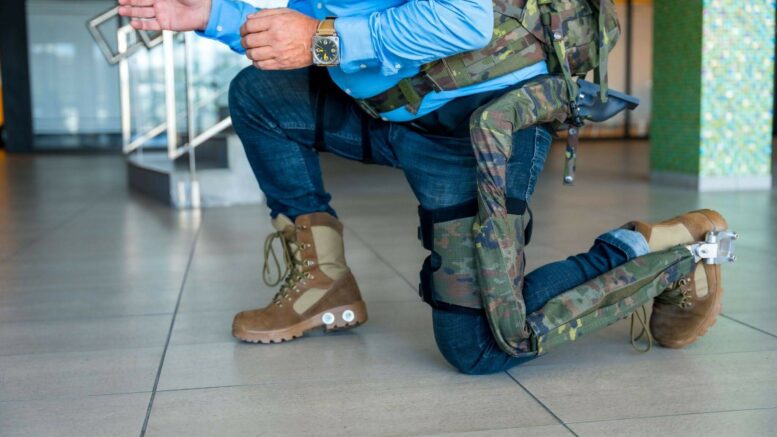
The Iron Man comparison gets made every time someone writes about military exoskeletons — and then, usually, the article moves on without explaining what these systems actually are or how close to operational reality they sit.
The honest answer in 2026 is that passive exosuits are already in soldiers’ hands, powered systems are moving through testing programs at a serious pace, and the engineering that makes all of it work is less about hydraulics and more about sewn textile construction than most people expect.
Here is what this article covers:
- The difference between passive and powered exoskeletons, and which the military is actually fielding
- The programs and companies driving real-life exoskeleton development through 2025–2026
- How sewn soft goods form the structural backbone of every exosuit — and what that means for manufacturers and their supply chains
What Is a Military Exoskeleton?
A military exoskeleton is a wearable mechanical structure designed to augment the physical capabilities of the soldier wearing it — reducing injury risk, extending endurance, or amplifying load-carrying capacity.
The technology divides into two categories with fundamentally different engineering profiles, fielding timelines, and manufacturing requirements: passive systems and powered systems. That distinction is not a minor detail. It determines how quickly a program can move from prototype to field deployment, how much maintenance it demands, and what the supply chain looks like.
Passive Exoskeletons — Lightweight and Already in Use
A passive exosuit uses no motor, no battery, and no external power source. Instead, elastic bands, mechanical springs, and carefully routed textile structures redirect and redistribute the forces generated by human movement, reducing the strain on the joints and muscles that would otherwise absorb them.
The most significant active program in this category is the U.S. Army’s SABER exosuit. Developed by Vanderbilt University and HeroWear under funding from DEVCOM Army Futures Command, SABER weighs approximately 2.7 pounds and was designed specifically to reduce back strain during the resupply and artillery operations that account for a disproportionate share of musculoskeletal injuries in the force.
In May 2022 field trials, 90% of soldiers reported that the exosuit improved their job performance, and every participant indicated they would want to continue using it — a striking result for a wearable device in a military environment where comfort and practicality are critical adoption factors.
Powered Exoskeletons — The Next Phase
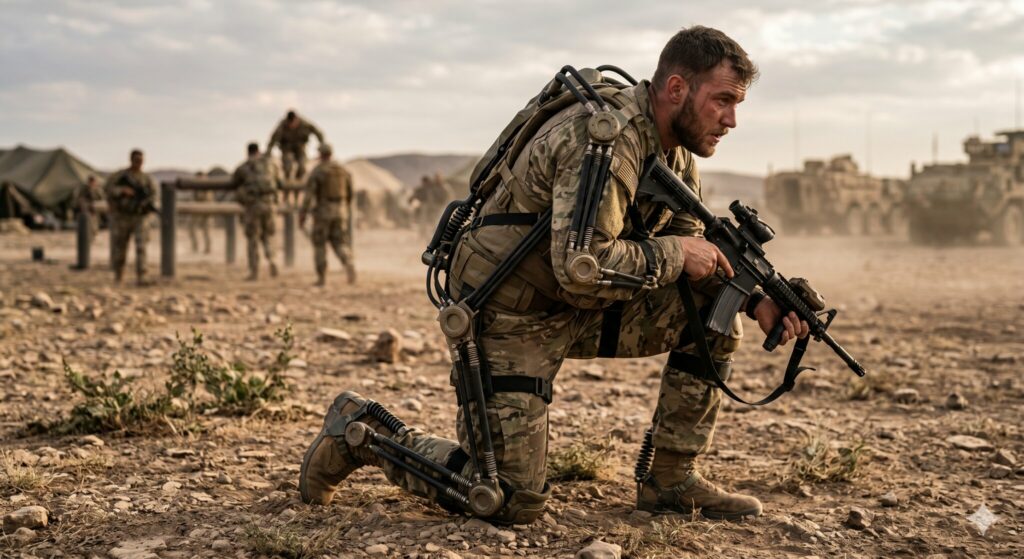
Powered exosystems add electric motors, hydraulic actuators, or pneumatic systems to amplify strength, support limb movement, or sustain load-bearing capacity over extended durations.
Lockheed Martin’s ONYX lower-body exoskeleton and the Dephy ExoBoot represent two of the more developed U.S. military-tested platforms in this category. ONYX uses motor-driven knee support to reduce the metabolic cost of movement under load; the ExoBoot targets ankle-assist for extended march performance.
Powered systems are projected to account for approximately 64% of the military exoskeleton market by 2026, according to Coherent Market Insights data. That projection reflects investment direction more than fielding reality.
Battery weight, operational endurance, and field maintenance complexity remain genuine barriers to wide deployment. These systems are progressing, but widespread fielding is a 2030s proposition, not an immediate one.
Military Applications — What Exosuits Are Actually Doing in the Field
Program announcements and market projections tell part of the story. The more useful question is what exosuits are actually doing — or have been tested doing — in documented military contexts.
Load Carrying and Resupply
Soldiers in field artillery routinely handle 50- to 100-pound rounds. Musculoskeletal injury is among the leading causes of military medical discharge, and lower back injury accounts for a significant share of that burden.
The SABER program was designed specifically around this problem: biomechanical testing at Vanderbilt demonstrated that the system reduced perceived back strain substantially during repetitive lifting.
Karl Zelik, Vanderbilt professor and chief scientific officer at HeroWear, has noted publicly that soldiers face a unique physical challenge — they do not get to choose when or how frequently they lift, and they carry loads that would violate occupational safety standards in a civilian workplace. The exosuit has to function under those conditions without impeding movement or adding significant weight to an already-loaded soldier.
Maintenance and Sustainment Operations
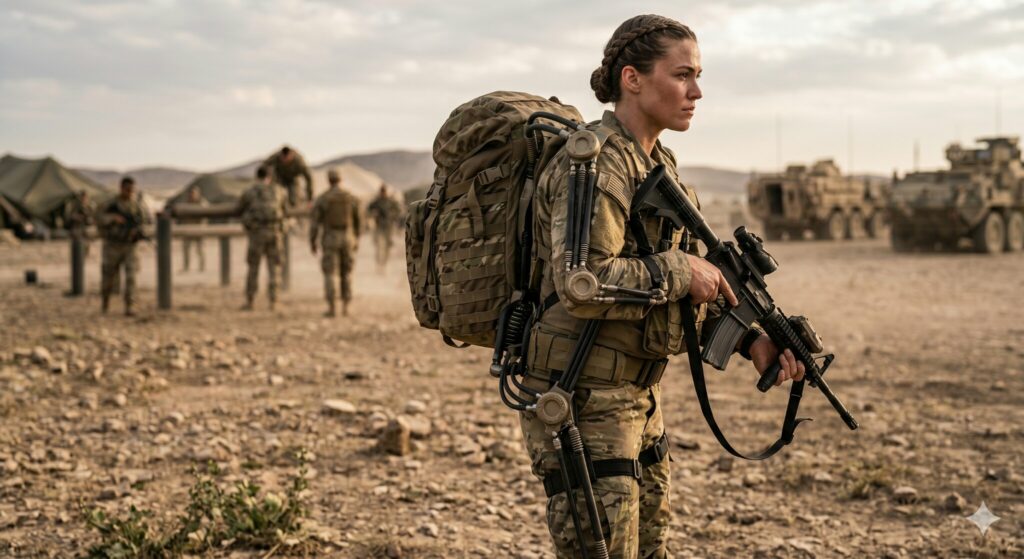
The fielding rationale for SABER, as articulated by Army Futures Command, extends beyond combat roles. Logistics and sustainment personnel perform repetitive heavy lifting throughout every deployment cycle — loading vehicles, moving munitions, handling equipment.
Reducing cumulative physical strain across that population has measurable force-readiness implications that go beyond any single soldier’s injury risk.
Medical Applications — Exosuits in Rehabilitation and Clinical Settings
The medical exoskeleton sector is mature enough that several platforms have moved through FDA regulatory review and into clinical use.
Restoring Mobility After Injury or Neurological Disease
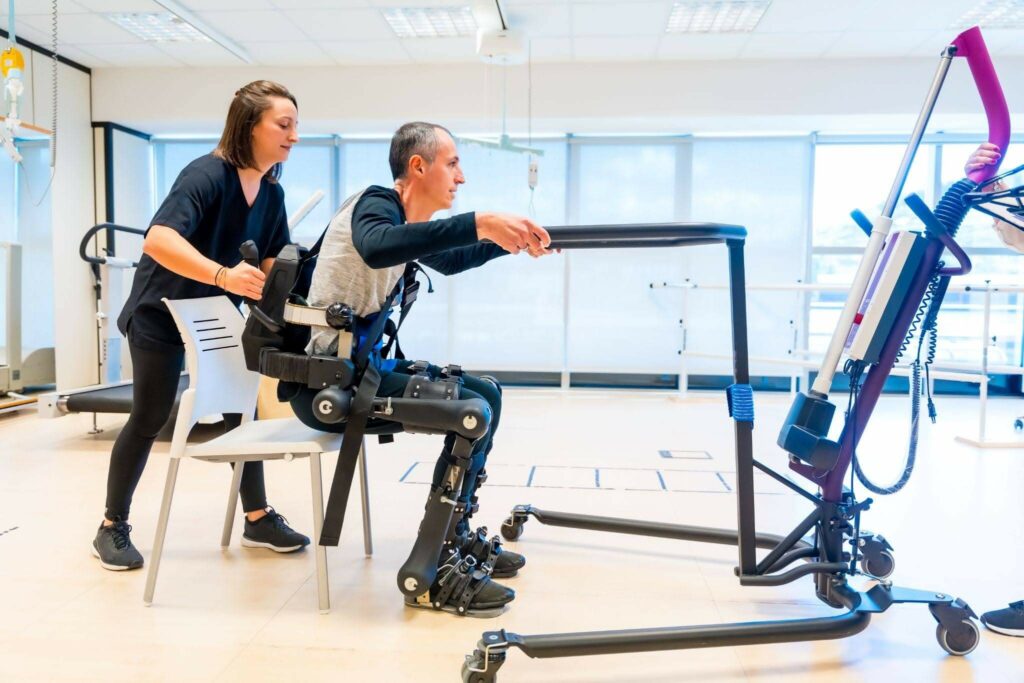
ReWalk Robotics produces the Personal System, one of the best-documented lower-limb rehabilitation platforms, cleared by the FDA for both clinical and personal use in individuals with spinal cord injury.
EksoNR, manufactured by Ekso Bionics, is used in rehabilitation settings for stroke and spinal cord injury patients.
Wandercraft’s Atalante X, which received FDA 510(k) clearance, allows hands-free overground walking during gait rehabilitation.
Exosuits for Caregivers and Practitioners
Ottobock has developed industrial exosuits aimed at reducing musculoskeletal strain for workers who perform repetitive lifting — including caregivers who transfer and reposition patients.
The application sits between industrial and medical categories, and the soft goods requirements are essentially identical to what load-bearing military harnesses demand: durable shell materials, adjustable fit, and reinforced stress points at every hardware attachment.
The Role of Soft Goods in Exoskeleton Design
This is the aspect of exoskeleton manufacturing that almost no one outside the supply chain talks about, and it is the most directly relevant to what we do.
Every exosuit, passive or powered, military or medical, must physically couple to a human body. It does that through a wearable textile structure. In powered rigid systems, that structure is the harness and padding that connects the frame to the wearer.
In soft passive exosuits like SABER, the textile is the functional structure — the elastic bands that reduce back strain are routed through sewn channels and anchored at load points on the shoulder and thigh panels. Remove the sewn soft goods, and there is no exosuit. There is only hardware with nothing to hold it in place.
The development process for HeroWear’s Apex — the commercial predecessor to SABER — illustrates this clearly. The Interwoven Design Group case study on the Apex development describes a process built around materials research, manufacturing method evaluation, rapid iterative prototyping, and redesign for soldier-specific performance requirements.
Breathability, low-profile fit under load-bearing equipment, and durability over thousands of use cycles were the primary textile engineering goals. The sewn construction had to perform across all three simultaneously.
The manufacturing requirements for an exosuit harness assembly are directly comparable to what we produce for military and industrial OEMs as part of our heavy-duty sewing services and soft goods design engineering work. A typical military exosuit soft goods assembly includes:
- Harness shell in 500D or 1,000-denier Cordura or ballistic nylon
- Shoulder pad assemblies with multi-layer foam and load-distributing stitching
- Waist belt panel with webbing channels and adjuster hardware
- Thigh sleeve panels in stretch-compatible woven or knit constructions
- Elastic band routing channels — sewn to precise dimensional tolerances
- Hardware attachment points: D-rings, quick-release buckles, load adjusters
- Reinforced bartack stitching at every stress concentration point
The sewn assemblies that make a passive exosuit function are the same category of work we execute every day for military harness and load-bearing soft goods OEMs.
Will the Military Use Exosuits in the Future?
The short answer: passive systems are already deployed, powered systems are on a credible but longer fielding horizon, and several real engineering challenges still need solving before either category reaches the full force.
Passive Systems Are Already Deployed
The SABER program is not a future projection. DEVCOM’s Soldier Center was actively preparing the system for pre-production manufacturing as of 2022, with HeroWear receiving DEVCOM funding to produce units for extended field trials.
For passive exosuits in logistics and sustainment roles, the question is not whether the military will use them — it is how fast procurement and training infrastructure can scale to support wider adoption.
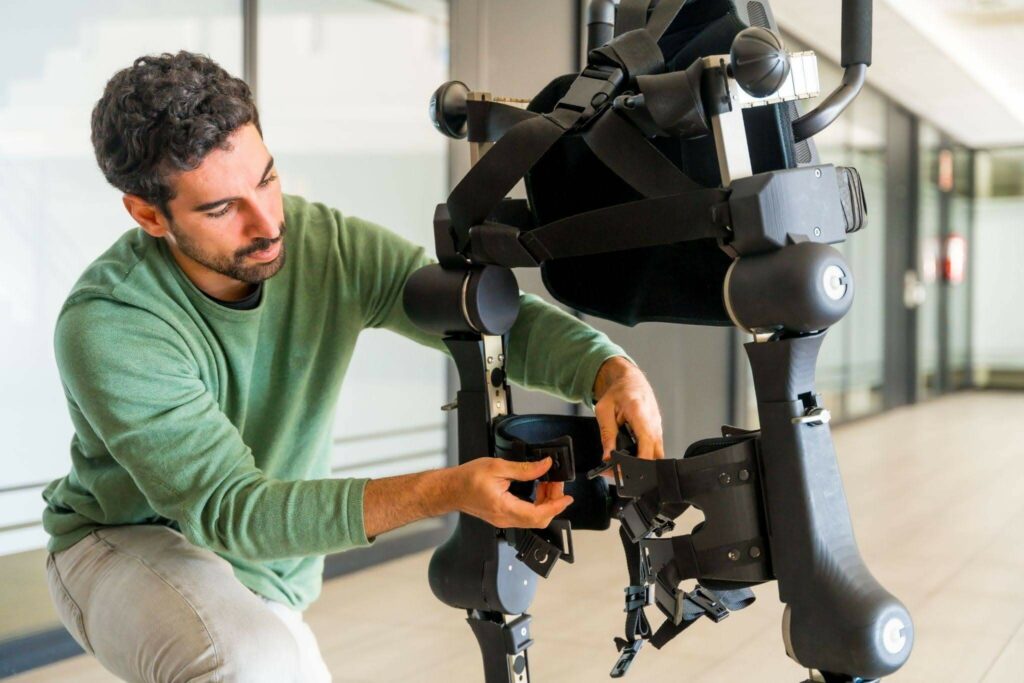
Powered Systems Are on a 5–10 Year Fielding Horizon
Powered exosystems are further out. German Bionic’s Exia platform, updated in May 2025 with modular AI-driven architecture, represents the direction the technology is moving — lighter, more adaptive, more maintainable.
But battery endurance measured in hours rather than days, field maintenance requirements that exceed what a forward-deployed unit can support, and per-unit costs that are not yet compatible with large-scale procurement all remain genuine constraints. Wide powered-system fielding is more realistically a 2030s timeline.
Who Is Building Military Exoskeletons Today?
The table below reflects program status as of early 2026. Fielding status changes frequently in this sector — readers should verify current program activity directly with the organizations listed.
| Company | Focus Area | Notable Product/Innovation |
|---|---|---|
| Bionik Labs | Rehab for arm/hand movement | InMotion Therapy (neurological injury recovery) |
| Cyberdyne | Neuro-controlled suits | HAL suit (brain signal-assisted mobility) |
| Ekso Bionics | FDA-approved rehab exosuit | EksoNR, now merged with Indego |
| Honda | Gait training | Honda Walking Assist for stroke survivors |
| Ottobock | Professional & surgical support | Acquired SuitX, produces industrial and medical exosuits |
| ReWalk Robotics | Spinal cord injury mobility | ReWalk (motor-powered hip/knee control) |
| Rex Bionics | Lower-limb rehab | Robotic suits for spinal cord injury |
| Fourier Intelligence | Gait improvement | ExoAtlet II (for multiple neurological conditions) |
| Seismic | Elderly mobility support | Soft robotic strength-enhancing garments |
| Trexo Robotics | Pediatric mobility | Battery-powered kids’ exosuits |
| Wandercraft | Full-body motion rehab | Atalante X (enabling natural walking) |
How Fieldtex Supports the Defense and Medical Wearables Supply Chain
We do not manufacture exoskeleton frames, actuators, or power systems. What we manufacture is the textile infrastructure that every wearable system — passive or powered, military or medical — requires to function. That includes:
- Load-bearing harness assemblies in Berry Amendment-compliant materials
- Heavy-duty webbing and strap systems with reinforced bartack stitching at stress points
- Padded soft goods components for body-worn devices, including shoulder assemblies and waist belt panels
- Prototype and pre-production support for early-stage programs that need design-for-manufacturability input before committing to tooling
We have operated under Berry Amendment-compliant production requirements for decades, our quality management system supports the documentation and traceability standards that defense programs require, and our 125-plus operators in our 86,000-square-foot Rochester, New York facility can handle both prototype quantities and production runs into the thousands.
If you are developing a wearable system and need a U.S.-based contract sewing partner for the soft goods components, explore our prototype sewing services and our military-grade sewing capabilities, or request a quote to discuss your program requirements. You can also reach us directly at 1-800-772-4816.
Frequently Asked Questions
What Is the Difference Between a Passive and Powered Military Exoskeleton?
A passive exoskeleton uses no motor or battery. A powered exoskeleton adds electric motors, hydraulics, or pneumatic actuators to actively amplify strength or support limb movement. Passive systems are lighter, simpler to maintain, and already being fielded. Powered systems offer greater capability but remain in testing and limited deployment phases due to weight, battery life, and maintenance complexity.
What Materials Are Used in Military Exosuit Construction?
Military exosuits combine rigid structural materials with sewn textile assemblies. Frame components may use carbon fiber, aluminum, or high-strength polymers for powered systems. The soft goods portions — harnesses, shoulder pads, thigh sleeves, waist belts, and webbing systems — typically use 500- to 1,000-denier Cordura or ballistic nylon for the shell, multi-density foam for padding, and mil-spec webbing at load-bearing attachment points.
How Does a Soft Exosuit Differ From a Rigid Exoskeleton?
A rigid exoskeleton uses a structural frame — typically carbon fiber or metal — to transfer load around the body. A soft exosuit achieves a similar mechanical effect entirely through textile-based construction: elastic bands routed through sewn channels, load distributed across woven harness panels, and hardware anchored at reinforced stitching points.